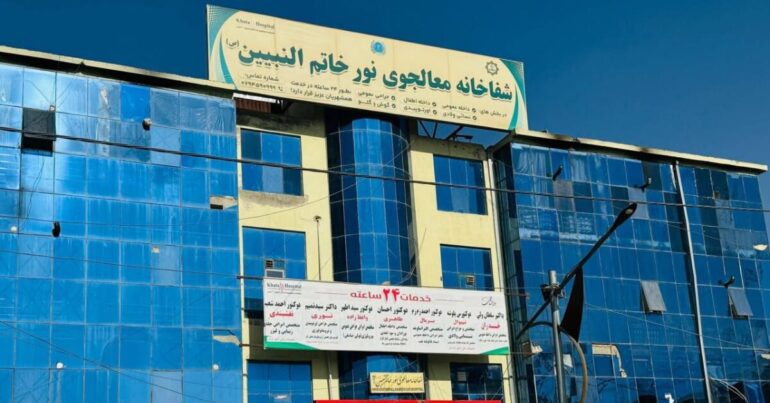

KABUL, AFGHANISTAN – Jawad Mohseni, the owner of Khatam al-Nabieen Private Hospital, says the medical facility has been shut down on the orders of Abdul Hakim Sharaee, the Taliban’s Minister of Justice.
In a statement published on his Facebook page on Saturday, November 14, Mohseni said Sharaee had informed the hospital’s management last week that it must either hand over the administration and management of the facility to the Taliban minister or face closure.
Mohseni said he rejected the demand, arguing that transferring control of a medical institution to the justice minister without any legitimate legal basis was unacceptable.
He added that Khatam al-Nabieen Hospital had provided healthcare and medical services for more than 15 years. However, he said its closure was part of what he described as Sharaee’s discriminatory and religiously motivated treatment of institutions belonging to Afghanistan’s Shia community.
“The doors of this medical centre have also been closed,” Mohseni wrote, describing the decision as a continuation of discriminatory actions against Shia-affiliated institutions.
The Taliban’s Justice Minister had declared the land belonging to Khatam al-Nabieen Religious School to be state property.
Mohseni said the hospital operated in a rented building and had no political activities or affiliation with any political party. He added that its association with a Shia owner appeared to have been sufficient grounds for its closure.
“Apparently, the mere fact that this hospital belonged to a Shia owner was enough to justify its closure,” he said.
He further condemned the decision, saying that depriving people of healthcare services solely because of the religious affiliation of an institution’s owners was incompatible with the country’s interests, Islamic justice and a government’s responsibilities towards its citizens.
Mohseni called on the Taliban’s intelligence and security agencies to investigate the conduct of officials whom he accused of pursuing extremist and divisive policies and creating divisions between the public and the authorities.
The closure comes as the Taliban have intensified restrictions on Afghanistan’s Shia community and its institutions. On September, the Taliban’s Ministry of Justice reportedly dissolved the High Shia Commission of Afghanistan, confiscating the membership cards of 25 members and ordering them not to return to the commission’s office. The commission had reportedly been established with the support and coordination of the Taliban’s intelligence agency.
Taliban authorities have raided and closed the Khatam al-Nabieen complex in Kabul, including its religious seminary and university, while the university’s operating license was subsequently revoked.
The Taliban have also taken action against Tamadon TV, a Shia-affiliated broadcaster, and have pursued a legal case declaring more than 1,500 jeribs of land in Omid-e-Sabz Township in Kabul state-owned. The Committee to Protect Journalists (CPJ) has reported restrictions on Tamadon TV, citing concerns over the Taliban’s actions against media outlets associated with Afghanistan’s Shia community.
In Herat’s Jebrail area, Taliban authorities have also closed around 100 shops amid a land ownership dispute and reportedly arrested several residents.
These developments have prompted concerns among Shia and Hazara figures and rights advocates over what they describe as increasing restrictions on their religious, social and economic institutions.
The Taliban minister has also been accused of maintaining a private prison inside the Ministry of Justice building and repeatedly ordering the arrest and detention of Shia community elders.
The broader dispute over Shia-affiliated institutions has also drawn attention from international observers. The United Nations Assistance Mission in Afghanistan (UNAMA), in its October 2026 human rights update, documented the detention of 28 male employees of Khatam al-Nabieen University by Taliban Justice Ministry personnel on September 5. Twenty-four were subsequently released on September 8 and 9. The Taliban’s Ministry of Higher Education revoked the university’s operating licence on September 16.
These developments have raised further concerns about the security of religious, educational, media and healthcare institutions serving Afghanistan’s Shia population. The closure of a functioning hospital could also affect patients who depend on its medical services.