
By Nicholas Biswas
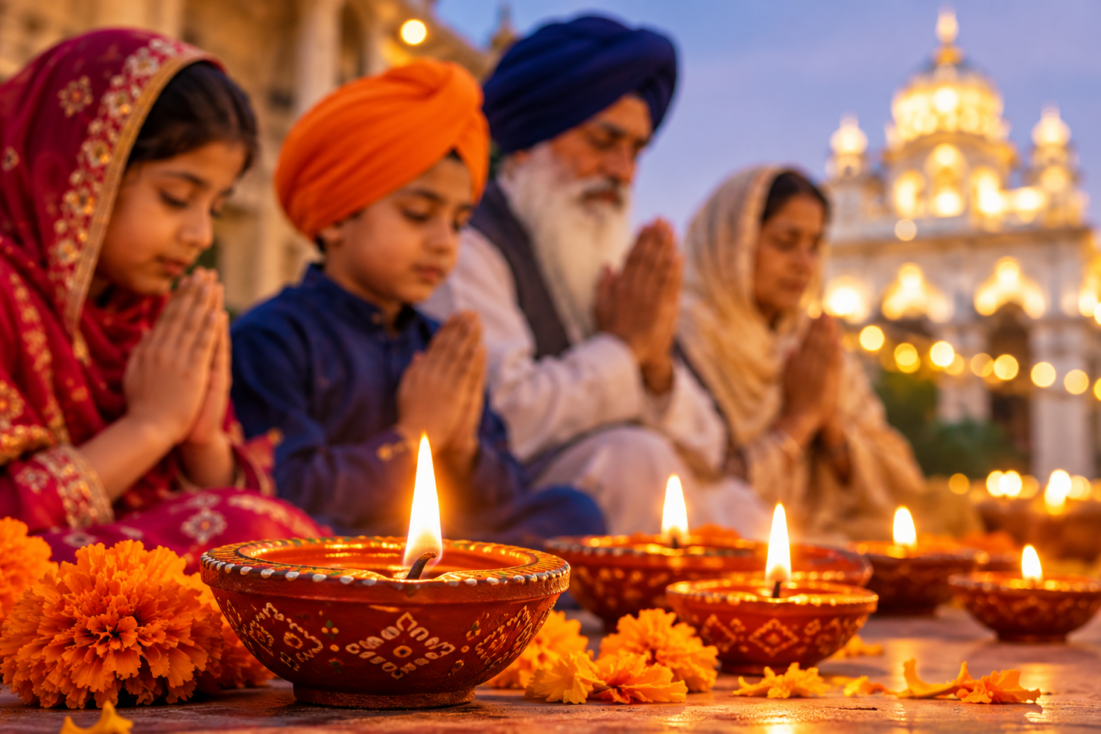
Every year, millions of people illuminate their homes, streets and communities to celebrate Diwali, the Festival of Lights. More than a religious or cultural occasion, Diwali carries a message about the enduring struggle between light and darkness, good and evil, knowledge and ignorance. In a world of conflict and intolerance, that message deserves more than decoration. It should be tested where light is hardest to keep burning, particularly in Afghanistan, where Hindu and Sikh communities that once lit their lamps have almost disappeared.
Derived from the Sanskrit Deepavali, meaning a row of lights, the festival commemorates for many Hindus the return of Lord Rama, with Sita and Lakshmana, to Ayodhya after fourteen years of exile. Other traditions add their own meanings: the nirvana of Lord Mahavira for Jains, and Bandi Chhor Divas for Sikhs, marking Guru Hargobind Ji’s release from imprisonment. Their stories differ, but they share a longing for freedom, righteousness and enlightenment—values that carry particular significance for Afghanistan’s remaining religious minorities.
Diwali is now celebrated from India, Nepal and Bangladesh to Singapore, Mauritius, the United Kingdom, the United States, Canada and Australia. Across borders, Diwali is a chance to reaffirm coexistence.
Harmony, however, cannot be reduced to festive greetings. It requires freedom of religion, equal citizenship, protection of minorities and the rejection of discrimination. A pluralistic society shows its character when people stand together not only during celebrations but also when others’ rights and dignity are threatened.
Afghanistan: When the Lamps Go Dark
For generations, Hindus and Sikhs were part of Afghanistan’s social and cultural landscape, running shops and tending temples and gurdwaras in cities such as Kabul, Jalalabad and Ghazni. Decades of conflict, discrimination and migration thinned their ranks, and the Taliban’s return to power in August 2021 hastened the departures. Around 300 Sikhs reportedly lived in the country at that time, according to a 2022 BBC report cited by the European Union Agency for Asylum (EUAA).
The EUAA’s February 2026 country-focus report says community representatives put the number of Hindus and Sikhs still in Afghanistan at about 100 in total, mainly in Kabul, Jalalabad and Ghazni, with some 2025 sources reporting fewer than 50 Sikhs. Estimates vary, and the figure indicates scale rather than offering a census. But the loss is not merely demographic. Each departure risks the loss of a temple, a tradition, a neighbourhood tie and a piece of cultural memory. A festival built on community is hard to sustain when the community can barely gather.
Safety remains a concern. In 2022, a Sikh place of worship in Kabul was attacked, and an explosion later that July targeted a Sikh shop near a Kabul gurdwara; the Islamic State-Khorasan Province (ISKP) has been linked to attacks on Sikhs since the takeover. The EUAA found no attacks on Hindus or Sikhs in its latest reference period, yet it also notes that the few reports of mistreatment reflect the communities’ “small numbers and low visibility.” Silence is not the same as security.
There have been diplomatic overtures. On 13 October 2025 in New Delhi, the Taliban’s foreign minister, Amir Khan Muttaqi, told a delegation of exiled Afghan Hindus and Sikhs that they were welcome to return and could restart businesses, and that the authorities supported renovating religious sites and protecting property rights. The delegation was sceptical, citing safety and security as the main obstacles, and asked for the return of seized properties, restoration of religious sites and greater representation in the de facto government. Such words must be measured by whether families can live safely, worship openly, recover homes through fair procedures, educate their children and take part in public life without fear. For families who have left, rebuilding trust will require more than assurances.
The challenge extends to other religious minorities. The United States Commission on International Religious Freedom (USCIRF), in a report released on 7 August 2024, said strict religious edicts enforced by the Taliban authorities have “severely restricted the religious freedom of all Afghans,” naming Ahmadiyya Muslims, Sikhs, Hindus, Christians and Shia Muslims among those affected. USCIRF’s 2024 annual report recommended designating Afghanistan a Country of Particular Concern. The sources of danger differ, from state restrictions to extremist violence, but the result is a climate in which many cannot practice their beliefs with confidence.
Afghanistan is not only a question of geopolitics or security; it is home to people whose families and faiths are part of its history. Their plight calls for principled international attention, sustained human-rights monitoring, protection of cultural heritage and support for the safe, voluntary return of those who wish to rebuild their lives, without pressure or unrealistic assurances.
For South Asia, this is not a distant concern. Our histories are interwoven, and the dignity of minorities in one country resonates in another. A society that wants its own minorities respected should also speak for minorities elsewhere. Diwali’s light becomes meaningful when it inspires solidarity with people who cannot celebrate openly, maintain their temples or practice their faith without fear. Religious freedom is not a privilege granted by a majority; it is a right belonging to every person.
Let the Light Continue Beyond Diwali
Diwali should not be remembered merely for illuminated streets, sweets and family gatherings. Its relevance depends on whether its moral message shapes everyday behavior.
Perhaps the greatest celebration would be one in which no child is deprived of education, no family is denied dignity, and no community lives in fear because of its religious identity. That aspiration must include the Hindu and Sikh families of Afghanistan, and every other minority whose future, identity and freedom remain uncertain.
This Diwali, let the celebration extend beyond the lighting of lamps. Let it illuminate conscience, strengthen mutual respect and move us to stand beside those living in the shadow of discrimination and fear. For Afghanistan’s Hindu and Sikh families, that solidarity must continue long after the lamps have faded. After all, the true victory of light is not only what people see around them, but what they choose to become within themselves.
Nicholas Biswas is a media freelancer and a recipient of the United Nations Population Fund (UNFPA) Media Award.