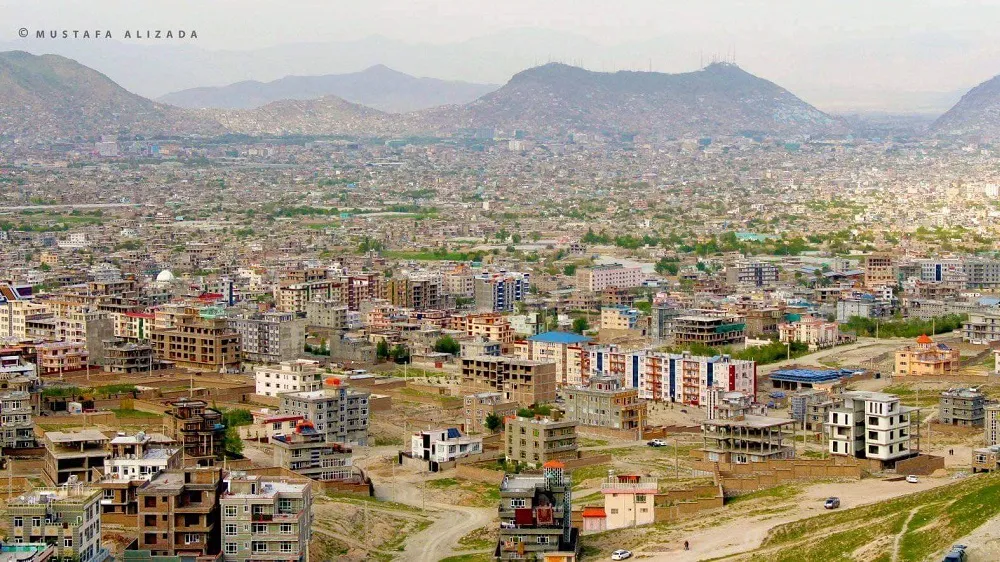

Thousands of families in a mainly Hazara neighborhood of Kabul face eviction, rent demands and the possible loss of their homes after a Taliban court declared the land beneath them state property.
By KabulNow
Original reporting by Hamid Noman and Etilaatroz
In early October, residents of Omid Sabz, a large residential township in western Kabul, began seeing Taliban officials and armed men moving from house to house.
They asked residents for copies of their property documents, inspected homes and sealed some houses that were empty. Families renting homes in the township were told to pay rent to the Taliban’s Ministry of Justice instead of their landlords. Some residents said they were being threatened with eviction if they did not comply.
For many families, the dispute is no longer just about land ownership or a court decision. It is about whether they can remain in homes they bought and built years ago.
One resident told Etilaatroz that he had paid for his house and possessed legal and religious ownership documents. He said he would not willingly leave, even under financial pressure. His main fear was that the authorities might eventually cut off access to basic necessities, including water and electricity, to force residents out.
“The plan is to put pressure on people until they leave on their own,” the resident told Etilaatroz. He accused Taliban forces of demanding money, arresting and mistreating residents, and entering homes with weapons to intimidate families.
Omid Sabz is not a small settlement on the outskirts of the capital. According to local figures obtained by Etilaatroz, it is home to approximately 80,000 people, or 11,500 families, living across four phases. The township contains around 2,100 residential buildings, along with shops, mosques, schools, health facilities and paved roads. A large proportion of its residents are Hazaras, a predominantly Shia ethnic minority in Afghanistan.
Many families bought their houses, apartments or plots from previous owners, relying on property documents, municipal approvals and an officially approved urban development plan.
But a Taliban court has now declared the land beneath their homes to be state property. The decision has placed thousands of families at risk of losing properties they believed they legally owned.
A dispute with a long history
The ownership dispute over Omid Sabz goes back more than three decades and has passed through several governments, including the Taliban’s first administration in the 1990s, the governments of Hamid Karzai and Ashraf Ghani, and the Taliban’s current administration.
Documents reviewed in an Etilaatroz investigation published in August show that Mohammad Nabi Khalili, the main developer of the township and brother of former Afghan vice president Mohammad Karim Khalili, bought land in the area in 1994 from previous owners, including the heirs of Malek Khushdel.
Khalili initially planned to develop a residential area for Afghans returning from neighboring countries. Some of the land was sold to returnees, and the settlement was first known as Shahrak-e Hijrat, or Migration Township.
The project was interrupted by the civil war and the Taliban’s rise to power. Khalili later left Afghanistan, and the land became the subject of competing ownership claims.
During the Taliban’s first period in power, a special court examined competing deeds and other property records relating to hundreds of jeribs of the disputed land. A jerib is a traditional unit of land measurement used in Afghanistan.
The court ruled in favor of the heirs from whom Khalili had purchased part of the property. It recognized their private ownership after reviewing documents, witnesses and records held by Taliban institutions.
After the Taliban government fell in 2001, Khalili returned to Afghanistan and resumed the development project, which was renamed Omid Sabz.
The ownership documents underwent further administrative and judicial reviews during the government of President Hamid Karzai. Government departments, Kabul Municipality and courts examined deeds, tax records and competing state claims.
Between 2007 and 2012, different levels of the Afghan court system rejected government claims over the disputed property and ruled in favor of Khalili. In 2012, Afghanistan’s Ministry of Urban Development approved a detailed development plan for the township.
The project expanded, and thousands of families purchased land and homes.
The dispute, however, did not disappear.
Under President Ashraf Ghani, the case was investigated again. In 2020, the Supreme Court’s High Council cancelled earlier court rulings, and the authorities ordered a halt to construction and property transactions.
This reopened a case that had already passed through several rounds of litigation.
When the Taliban returned to power in August 2021, the ownership question remained unresolved.
A few months later, the Taliban established a commission to identify and recover what it described as usurped state land. Omid Sabz eventually became one of the cases examined by the commission.
Technical reviews began in 2023 and continued through several government institutions.
The Taliban’s own review panel found that some of Khalili’s ownership deeds were registered in court archives and supported by property and tax records. However, cadastral maps dating from the 1970s showed parts of the disputed area as government land, while other sections were not registered under an individual’s name.
A cadastral map records land parcels, boundaries and ownership information.
The review panel referred the case to a special court for a final decision.
In April 2026, the court ruled that 1,507.49 jeribs (around 301 hectare) of land in Omid Sabz were “Emirati”, a term the Taliban uses for property belonging to its Islamic Emirate.
The ruling rejected private ownership claims over the disputed land and ordered its recovery by the authorities.
The same documents, different conclusions
At the center of the dispute is a question about how the authorities evaluate conflicting evidence of land ownership.
In the Omid Sabz case, the Taliban court placed significant weight on cadastral records showing parts of the area as government property.
Earlier courts had taken a different approach. They considered those records alongside ownership deeds, tax records and other evidence rather than treating the cadastral registration alone as conclusive proof of state ownership.
The Taliban court also rejected the validity of a ruling issued during the group’s first period in power. Among the problems it identified in that earlier judgment were 20 spelling errors, which it described as violations of administrative procedures.
The difference becomes more striking when Omid Sabz is compared with another land dispute in Kabul.
In the case of Sayed Jamaluddin Afghan Township, owned by businessman Mirwais Azizi, more than 1,188 jeribs of land had been recorded as state property in cadastral documents.
However, the Taliban court examined ownership deeds and consulted religious scholars before recognizing the land as private property. The Taliban’s Ministry of Justice subsequently announced that the land commission had withdrawn its claim.
The August Etilaatroz investigation documented the different approaches taken in the two cases.
The difference does not, by itself, establish why the courts reached different decisions. But it has raised questions about whether the same standards are being applied to competing ownership claims.
The issue is particularly sensitive for residents of Omid Sabz, where a large proportion of the affected families belong to the Hazara community, a historically persecuted ethnic minority in Afghanistan.
After the eviction order became public, Hazara and Shia religious and community representatives accused the Taliban of discriminatory treatment. They described the measures as an attempt at forced displacement and warned against the unequal application of the law.
From a land ruling to an eviction order
The court decision soon moved beyond a dispute over ownership documents.
In early August, Abdul Hakim Shara’i, the Taliban’s minister of justice and head of the commission responsible for recovering allegedly usurped land, told residents that homes and commercial properties in Omid Sabz had to be vacated within days.
Residents were also informed that buying, selling and renting properties in the township was prohibited.
The deadline passed without a large-scale eviction, and for several weeks there was little public information about what the Taliban intended to do next.
By late September and early October, however, residents said the pressure had returned.
Teams from the Ministry of Justice began collecting copies of ownership documents and inspecting houses. Armed men accompanied some of the teams. Empty houses were sealed, and residents said their owners were not allowed to reopen them.
On October 7, Etilaatroz reported that the Taliban had instructed tenants in Omid Sabz to pay 4,000 Afghanis per room, including rent for previous months and six months of advance payments.
The Ministry of Justice had also instructed tenants to stop paying rent to private landlords and instead deposit the money with the ministry.
According to sources, the rate for Taliban members and personnel who would be housed in the township was set at 1,000 Afghanis per room, a quarter of the amount demanded from other tenants.
Residents told Etilaatroz that the measures were intended to make it increasingly difficult for families to remain in the township.
By October 10, one resident estimated that between 100 and 200 homes might have been vacated. He said Taliban members were quickly moving into some empty properties.
Etilaatroz also reported that more than 30 residents, reportedly including community representatives, had been detained and beaten during the previous week.
According to sources, the detainees were later required to promise that they would leave their homes within two days.
The Ministry of Justice was also reported to have written to other Taliban institutions, including the intelligence agency, requesting lists of Taliban members who had moved to Kabul from the provinces and needed accommodation.
A source familiar with the matter told Etilaatroz that these individuals could then be housed in Omid Sabz at the lower rental rate.
If carried out on a large scale, such a plan would mean that a court ruling about ownership of the land could result not only in the displacement of existing residents but also in the settlement of Taliban members and their families in their place.
What the Taliban’s own law allows
The threat of eviction also raises questions about whether removing residents is necessary under the Taliban’s own laws.
The Taliban has adopted a law governing the sale and distribution of state land.
Article 15 of that law provides a mechanism through which land in residential townships or government projects, once determined to be state property, can be transferred to those already occupying it in exchange for a price set by the authorities.
The law also allows payment in installments under certain conditions.
In other words, declaring land state property does not necessarily require the removal of everyone already living on it.
The Taliban has considered or applied similar arrangements in other land disputes.
In Mullah Tarakhil Township, the commission responsible for recovering state land reportedly collected payments from residents and transferred ownership to them.
Another example is Omar Gulistan, a residential complex in Kabul where approximately 680 families live in eight residential and commercial buildings.
The Taliban’s Ministry of Justice declared the land beneath that complex to be state property. But documents reviewed by Etilaatroz show that the special court distinguished between ownership of the land and ownership of the buildings constructed on it.
The court referred to legal provisions allowing land to be transferred back to occupants in return for payment.
Despite this, residents of Omar Gulistan said they were facing additional financial demands.
According to Etilaatroz, the Taliban-controlled management of the complex was collecting monthly service fees of 2,000 Afghanis per apartment, compared with the 1,200 Afghanis previously paid to a private service company.
Residents also reported being told to pay 5,000 Afghanis per room in monthly rent, although they said no formal written order authorizing the payments had been shown to them.
These differences have raised questions about how the Taliban’s Ministry of Justice applies land rulings and what rights remain with people who purchased or constructed buildings on land subsequently declared state property.
In Omid Sabz, residents say they have not been offered a clear process through which they can purchase the land or regularize their ownership. Instead, they describe demands for rent, restrictions on their properties and pressure to leave.
As the October 10 Etilaatroz investigation documented, even the Taliban’s own rules provide possible alternatives to eviction. The authorities have not explained why those alternatives are not being offered to Omid Sabz residents.
Bigger than Omid Sabz
The dispute in Omid Sabz is part of a much wider campaign involving land ownership across Afghanistan.
Since returning to power in August 2021, the Taliban has pursued disputes over land it considers state property through commissions, administrative investigations and special courts.
According to the Taliban’s Ministry of Justice, land belonging to 49 residential townships in 14 provinces has been declared wholly or partly state property over the past four years.
Other disputes have involved rural land and pastures, including cases where nomadic claimants have sought land occupied by local communities for decades.
In some cases, residents, particularly Hazaras, have faced orders to leave land and homes after competing claims were decided in favor of other parties.
The consequences of the Omid Sabz case could therefore extend beyond one residential area in Kabul.
It illustrates how an ownership dispute involving land developers and government institutions can ultimately affect thousands of families who were not parties to the original transactions.
Many residents purchased their properties years after the initial ownership disputes began. They relied on documents issued or recognized by government institutions, court decisions and municipal approvals.
Some invested their savings in construction. Others bought completed houses or apartments and raised families there.
Now they face the possibility that documents once accepted by the authorities may no longer protect their homes.
They have documents showing that the land passed through courts and government institutions under several administrations. Some bought their homes from people whose ownership had previously been recognized. Others built houses under municipal approvals.
Yet the authorities now controlling Afghanistan have reached a different conclusion about the land beneath those homes.
The question for these families is no longer only who legally owned the land decades ago. It is whether a court ruling about that land can turn people who believed they were homeowners into tenants, and whether refusing to accept that new status could ultimately cost them their homes.
Editor’s Note: This article is based on three reports originally published in Farsi by Etilaatroz on August 15, October 7, and October 10, 2026. It was adapted with the assistance of AI and reviewed and edited by KabulNow’s editorial team.