


By Shahrbanu Haidari and Rebecca Hawkins
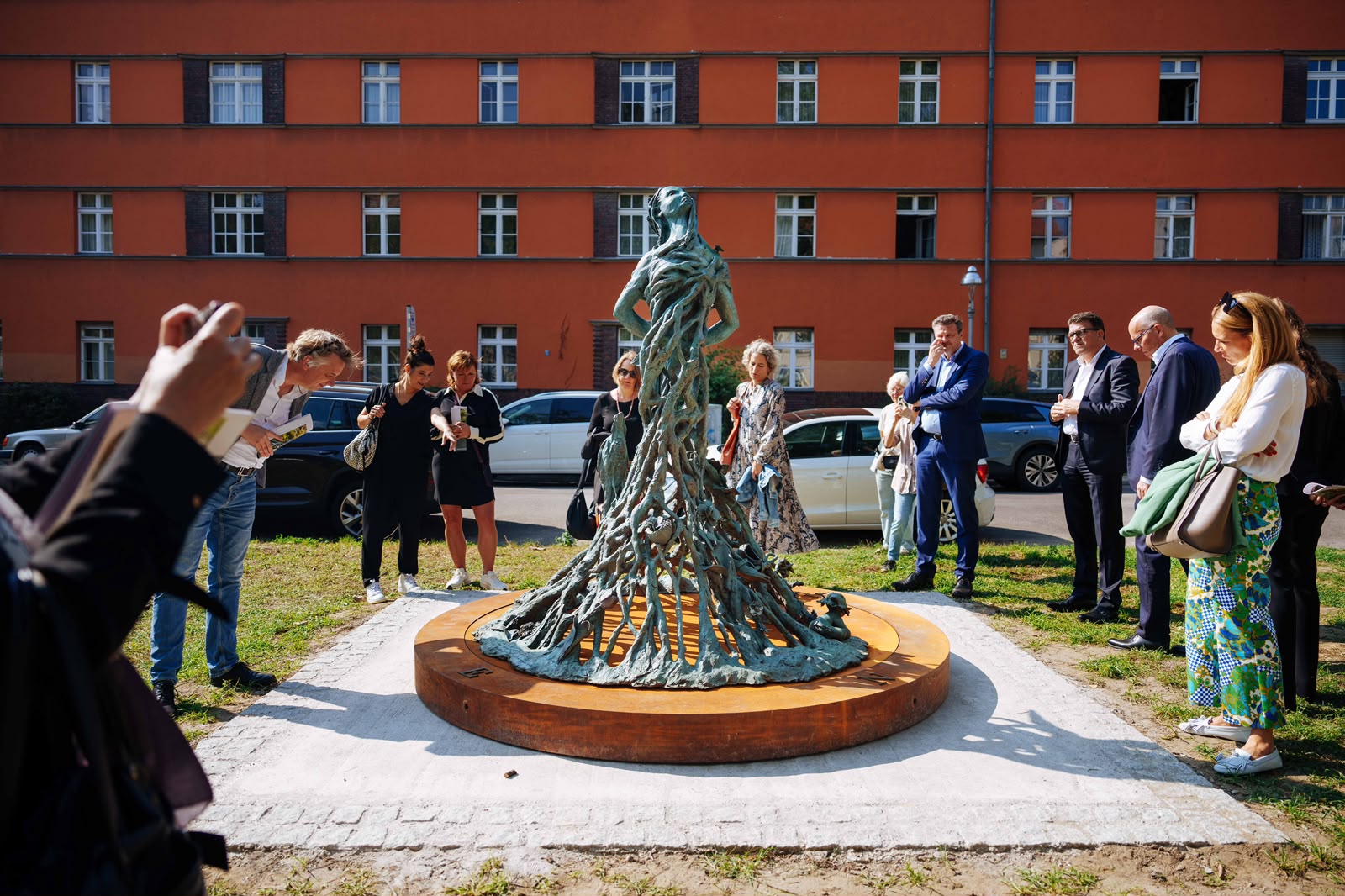
Among the bronze vines of Petrified Survivors, the world’s first memorial sculpture to all victims and survivors of conflict related sexual violence (CRSV), there is an almond blossom chosen by Hazara women as the symbol to represent their community. The blossom reflects the shape of their eyes, the feature that has marked the Hazara out for persecution for more than a century. Beside it sits a red tulip for all the women of Afghanistan, a flower that returns every spring after the frost.
One of us designed and produced the sculpture. The other, through Associazione di solidarieta Donne per le Donne, helped shape it alongside survivor groups from more than 30 countries. The chosen symbols represent the women of Afghanistan rather than “Afghan women”, because for much of the country’s history “Afghan” has carried a specific ethnic meaning. Applying it to every woman in the country erases the very difference that decides who is targeted and why.
Recent action by the International Criminal Court (ICC) to prosecute crimes perpetrated against women in Afghanistan, whilst welcome, erases part of their identity in the same way.
Today, Hazaras still reflect on the fall of Hazarajat in 1893, when the forces of Abdur Rahman Khan killed, enslaved and sold Hazara men, women and children. The world has never formally recognized it as genocide. Nor has the violence remained in the nineteenth century. Last month, a grenade went off at a school in Dasht-e-Barchi, the Hazara district of west Kabul, wounding at least 42 children. Its cause is still being investigated. But Dasht-e-Barchi is home to a Hazara community that has been attacked for generations.
Sexual violence has run through every chapter of this story. Human Rights Watch recorded rapes and abductions of Hazara civilians in Kabul in 1993, and young women taken in Mazar-i-Sharif in 1998 who were never found. Since the Taliban returned to power in August 2021, Hazara women and girls have been detained in Dasht-e-Barchi for supposedly wearing the hijab improperly. Recent testimony given to the United Nations describes rape, gang rape and sexual torture in custody, often filmed so that shame will keep the women silent. Some were targeted precisely because they were Hazara.
In July 2025, the International Criminal Court (ICC) issued arrest warrants for the Taliban’s supreme leader, Haibatullah Akhundzada, and its chief justice, Abdul Hakim Haqqani, accusing them of persecuting women, girls and anyone seen as standing with them. It was a historic step in the right direction. However, neither man has been or is likely to be arrested, and the court cannot hold a trial without the accused present.
The warrants also leave out crucial details. Article 7 of the Rome statute, the Court’s founding treaty, allows it to prosecute persecution on ethnic and religious grounds, and rape and other sexual violence as crimes in their own right. The Court’s own summary mentions rape, yet according to that summary the warrants, which remain sealed, charge only gender and political persecution. They say nothing about ethnicity or religion, the two grounds on which Hazaras have been pursued for more than a century. The sexual violence, meanwhile, is folded into the wider charge rather than named as a crime in itself.
So, a Hazara woman raped in Taliban detention enters international justice, if she enters it at all, as a woman. She does not enter it as a Hazara. Half of what was done to her, and half of why, is missing from the record.
The persecution of Hazaras as Hazaras is already documented. Legal experts at the New Lines Institute have found that attacks on Hazaras meet the acts set out in the genocide convention, and have called for the court to take up their case. A UK parliamentary inquiry issued a similar warning in 2022. That record is enough to support charges of persecution on ethnic and religious grounds today. What is missing is evidence of the sexual violence itself, the hardest of all to collect, because survivors carry the stigma, investigators cannot enter the country, and most witnesses are still inside it.
The problem is that the ICC is a court under siege. It has had no chief prosecutor since Karim Khan was removed in July. Washington has sanctioned 13 people connected to it, including both deputy prosecutors, and has vowed to dismantle it. A prosecutor’s office under that kind of pressure builds the narrowest case it can defend, not the fullest one the evidence supports.
That is why this now falls to the states that fund the Court and will choose its next prosecutor.
When the Court’s member states meet in New York in December for their annual assembly, we ask them to do two things. First, fund the investigative mechanism properly, so that the sexual violence done to Hazara women can be documented before that evidence is lost. Second, put this question to every candidate for prosecutor: will you charge the crimes against Hazara women in full, as persecution on gender, ethnic and religious grounds together, and as sexual violence in its own right? The prosecutor’s office does not need to wait for that appointment, or for that evidence. The persecution of Hazaras is already documented, so it can ask the judges now to add ethnic and religious grounds to the warrants.
None of this requires new law. The grounds are already written into article 7. What is missing is the decision to use them. It is time the Court recognize that these women are both women and Hazaras.
Shahrbanu is co-founder of Associazione di Solidarietà Donne per Le Donne (ASDD) in Italy that support women refugees and migrants from Afghanistan while fostering cultural exchange. The organisation aligns with the UN’s fifth Sustainable Development Goal of gender equality and women’s empowerment. ASDD is also one of more than 20 partner organisation s involved in the Petrified Survivors initiative.
Rebecca Hawkins is a British sculptor whose work has focused on memorization honoring victims and survivors of conflict-related sexual violence (CRSV). Her most recent pieces include Petrified Survivors, the world’s first memorial dedicated to all survivors and victims of CRSV, which was created with the input of survivors from over 30 countries, including Afghanistan.

