
Original reporting by Khalid Mohammadi and Etilaatroz; translation and further development by KabulNow team.
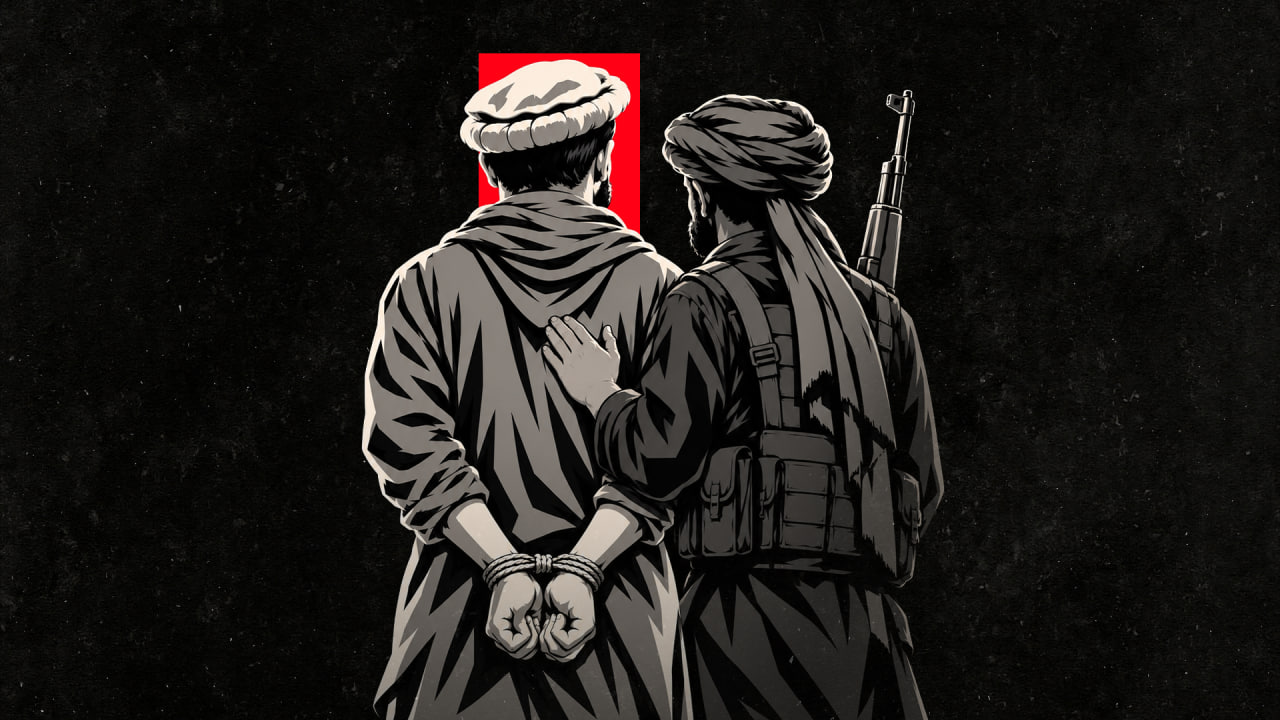
On the morning of September 17, Taliban fighters entered Esmatullah’s home in Panjshir’s Hesarak Valley, tied his hands and took him away. The previous day, two Taliban military vehicles had been set on fire in the area, prompting a security operation that led to the detention of dozens of residents.
Esmatullah, whose name has been changed for his safety, said he had no involvement in the incident. At a Taliban military facility in Dashtak, he saw more than 30 local residents being held over the attack. He was released after a week, but six men from his village remained in detention when he spoke to Etilaatroz.
His account is among several documented in two recent Etilaatroz investigations into alleged arbitrary arrests, torture and forced displacement in Panjshir, where residents say Taliban forces increasingly hold civilians responsible for attacks carried out by armed opposition groups.
Panjshir, a mountainous province north of Kabul, resisted the Taliban in the late 1990s and was the last province to fall when the group returned to power in 2021. Armed opposition groups, particularly the National Resistance Front (NRF) and the Afghanistan Freedom Front (AFF), continue to carry out attacks against Taliban forces in the province.
Residents say Taliban forces have imposed checkpoints and night-time travel restrictions, while security operations following attacks have led to repeated arrests.
Arrests After Taliban Vehicles Were Set on Fire
Esmatullah said he spent the night watching from his window as more Taliban fighters arrived in his village.
“I told them there were women inside the house and that I was the only man there,” Esmatullah told Etilaatroz. “They tied my hands, took me out of the house.”
He said 15 other residents of his village had already been arrested when he was taken away. They were held at the Taliban army’s Special Brigade headquarters in Dashtak on accusations of involvement in the burning of the vehicles.
According to Esmatullah, the Green Trend, associated with former vice-president Amrullah Saleh, claimed responsibility for the attack. Esmatullah insisted the villagers had played no part. He recalled Taliban fighters telling detainees: “To us, civilians and military personnel are all the same. If you are not beaten and imprisoned, your military personnel will attack us every day.”
Villagers Detained Inside a Mosque
Faridoon, a Panjshir resident who spoke under a pseudonym, said Taliban forces detained him and more than 20 other villagers after an explosion near Ab Dara village in Anaba district on August 25. The villagers were performing the evening prayer when they heard the blast. As they tried to leave the mosque, Taliban fighters entered and surrounded them.
“They tied our hands one after another and, treating us very harshly and aggressively, took us out of the mosque and transferred us to their battalion headquarters,” he said.
Taliban commanders demanded that the villagers identify those responsible for the explosion. When they said they knew nothing, they were detained. According to Faridoon, one commander said villagers are responsible for their village’s security and must report any activity by armed opposition groups. Faridoon said a village elder asked how residents could do so when they were not allowed out of their homes at night. The commander became angry, he said.
They were held for nearly ten days before local Taliban members helped secure their release.
Detainees Describe Torture and Deaths in Custody
The Special Brigade prison has become a particular source of fear. Residents say it operates outside the Taliban’s regular prison system. Families are not allowed to visit.
Zubair, another resident using a pseudonym, was detained simply for leaving his house after dark. He was held alone in a dark, cold room. After questioning, the authorities concluded he was a civilian with no military or political links and released him after obtaining a guarantee.
Iqbal, also speaking under a pseudonym, gave a more serious account. He said two of his relatives died after beatings and torture at the same facility during the second year of Taliban rule. He described the prison as one of the most frightening in the province, where detainees can be held indefinitely without formal charges or court proceedings.
“The Taliban keep people imprisoned there for as long as they want, subjecting them to severe beatings and torture. Some even die under torture,” Iqbal said.
He also alleged that some detainees accused of serious crimes were taken into the mountains and shot after being tortured. He cited the cases of two residents of Dara district who, he said, were subjected to summary executions the previous year.
Prolonged Interrogations and Allegations of Extortion
Residents and sources who spoke to Etilaatroz also described alleged abuse during interrogations at the Taliban provincial police headquarters. Suspects were reportedly held in rooms with restricted access and subjected to physical abuse.
According to the sources, Qari Ahmadullah Badr, the Taliban police chief in Panjshir, and Haji Mullah, head of the criminal investigations department, oversee interrogations involving people suspected of supporting anti-Taliban armed groups or having served in Afghanistan’s former security forces.
Jamshid, a source from Anaba district who also used a pseudonym, described the case of Mohammad (a pseudonym), a former military officer who had also been a member of an armed opposition group. He was arrested in Takhar province in late spring 2026 and transferred to Panjshir, where he was held for three months at the police headquarters. During that period, Jamshid said, Mohammad was repeatedly tortured to extract information about money and weapons and to deter others. He was then transferred to the intelligence directorate for further investigation on political charges.
Jamshid also alleged that some detainees were subjected to extortion. According to his account, Taliban personnel sometimes confiscated drugs or demanded money and other assets from people accused of drug trafficking, theft or illegal possession of weapons.
In some cases, he said, detainees were held longer so that visible injuries could heal before release or transfer to court.
Families Forced from Mountain Villages
Fahim, a resident of Paryan district using a pseudonym, said five villages were ordered to leave after a series of incidents this summer. Fighting broke out in the Kujan mountains. A rocket struck the district headquarters. Qari Gul Haidar, a senior intelligence official, was killed at night.
Residents of Surkhshal, Mehr and Samir Kohsar, Shaniz and Jashta were told to pack and descend from the mountains. When one man questioned the order, Fahim said, he was beaten and the families were forced out.
The displacement disrupted the communities’ seasonal livelihoods, Fahim said. These communities traditionally farm and raise livestock in the high pastures during spring and summer, descending only as winter approaches. Forced to leave early, they watched their crops dry and their animals lose access to grazing land. For families dependent on a single season’s harvest, the loss can be severe.
Taliban Deny Allegations of Abuse
Taliban officials in Panjshir have rejected allegations of arbitrary detention, mistreatment, torture and the deaths of civilians in detention facilities.
In earlier remarks, Governor Mohammad Agha Hakim said there were no political prisoners in the province and put the total number of prisoners at 59. He also denied reports of mistreatment and a crackdown on civilians, according to Etilaatroz.
Abdul Salam Hanafi, the Taliban’s deputy prime minister for administrative affairs, recently visited Panjshir’s central prison and pledged to address prisoners’ problems. However, the visit did not include the Special Brigade prison or the Taliban police detention facilities described by residents.
Rights Groups Cite Collective Punishment
Human rights organizations have previously described Taliban actions in Panjshir as collective punishment. In 2023, Amnesty International stated that many individual acts by Taliban forces constituted war crimes and that, taken together, they amounted to the war crime of collective punishment.
“Each individual act is abhorrent, and this conduct in sum amounts to collective punishment – in itself, a war crime,” Amnesty said.
For families in Panjshir, the consequences extend beyond detention. Some have lost access to relatives held in Taliban facilities, while others have been forced to abandon their homes and livelihoods. Residents interviewed by Etilaatroz say they continue to live with the fear that another attack by armed opposition groups could lead to more arrests and punishment in their communities.