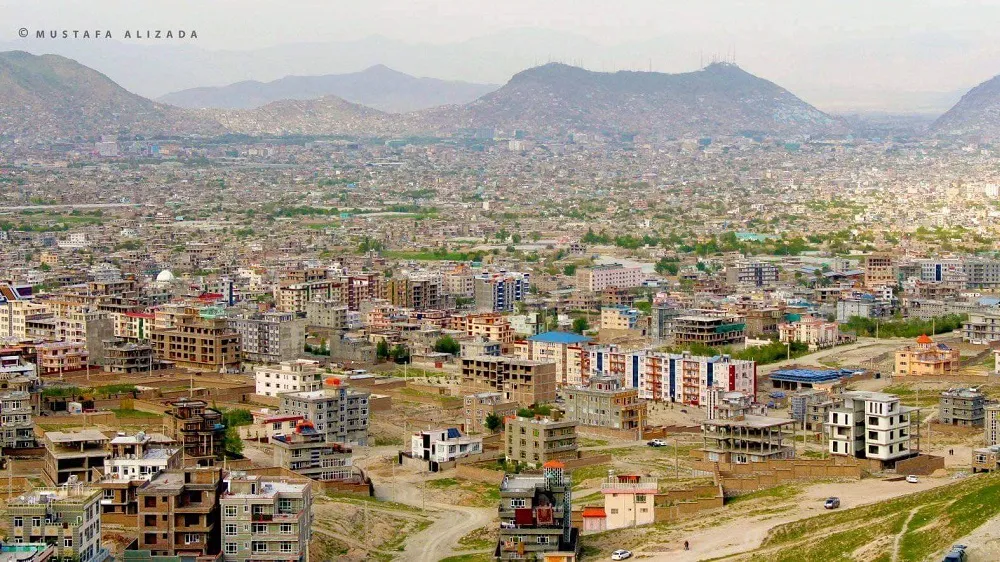

A Taliban court has declared Kabul’s Omid Sabz township state property, and about 80,000 people, most of them Hazaras, are at risk of losing their homes. Dr. Mohammad Amin Ahmadi, a legal scholar, former member of Afghanistan’s constitutional review commission and Republic peace negotiator, has a family home in the township. In a long interview with Etilaatroz, he explains how the case against it was built and why many Hazaras see an old pattern in it.
When people from Baghchar go back to visit, there is nowhere for them to sit. No house to rest in, no one to offer them tea. They look at the ruins of their old homes, empty for thirty or forty years. Then they go to the village cemetery.
“The cemetery is the only place where they still feel a sense of belonging and ownership,” says Mohammad Amin Ahmadi, who was born in Baghchar, a small mountain valley in Uruzgan province, in 1963.
Ahmadi says the valley’s Hazara families lost their land during Amir Abdur Rahman Khan’s campaigns against the Hazaras in the 1890s. They rebuilt a smaller community on land they bought back, and were driven out again in the 1980s, in 1990 and in 2009, the last time after, by his account, a local Taliban commander killed nine young men from the valley. Today many cannot return, because they own nothing there.
“I am from Baghchar, yet at the same time, I am not,” he says. “When you cannot exercise ownership over a place, you are no longer considered one of its people. Sooner or later, you are forgotten.”
He fears the same thing is now happening in Kabul, where his family’s home is in Omid Sabz. “After more than a century, we struggled to light the lamp of our own home in Kabul, in this township,” he says. “Now the Taliban want to put out this light as well, and make me a stranger in Kabul, just as we are strangers in Baghchar.”
Omid Sabz is home to about 11,500 families, roughly 80,000 people, according to an Etilaatroz investigation. In April, a Taliban special court ruled that the land under their houses belongs to the state. Since then, the Taliban have ordered residents to leave, demanded rent for homes the families bought, and detained community representatives who refused to sign their homes away. Omid Sabz is not an isolated case. The Taliban’s Ministry of Justice says it has declared all or part of 49 residential townships in 14 provinces state property.
Ahmadi’s argument is that the Taliban are not ignoring the law to do this. They are using it.
A township declared “Emirati property”
Omid Sabz lies in Kabul’s Districts 6 and 13. Its main developer, Mohammad Nabi Khalili, began buying the land in 1994. He is the brother of former vice president Mohammad Karim Khalili. Its ownership has been disputed under every government since. Courts recognized private ownership under the first Taliban government in the 1990s and again under President Hamid Karzai, before the Supreme Court reversed those rulings in 2020.
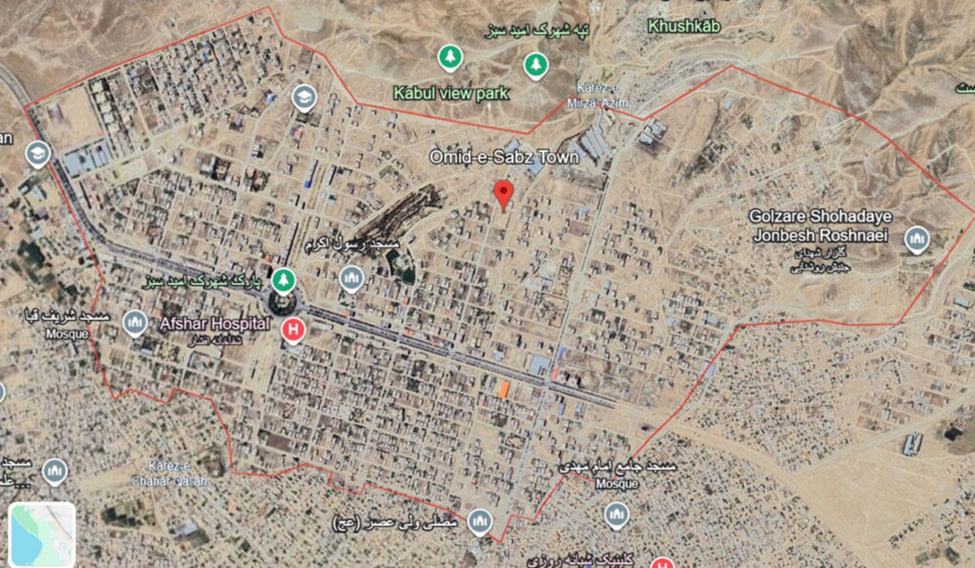
The Taliban say large areas of public land were illegally occupied or sold under previous governments and must go back to the state. In April 2026, their special court ruled that all 1,507.49 jeribs of the township, about 301 hectares, were Emirati property, registered to the state in five cadastral sections. In August, the Ministry of Justice ordered residents out and told owners to seek compensation from the people who sold them the land. Taliban Justice Minister Abdul Hakim Sharei called enforcing the ruling “a religious and legal duty,” and called any link to ethnicity or religion “illogical.” Khalili says the township was built on valid Sharia deeds and a legal building permit.
Residents say they purchased their properties using legal documents registered with government institutions, Sharia deeds and official permits, paying substantial sums for homes and land that are now at risk of confiscation. “For the past three years, the authorities have deprived us of peace of mind,” a resident told Etilaatroz. “Our lives have become miserable. We are citizens of this country too. We have lived on this land, worked here and built our homes through years of hard work and sacrifice. If our documents are legal, if we have Sharia deeds and our properties are registered with government institutions, why is no one listening to us today?” he said.
Since October, residents who stay have been told to pay rent of 4,000 afghanis per room, and dozens have reportedly been detained. Another resident said that armed men from the justice minister’s office gave him one day to leave. “It is my own private house, a house I worked for years to build,” he said. “The rent is only a tool to pressure helpless people into leaving their homes.”
Earlier in November, the Taliban justice ministry detained two community representatives from the township after they refused to sign documents agreeing to vacate their properties. According to local sources, Abdul Raziq Musaddiq and Wakil Jafari were detained after being summoned to the ministry alongside two other representatives. The two others, who signed the documents, were released, while Musaddiq and Jafari remain in the ministry’s custody.
For the full timeline of the evictions, read KabulNow’s From Homeowners to Tenants.
The man reading the rulings
Ahmadi is not a neutral observer, and he does not present himself as one. But few people are better placed to read these rulings. He holds a doctorate in philosophy and Islamic thought from the University of Tehran and taught and served as a university president at Kateb and Ibn Sina universities in Kabul. He sat on the commissions that reviewed Afghanistan’s constitution and oversaw its implementation, and was a member of the Republic’s negotiating team in the Doha talks with the Taliban. He now lives in Norway. He spoke to Etilaatroz reporter Farzad Sharif, and the interview was published in Persian on 25 October.
A long memory
For at least 150 years, Ahmadi says, land in Afghanistan has been tied to identity, power and security, not only to money.
He points to Amir Abdur Rahman Khan, who ruled from 1880 to 1901. In a letter preserved in the court history Siraj al-Tawarikh, the Amir told the Nasar, a Pashtun nomadic tribe, that they could enter the country only if one in ten of their wealthier households settled in Qataghan, in the north, to become “a powerful arm of the state.” British India backed this “Afghanization” of the northern borderlands, and later governments, including King Amanullah Khan’s, kept settling Pashtun migrants in the north.
Hazara land was taken at the same time. The justification then, Ahmadi notes, was the logic of war. As the court historian Fayz Muhammad Katib recorded, Hazaras were declared unbelievers because of their faith, and their property and lives were declared lawful spoils. Ahmadi says the loss began even earlier and moved village by village. “We are dealing with a recurring pattern,” he says. “It has become part of the Hazaras’ historical memory. For this reason, they also see the same pattern in the Taliban’s broader policies.”
He does not say today is the same as the 1890s. The scale, the methods and the times are different. But he sees a shared result: the Hazaras’ economic base weakened and the community pushed to the margins.
He recalls a moment from the Doha negotiations. The two sides were discussing the civil and religious rights of Shias. A Taliban representative looked across the table at him and said: “You have become too powerful.”
Ahmadi believes many in the Taliban think Hazaras and Shias gained too much during the Republic. Seen that way, Hazara townships, property and businesses are signs of a community growing in power. “The seizure of their property, homes and shops is then not only a matter of land ownership,” he says. “It can also be a tool for weakening this group’s economic base and reducing its social power.”
Whose land is it?
In almost every land dispute Sharif reported on, the fight came down to one question: what kind of land is this? Afghan law recognizes five kinds: private property, public land such as common pasture, religious endowments, village pastures, and state land, which covers anything registered to the state or not fitting the other four. The categories come from the Republic’s 2017 Land Management Law. The same law lists the documents that can prove ownership, from Sharia deeds and court judgments to tax receipts. A cadastral record registering land to the state also counts, but in principle only where no other valid document exists.
Ahmadi, who sat on the constitutional review commission, argues that the 2017 law read the constitution in the widest way possible for the state. It turned almost any land not clearly private into state land, even though the constitution obliges the state to give land to citizens for housing. Decades of war then left the property registries in disorder. That, he says, gave officials and judges room to impose political will “at the expense of vulnerable groups of ordinary citizens.”
He adds a point that is uncomfortable for many former officials. The language now used to justify the seizures, he says, took shape under President Ghani, whose campaign against “land grabbing” paid little attention to ordinary people who had built homes on barren land because they had nowhere else to live. That campaign, he says, now makes it harder for the public to see what the Taliban’s land commission is doing, because its work is presented as fighting corruption.
Small changes, large consequences
The Taliban’s special court did not throw out the 2017 law, Ahmadi argues. It used it. That, in his view, is what makes the Omid Sabz ruling hard to challenge.
A Taliban technical review that began in 2023 found that some of Khalili’s deeds were registered in court archives and backed by tax records, but that cadastral maps from the 1970s showed parts of the area as government land. The court gave the maps the decisive weight.
Etilaatroz’s August investigation, on which Ahmadi relies, documented three changes in how the court handled the documents. None looks large on its own.
- When the court asked the Sabt-e Mahfuz registry to confirm a deed, it changed the deed holder’s name and his father’s name in the request. A registry asked about a different person will answer that no record exists.
- The court treated a difference in ink color in a register as if it were an erasure or a blot. The law lists erasures and alterations as reasons to reject a document. Ink color is not on that list.
- A technical committee’s report stated that something “is” the case. When the judge asked the Supreme Court’s muftis for a religious opinion, the request said it “is not.” One word reversed the meaning.
The defendants’ lawyers objected, but the court paid no attention, Ahmadi says. On the strength of these changes, it set aside earlier court rulings, Sharia deeds, registry records and tax receipts. It also rejected the ruling issued under the Taliban’s own first government, citing 20 spelling errors in it as breaches of procedure.
“Formal legality, which appears to rely on the law, procedures and proper jurisdiction, becomes an instrument of dispossession when it is not matched by substantive legality,” Ahmadi says. By substantive legality he means decisions that actually follow the legal rules, respect people’s rights, meet the standards of evidence and give a fair hearing.
He does not spare the Republic. The Supreme Court’s 2020 reversal, he says, apparently followed the wishes of President Ghani. Yet the Land Law ranks final court judgments above cadastral records as evidence of ownership, and the Supreme Court had itself upheld the earlier rulings on appeal. In his view, those judgments should have stood.
From “state land” to “Emirati property”
Taliban rulings and statements now call state land Emirati, “belonging to Islamic Emirate.” Ahmadi argues this is more than a new label. It changes who the land is understood to belong to.
Under the Republic’s constitution, as he reads it, state land was a form of public property. Every citizen had an equal right in it, and the state managed it on their behalf, with priority for the poorest. Both Western legal philosophy and Islamic jurisprudence, he says, hold that people gain rights in land by working it, and that the state’s role is to manage natural resources fairly, not to own them.
In the Taliban’s framework, everything that is not a religious endowment, private property or a village’s own pasture belongs to the Emirate. It is controlled by the Taliban’s supreme leader, who decides its use by his own judgment of the public interest. “The ruler is accountable to no one but God,” Ahmadi says of this model. That public interest has no written standard and cannot be checked by any court or body outside the leadership. In Ahmadi’s words, land has moved out of public law and into sovereignty “in its pre-modern sense.”
Same documents, different outcomes
If the Taliban applied one rule to everyone, Ahmadi says, Omid Sabz would have been handled differently.
In May, the Taliban’s leader approved a law that lets residents of townships declared state property buy the land at a price the authorities set. In Mullah Tarakhil township in Kabul, residents reportedly paid and received ownership. Etilaatroz reported the price as 70,000 afghanis per jerib. In the Sayed Jamaluddin Afghan township, which Etilaatroz described as belonging to a Pashtun businessman, Mirwais Azizi, more than 1,188 jeribs were recorded as state land in the cadaster, as in Omid Sabz. There, the court examined the deeds, consulted religious scholars and recognized private ownership.
Ahmadi argues that the Mullah Tarakhil rule should apply with even more force to Omid Sabz, which was developed with legal permits. The land was barren, held Soviet-era bunkers and was full of unexploded ordnance. The developer had an urban plan approved by the Ministry of Urban Development and cleared the land, and the owner and buyers together paid for roads and other infrastructure. The township became part of Kabul’s District 6 and has paid municipal fees ever since.
“My emphasis is not on establishing private ownership of the land,” he says. “The issue is the limits of the Emirate’s rights, even assuming the land belongs to the Emirate.”
He cites Article 906 of the Majalla, the Ottoman-era code of Hanafi law. It says that a person who builds in good faith on land they believe is theirs, where the building is worth more than the land, may pay the land’s value and keep it. Applied to Omid Sabz, Ahmadi says, the Taliban could at most claim the value of the bare, mined land. Instead, owners have been told to recover their money from the sellers, and those who stay are being charged rent.
The difference in treatment, he says, “lacks any convincing legal justification.” These cases, he adds, must be examined “in terms of equality before the law, the prohibition of discrimination, and the possible misuse of government power.”
A pattern, or a policy?
The Taliban say the campaign is about law, not identity. Hazara and Shia representatives see it differently. In August they accused the justice minister of “systematic discrimination” and of trying to force Hazaras and Shias from their homes. They asked the Taliban leadership to revoke the Omid Sabz order and review the documents again, saying a Taliban land commission had itself found the township privately owned.
Sharif put the question to Ahmadi directly. Land recovery cases such as Angur Bagh in Jalalabad and Omar Gulistan township in Kabul seem to move forward only in non-Pashtun areas. Are the Taliban engaged in social engineering?
Ahmadi is careful. If it is shown with enough evidence that restitution is concentrated in non-Pashtun areas, he says, then, together with what happened in Omid Sabz and Nawabad, “the possibility of a structural and discriminatory pattern cannot be ignored.” But concluding that there is a deliberate policy of social engineering, he says, would require closer study of how the decisions are carried out, how similar cases are treated, and what the evidence shows about their aims.
He is less cautious about what such a pattern would mean. A court used to strip one ethnic or religious group of its property, he says, stops being an institution of the whole country and treats that group “as though they were not citizens of the country but its enemies.” If homes are taken or demolished without regard to the rules he has described, the actions could amount to dispossession, forced displacement and demographic change. Each of these, he says, can be an international crime in its own right.
He also describes the mood among Hazaras. Many, in his account, now look for an answer in a new balance of power and in changes to the structure of the state, so that such policies become too costly to pursue.
Early in the interview, Ahmadi described what losing land does to a person.
“You become a stranger in your own land, the place where you were born,” he says. “You lose any chance to have a say over it. You lose your most important means of living. And before long, you are forgotten.”