

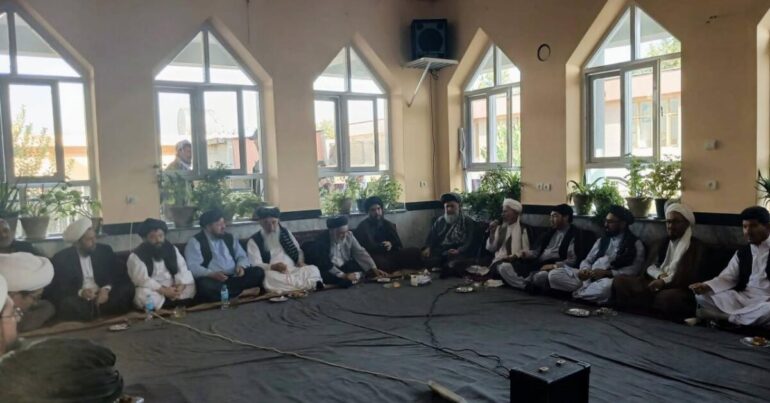

KABUL, AFGHANISTAN – Representatives of Afghanistan’s Hazara-Shia community have accused the Taliban’s justice minister of pursuing discriminatory policies, saying his actions amount to “systematic discrimination” and an attempt to forcibly displace members of the community.
In a joint statement on Thursday, the representatives called on the Taliban leadership to intervene, alleging that Abdul Hakim Shara’i has repeatedly targeted the Shiite community through arrests, property disputes, closures of religious institutions, and other measures over the past five years.
The statement came days after the Taliban Ministry of Justice ordered residents of Omid-e Sabz Township, also known as Haji Nabi Township, to vacate the area after a special Taliban court declared more than 1,500 jeribs (about 301 hectares) of land to be state-owned. The township, located in Kabul’s Districts 6 and 13, is home to more than 4,000 families, most of them from the Hazara Shia community.
The representatives described the evacuation order as “hasty and questionable,” saying it contradicted the findings of a Taliban land commission, which they said had concluded the township was privately owned rather than state property. They urged the Taliban leadership to revoke the order and conduct a fresh review of the township’s ownership documents.
“The collection of these behaviors and actions by the justice minister constitutes systematic discrimination and an attempt to forcibly displace Hazara and Shia people, and its continuation is intolerable,” the statement said.
The evacuation order has raised concerns among residents, who say they have valid ownership documents, have lived in the township for years, and invested in homes, businesses, and factories.
A day earlier, Mohammad Nabi Khalili, one of the township’s shareholders and the brother of former Afghan Vice President Mohammad Karim Khalili, also challenged the decision. He said the township had been developed on the basis of valid Islamic title deeds, legal ownership documents, and official permits, and called on Taliban authorities, the group’s Supreme Court, religious scholars, legal experts, and tribal elders to independently review the case.
The Hazara and Shia representatives also accused Shara’i of repeatedly insulting, detaining, and imprisoning Shia religious scholars, community leaders, and residents without court orders or proof of wrongdoing.
They further alleged that the justice minister ordered the closure of a cemetery in Kabul’s Afshar area, forced residents to pledge not to bury their dead there, displaced Shia families from the Sanatorium area of Darulaman, and demolished their mosque.
The statement also cited the closure of Tamadon Television, the Khatam al-Nabieen mosque and religious seminary, other Shia mosques and cultural centers, and the removal of Muharram mourning flags from mosques in Kabul as examples of what it described as discriminatory measures against the Shia community.
The representatives said they had repeatedly raised their concerns with senior Taliban officials in Kabul and sent petitions and letters to the group’s leadership in Kandahar, but had received no response. They called on the Taliban to reopen Tamadon Television, Khatam al-Nabieen, and other Shia religious and cultural institutions, and to ensure that Shia citizens are treated equally with other citizens.
The Taliban have not yet responded to the statement.

