
KABUL, AFGHANISTAN – Afghan women activists, UN officials and international representatives have called for stronger global efforts to hold the Taliban accountable for systematic violations of women’s rights, urging countries to recognize “gender apartheid” as a crime under international law during a conference in Madrid, Spain.
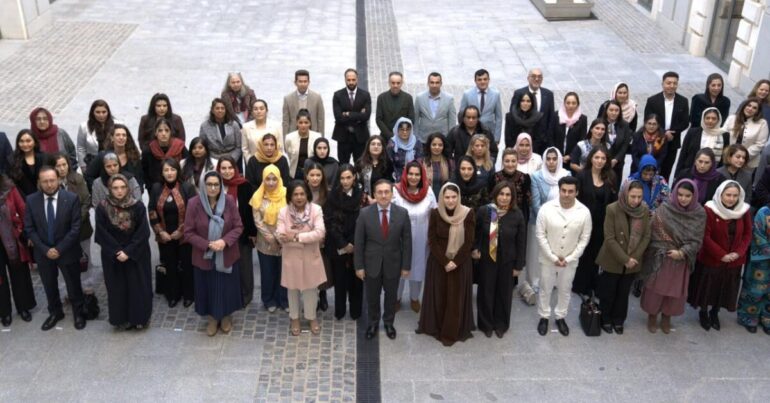
The fourth “Hear Our Voices” summit opened on Monday, November 23, bringing together Afghan women’s rights activists, former lawmakers, human rights experts, diplomats and representatives of international organizations to discuss accountability, justice and the rights of women and girls under Taliban rule.
The meeting, organized by Spain’s Ministry of Foreign Affairs in partnership with Women for Afghanistan, focused on women’s rights, girls’ education, economic empowerment, international accountability and women’s participation in political and peace processes.
Spanish Foreign Minister José Manuel Albares, who opened the summit, said his country would never recognize the Taliban authorities as a legitimate government while they continue to violate the fundamental rights of women and girls. He described the Taliban’s policies as “gender apartheid” and said no government could claim legitimacy while systematically denying women’s human dignity.
Albares said Spain would advocate for the inclusion of gender apartheid in the forthcoming Convention on Crimes Against Humanity. He also reaffirmed Spain’s support for an independent investigative mechanism for Afghanistan and international efforts to ensure accountability for serious human rights violations.
Pramila Patten, the UN Special Representative of the Secretary-General on Sexual Violence in Conflict, said the Taliban has turned the exclusion of women from public life into official government policy. She said the group’s restrictions and decrees have evolved into a unified legal and administrative framework aimed at systematically removing women from public life.
“By June 2026, the Taliban had issued 264 restrictive decrees concerning human rights, including 166 specifically targeting women and girls,” Patten said. She described Afghanistan as one of the world’s most extreme examples of systematic persecution of women and said nearly 20 million Afghan women and girls are living under a system designed to strip them of their independence and human dignity.
She called for international support for Afghanistan’s independent investigative mechanism and efforts to preserve evidence of human rights violations.
Navi Pillay, the 2026 Nobel Peace Prize laureate and former UN High Commissioner for Human Rights, said the Taliban’s policies amount to the systematic persecution of half of Afghanistan’s population and could not be justified on cultural or religious grounds.
Pillay praised Afghan women for documenting human rights violations, continuing education through home-based classes and speaking out in exile. “You are not victims waiting to be rescued; you are human rights defenders and agents of change,” she told Afghan women, urging the international community to use available legal mechanisms to hold the Taliban accountable, with Afghan women leading these efforts.
Fawzia Koofi, a former Afghan parliamentarian and head of Women for Afghanistan, called on the international community to move beyond expressions of sympathy and take practical action. She criticized the Taliban for expecting international donors to provide food and humanitarian assistance to Afghans while using the country’s natural resources and other revenues for their own interests and lavish lifestyles, including multiple marriages
Koofi said 95% of Afghans live below the poverty line and depend heavily on humanitarian assistance. She urged international donors to prioritize women-led organizations in aid programs, saying they remain among the few sources of income and support available to women in the country.
She warned that the consequences of Afghanistan’s crisis would extend beyond the country if the international community fail to act. She criticized European governments for pursuing the deportation of Afghan asylum seekers while engaging with the Taliban, saying they should address the root causes of displacement instead.
Koofi further called for stronger international accountability efforts, including proceedings at the International Criminal Court and the International Court of Justice. She said political considerations should not stand in the way of justice for Afghan women.
Since returning to power in August 2021, the Taliban have imposed sweeping restrictions on women and girls, banning girls from secondary schools and universities and preventing women from working in most sectors. Women have also been barred from parks, gyms and other public spaces, while restrictions on movement and travel have further limited their participation in society.
The United Nations and human rights organizations have repeatedly warned that these restrictions have created one of the world’s most severe women’s rights crises. Millions of Afghan women and girls face limited access to education, employment, healthcare and public services. UN experts, rights groups and activists have described the system as “gender apartheid” and are calling for its formal recognition and criminalization under international law.