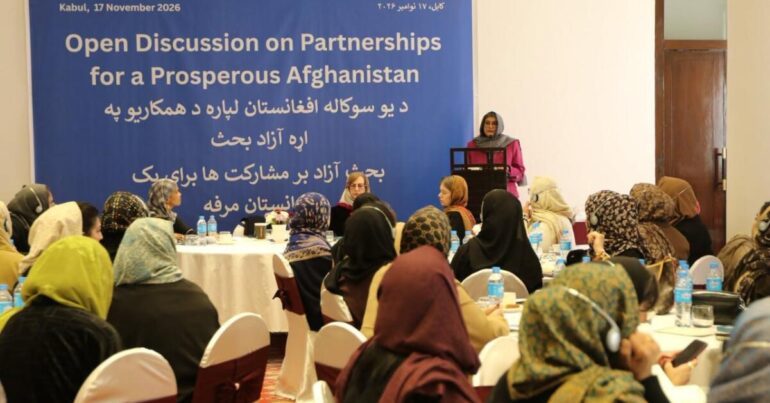

KABUL, AFGHANISTAN – Around 50 Afghan women’s rights advocates, media representatives, business leaders and community members met with the United Nations’ new envoy to Afghanistan, Rabab Fatima, in Kabul on Thursday to discuss challenges facing women and girls and ways to address them, the U.N. mission said.
In a statement, UNAMA said the gathering was held as part of its U.N.-backed Global Open Day initiative. Participants called for greater opportunities and meaningful participation for women in society, emphasizing the importance of access to education, employment and other fundamental rights.
“What will happen to Afghanistan in 20 years without educated women?” one participant asked, according to the statement.
In her remarks, Fatima, who also heads UNAMA, praised the determination of Afghan women. “Across the country, I have seen the determination, contribution and leadership of women,” she said. She emphasized that women do not want to be passive recipients of support but active participants in shaping the decisions and policies that affect their lives.
The meeting was among Fatima’s first public engagements with Afghan women since she assumed her role as the U.N. Secretary-General’s Special Representative for Afghanistan and head of UNAMA on October 18. She succeeded Roza Otunbayeva, whose term ended in September 2025.
Launched by the U.N. Security Council in 2010, Global Open Day events aim to promote dialogue between U.N. representatives and women’s organizations, highlight women’s contributions to peace and security, and support their participation in conflict prevention and resolution.
The meeting comes as the Taliban continue to enforce sweeping restrictions on women and girls since returning to power in August 2021. The authorities have barred girls from secondary schools and universities, restricted women’s access to employment and sharply curtailed their participation in public life.
The Taliban have also imposed restrictions on women’s freedom of movement and barred them from accessing public spaces, including parks and gyms.
U.N. experts, human rights organizations and activists have described the restrictions as systematic discrimination, with some characterizing them as “gender apartheid.”
U.N. experts have recently warned that the Taliban have further entrenched institutionalized gender-based repression over the past year, leaving an entire generation of girls without access to secondary education. Girls who were in sixth grade when the ban was introduced have now spent more than four years out of school.
Despite the restrictions, Afghan women and girls inside and outside the country continue to organize protests and advocacy campaigns, calling for the restoration of their rights and urging the international community to pressure the Taliban to reverse the measures.
Women’s rights activists have also called for international engagement with the Taliban to be tied to measurable progress on women’s rights, including reopening schools and universities to girls and restoring women’s right to work.