


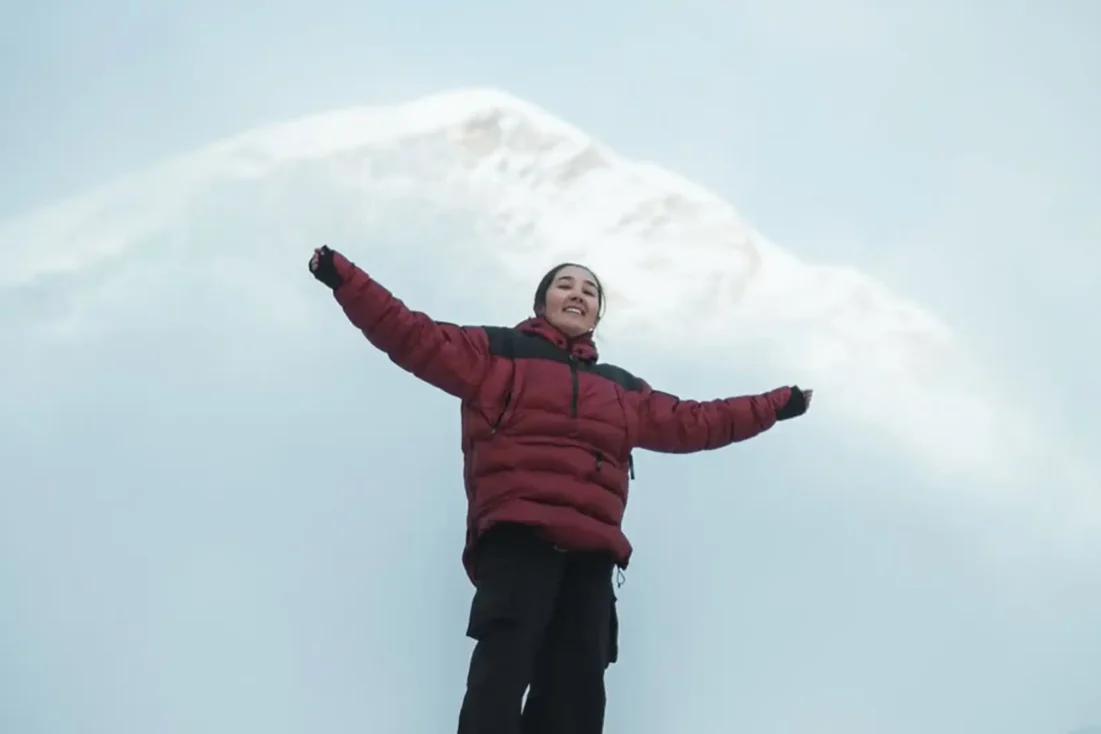
On May 21, Zakia Ahmad, known as “River,” reached the summit of Mount Everest, becoming the first woman from Afghanistan to climb the world’s highest mountain. For River, Everest was never only about climbing a mountain.
Her journey to the top of the world was shaped by war, displacement, grief and survival. Long before she reached Everest’s summit, she had spent much of her life confronting restrictions and hardship.
For many Afghans, especially women and girls living under Taliban restrictions, River’s achievement became more than a sporting milestone. It offered a rare image of possibility at a time when women in Afghanistan have been barred from education, sports and many forms of public life.
River first shared much of her personal story with Etilaatroz in an interview published in April while she was preparing for the Everest expedition. At the time, she had already climbed Mont Blanc, the highest peak in the Alps, and was training for what she described as the most difficult challenge of her life. Weeks later, she reached the summit.

Born in the 1990s in Jodari village in Jaghori district of Ghazni province, River grew up in an environment where opportunities for girls were limited from an early age. She walked for hours each day to attend school while also helping her family with livestock, farming and household work. In her interview with Etilaatroz, she recalled first becoming aware of gender restrictions as a child.
“I wanted to climb trees and jump from heights,” she said. “But my mother would stop me and say, because you are a girl, you cannot do these things.”

As she grew older, River increasingly understood how gender discrimination shaped everyday life in Afghanistan. Women worked alongside men under difficult conditions, she said, but were still denied the same freedom and opportunities. Like many girls, she was expected to accept a future shaped by social expectations and marriage.
River, however, continued to pursue her education.
After finishing school, she moved to Kabul. She studied journalism briefly at Kabul University before receiving a scholarship to continue her education in India, where she completed a bachelor’s degree in Business Administration and later studied International Relations at the master’s level. Life there was not easy. She worked night shifts at a call centre while studying during the day and helping support her family.
While studying in India, River researched the experiences of Afghan women in Delhi who, she said, were driven by poverty and displacement into exploitation. During that work, she was attacked by a masked man carrying a knife and left with a scar on her forehead. Despite the danger, she continued interviewing women and hoped to publish their stories in a book.
River later told Outside Online and New Lines Magazine that she survived a Taliban attack in 2014 while travelling to Kabul for university. According to her account, Taliban gunmen stopped the bus she was travelling on and opened fire on passengers. She survived by pretending to be dead after smearing blood across her face. Twelve passengers were killed, and she was one of only three survivors.
The trauma remained with her for years.
“I always carry that part of the attack with me,” she told New Lines Magazine. “Sometimes in my dreams I see two gunmen coming for me and trying to kill me.”
River continued with her life after the attack. But the death of her younger brother, Ahmad Wali, affected her profoundly.
In 2022, River and her family resettled in Australia on humanitarian visas. Six months later, Ahmad Wali died by suicide.
In her Etilaatroz interview, River spoke about the grief that followed. She withdrew from daily life, stopped many of her activities and experienced a period of homelessness after losing the brother to whom she had been closest.
“We only understand that his decision had a complicated background,” she said.
Before his death, Ahmad Wali and River often spoke about nature, mountains and dreams beyond the hardship they had experienced. Those conversations later became central to her mountaineering journey.
“My brother and I were very close,” she told Etilaatroz. “Most of the time, we talked about life, the future, and our shared dreams. Once, we were standing on a hill looking down below. He told me, ‘Look how beautiful nature is.’ Then he said that the Alps and Everest would be more breathtaking than anywhere else. I promised that I would accompany him in climbing them.”
After his death, River said those memories remained with her.
“My grief and hardships had crushed me,” she said. “The mountains were my last refuge… When I returned to the mountains, I felt they accepted me with all my sorrow, and I found my lost self again.”
Mountaineering became a way for her to return to life after loss.
At first, climbing was not about records or recognition. The mountains gave her a place to process grief and regain a sense of purpose.
In Australia, River began training seriously while balancing work and financial pressure. Mountaineering required significant physical endurance, preparation and financial resources, but she continued.
Before Everest, River climbed several peaks in Nepal and Europe, including Mont Blanc, the highest mountain in the Alps. The ascent gave her confidence that the dream she had once shared with her brother might be possible.
For River, Everest also carried a message for women and girls in Afghanistan, whose lives have been increasingly restricted under Taliban rule.
Before leaving for Everest, River told Etilaatroz that her message to women in Afghanistan was that they should not stop pursuing their aspirations.
“Everyone has abilities,” she said. “With effort and perseverance, they can reach their dreams.”
Preparing for Everest required months of training, fundraising and sacrifice. Before attempting the summit, she climbed other peaks in Nepal to prepare for high altitude and harsh conditions.
On May 21, the goal she had described to Etilaatroz became reality.
Zakia Ahmad “River” reached the summit of Mount Everest, becoming the first woman from Afghanistan to stand on the world’s highest peak.

Her ascent carried meaning far beyond mountaineering. As she told Etilaatroz before the expedition: “Like many women in Afghanistan, I have faced many hardships. But I never stopped.”

