

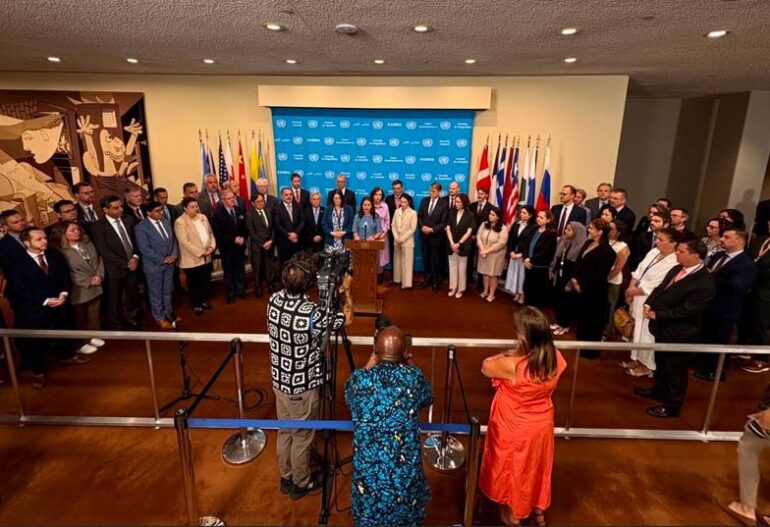

KABUL, AFGHANISTAN – A coalition of 56 United Nations member states and the European Union on Friday called on the Taliban to respect human rights, reverse discriminatory policies and restore girls’ access to education.
In a joint statement marking the fifth anniversary of the Taliban’s takeover of Afghanistan and delivered by Denmark’s permanent representative to the UN, the countries said Afghanistan continues to face serious human rights, humanitarian, economic and security challenges.
The statement described the Taliban’s treatment of women and girls as a defining feature of its rule, noting that Afghanistan remains the only country in the world where girls are barred from secondary and higher education.
The countries said the Taliban’s system of decrees and policies had further entrenched discrimination and weakened legal protections for women and girls.
“We once again call on the Taliban to reverse all discriminatory decrees and policies,” the statement said, urging the authorities to restore girls’ access to education and ensure the “full, equal, meaningful and safe” participation of women in all aspects of Afghan society.
The countries also said the absence of inclusive governance continues to undermine prospects for lasting peace and stability. Humanitarian needs remain acute, human rights abuses persist, and terrorist groups continue to threaten the Afghan people as well as regional and international security.
They stressed that terrorism in all its forms constitutes one of the most serious threats to peace and security and demanded that Afghan territory not be used to threaten or attack any country, plan or finance terrorist acts, or shelter and train terrorists. The countries called on the Taliban to take active measures to combat terrorism, including against individuals and groups designated by the U.N. Security Council.
The statement highlighted restrictions on the UN operation in Afghanistan, including the Taliban’s prohibition on Afghan female U.N. staff. Such restrictions, it said, are undermining the U.N.’s ability to deliver critical assistance to the Afghan people.
They stressed that humanitarian aid alone could not resolve Afghanistan’s crisis. The Taliban must create the conditions for Afghans to rebuild their lives with dignity, human rights, inclusive governance and security.
The statement was endorsed by countries including the United States, Britain, France, Germany, Canada, Japan, Australia, Denmark, Sweden, Norway, the United Arab Emirates, Ukraine, and South Korea, as well as the European Union.
The countries renewed their commitment to keeping Afghanistan high on the international agenda, working through the UN, and standing with the Afghan people in their quest for a future built on rights, inclusion, opportunity and security.
August 15 marks five years since the Taliban returned to power following the withdrawal of international forces and the collapse of Afghanistan’s former government in 2021. Since then, the group has imposed sweeping restrictions on women and girls, including bans on secondary and higher education, most forms of employment and access to public spaces such as parks and gyms.
The international community, particularly Afghanistan’s neighbours, also remains concerned about the presence and activities of multiple militant groups in the country, warning of risks to regional and international security.
Despite repeated calls from the United Nations, rights groups, activists and governments to reverse restrictions on women and girls and take action against militant groups, the Taliban has maintained its policies while denying that terrorist groups operate from Afghan territory.

