
KABUL, AFGHANISTAN – The European Union has called for the unconditional reversal of the Taliban’s discriminatory policies against women and girls in Afghanistan, condemning widespread human rights violations and severe gender-based discrimination under the group’s rule.
In a statement published on the EU’s website, the bloc said the Taliban’s restrictions had significantly worsened the situation of women and girls by severely limiting their participation in public life and denying them fundamental human rights, including access to education, employment and freedom of movement.
The EU expressed deep concern over the further deterioration of women’s and girls’ rights in 2026, particularly the continued exclusion of girls from general education beyond grade six. It said Afghanistan remained the only country where girls were systematically barred from secondary and higher education, a policy affecting more than 2.2 million girls.
The bloc called for the unconditional reversal of these discriminatory policies, stressing that the restrictions continued to deprive Afghan women and girls of opportunities to learn, work and participate fully in society.
The statement was issued by the EU delegation to the Organisation for Economic Co-operation and Development (OECD) and UNESCO in connection with UNESCO’s efforts to support Afghans at the organisation’s 225th Executive Board session.
The EU welcomed UNESCO’s efforts to provide alternative educational opportunities for Afghan women and girls, while emphasising that such programmes, although essential under the current circumstances, could not replace formal, inclusive and quality education.
The statement also highlighted the EU’s support for economic empowerment in Afghanistan. In 2025, the bloc launched a project worth €4.7 million in cooperation with UNESCO to strengthen economic opportunities through skills development and literacy education.
The EU further reaffirmed its strong support for independent Afghan media, civil society organisations, groups working on human rights and women’s rights, and human rights defenders, despite what it described as an increasingly restrictive and dangerous operating environment for these groups.
The statement also raised concerns over threats to Afghanistan’s cultural heritage, continued illegal excavations and the illicit trafficking of cultural property. It expressed particular concern about the safety of cultural-sector workers, especially women.
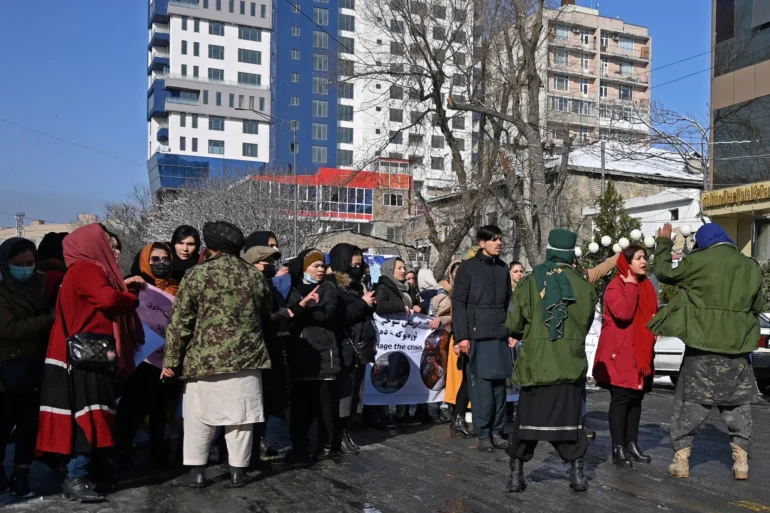
Since returning to power in August 2021, the Taliban have introduced a series of restrictions that have progressively excluded women and girls from education, employment and public life. Girls have been barred from attending secondary schools beyond grade six, while women have been prohibited from attending universities and restricted from working in many sectors, including parts of the humanitarian and non-governmental organisation workforce.
The restrictions have also affected women’s access to public spaces, travel and essential services, with rules and enforcement varying across different areas and circumstances. International organisations and human rights groups have repeatedly called on the Taliban to reverse these measures and restore women’s and girls’ fundamental rights.
UNESCO and other international organisations have continued to support alternative learning programmes, literacy initiatives and skills training for Afghans who have been excluded from formal education. However, these programmes cannot provide access to the full range of qualifications and opportunities available through a functioning education system.
The EU’s latest statement underscores continued international concern over Afghanistan’s education and human rights crisis. The restoration of girls’ access to education, women’s right to work and their meaningful participation in public life remain central demands of international human rights advocates.