
KABUL, AFGHANISTAN – The women of Afghanistan have been awarded the prestigious 2026 Chatham House Prize in recognition of their courage and resilience in the face of systematic gender-based persecution under Taliban rule.
The London-based international affairs institute announced the award in a post on X on Monday, saying it recognized the collective resistance of Afghan women and their determination to defend their rights despite growing restrictions.
“The Chatham House Prize recognizes the women of Afghanistan for their collective resistance and their continued efforts to advance equality and opportunity for future generations,” Chatham House said. “Their actions have become a powerful symbol of resilience and determination in the face of unprecedented challenges,” it added.
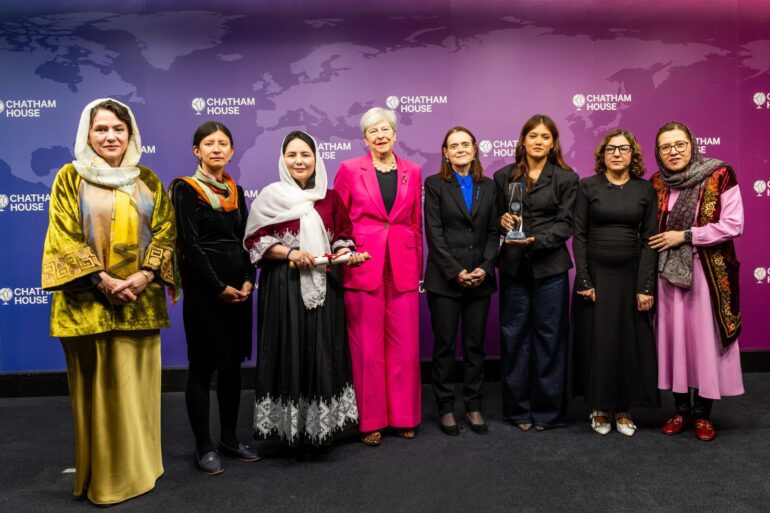
The award was presented by former British Prime Minister and Chatham House President Theresa May to Elaha Safdari, a former goalkeeper for Afghanistan’s women’s national football team, who accepted it on behalf of women of Afghanistan.
Several other Afghan women activists also attended the ceremony in London on Monday, November 9, where they discussed the challenges facing Afghan women and possible responses from the international community.
Chatham House, formally known as the Royal Institute of International Affairs, is a London-based policy institute focused on international affairs and geopolitical challenges.
The prize, established in 2005, is awarded annually to an individual, group or organization judged to have made a significant contribution to improving international relations. Recipients are selected by a vote of Chatham House members following nominations from the institute’s staff.
Previous recipients include Ukrainian President Volodymyr Zelenskyy, the medical humanitarian organization Doctors Without Borders and the Committee to Protect Journalists.
Since returning to power in August 2021, the Taliban have imposed sweeping restrictions on women and girls, barring them from secondary and higher education, restricting their access to employment and limiting their participation in public life.
The authorities have also restricted women’s freedom of movement and barred them from accessing public spaces, including parks and gyms. UN experts, human rights organizations and activists have described the policies as systematic discrimination, with some characterizing them as “gender apartheid.”
UN experts have recently warned that the Taliban have further entrenched institutionalized gender-based repression over the past year, and that a generation of girls has now been denied secondary education.
Afghan women and girls inside and outside the country continue to protest and campaign for the restoration of their rights, urging the international community to pressure the Taliban to lift restrictions and respect their fundamental rights.