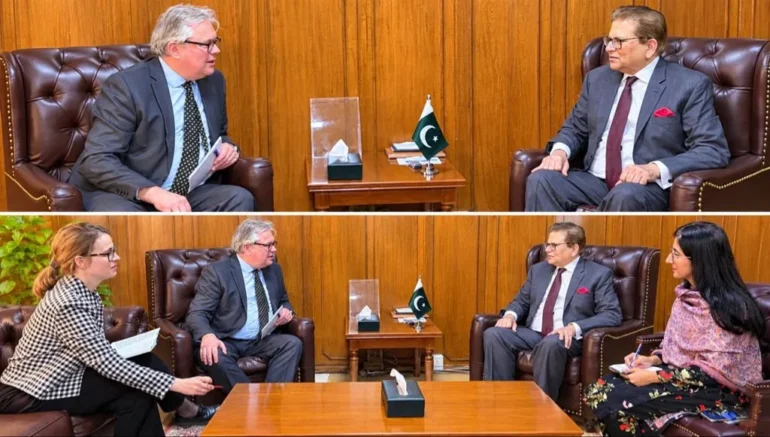

KABUL, AFGHANISTAN – Mohammad Sadiq, Pakistan’s special representative for Afghanistan, says he has discussed regional developments and the presence of terrorist groups in Afghanistan with the Dutch ambassador to Pakistan and a senior official from the Netherlands’ Ministry of Foreign Affairs.
Sadiq said in a post on X on Thursday (November 26) that he met Robert Jan Siegert, the Dutch ambassador to Pakistan, and Aline Botger, head of the South Asia division at the Dutch Ministry of Foreign Affairs.
He said the discussions covered issues of mutual interest, regional developments and the presence of a large number of terrorist groups in Afghanistan, citing reports by various international organizations, including the United Nations.
Sadiq did not provide further details about the meeting or specify which organizations’ reports were discussed.
The Dutch Embassy in Islamabad has not publicly commented on the meeting.
The meeting comes amid continued tensions between Pakistan and the Taliban over Islamabad’s allegations that militant groups, particularly the Tehreek-e-Taliban Pakistan (TTP), are operating from Afghan territory and launching attacks inside Pakistan.
Pakistani officials have repeatedly claimed that more than 20 militant groups, including the TTP, the Balochistan Liberation Army (BLA), al-Qaeda and Islamic State Khorasan Province (ISKP), are present in Afghanistan. Islamabad maintains that these groups use Afghan territory to organize and carry out attacks against Pakistan.
The Taliban authorities have rejected the allegations, insisting that they do not allow any group to use Afghanistan’s territory to threaten other countries.
Relations between Pakistan and the Taliban have deteriorated significantly since the Taliban returned to power in August 2021. Islamabad has repeatedly accused the Taliban of providing shelter to TTP members, while the group has intensified attacks against Pakistani security forces and government institutions. The Taliban have consistently denied supporting the group or allowing it to use Afghan territory for attacks against other countries.
Tensions escalated into deadly border clashes in October 2025 and further intensified in 2026, with Pakistani airstrikes and retaliatory actions by Taliban forces. The prolonged closure of major border crossings has also disrupted trade, transport and the movement of people between the two countries.
The meeting also comes amid continuing diplomatic efforts by regional and international actors to ease tensions between Pakistan and the Taliban authorities and prevent further escalation along their shared border.
Earlier, on November 14, Richard Lindsay, the United Kingdom’s Special Representative for Afghanistan, told Mullah Abdul Wasi, head of the Taliban prime minister’s office, during a video conference that Britain was consulting both the Taliban and Pakistani officials to help resolve their disputes and normalize relations.
According to Hamdullah Fitrat, the Taliban’s deputy spokesperson, Lindsay also said he planned to visit Pakistan to discuss the issues with Pakistani officials and help create conditions for negotiations.
Two days later, on November 16, Lindsay met Stephan Rey, Switzerland’s ambassador to Pakistan, and Sigvald Hauge, Norway’s ambassador to the country, at the Swiss Embassy in Islamabad. The diplomats exchanged views on developments in Afghanistan and their regional implications.
Rey said stability in Afghanistan was in the interest of the entire region and required sustained international engagement, coordination among international partners and continued dialogue with regional countries.
These meetings followed several other diplomatic initiatives aimed at reducing tensions between Afghanistan and Pakistan.
In October 2025, Qatar and Türkiye mediated negotiations between the two sides in Doha, where they agreed to a ceasefire following deadly border clashes. The two countries subsequently hosted another round of talks in Istanbul from October 25 to 30 to consolidate the truce and establish a mechanism to monitor violations.
However, the negotiations failed to produce a comprehensive agreement, with disagreements over Pakistan’s security demands and the activities of militant groups remaining unresolved.
Saudi Arabia also became involved in mediation efforts. In December 2025, representatives of the Taliban and Pakistan held talks in Saudi Arabia and reportedly agreed to maintain the ceasefire. The discussions were initiated by Riyadh, according to officials cited by Reuters.
In November 2025, Iran also announced efforts to organize a regional meeting to address tensions between the two sides. Iranian Foreign Minister Abbas Araghchi said Tehran had held consultations with officials in Kabul and Islamabad and discussed the proposed initiative with the foreign ministers of Russia, Qatar and Türkiye. Russia also expressed readiness to support diplomatic efforts to reduce tensions.
China subsequently facilitated another round of negotiations. Representatives from China, Pakistan and the Taliban authorities held week-long informal talks in Urumqi, Xinjiang, from April 1 to 7, 2026. According to China’s Foreign Ministry, the participants agreed to continue discussions on a comprehensive plan to address their differences and improve bilateral relations. They also agreed to avoid actions that could further escalate tensions along their shared border.
In March 2026, Saudi Arabia, Qatar and Türkiye also called for de-escalation and helped facilitate a temporary Eid al-Fitr ceasefire. Saudi Arabia, Qatar and Jordan welcomed the truce and urged both sides to pursue diplomatic solutions and work towards a lasting end to hostilities.
Despite these repeated initiatives, relations between Pakistan and the Taliban authorities have remained strained, with further military confrontations, airstrikes and border closures reported during 2026.
Pakistan’s central demand has been for the Taliban authorities to take verifiable action against militant groups allegedly operating from Afghan territory. The Taliban, meanwhile, have called for respect for Afghanistan’s sovereignty and rejected Islamabad’s accusations.
The prolonged closure of major border crossings, including Torkham and Spin Boldak, has also disrupted bilateral trade, commercial transportation and the movement of people, causing economic losses and hardship for communities on both sides.
The latest meeting between Pakistan’s special representative and Dutch officials adds to the growing number of international diplomatic contacts concerning Afghanistan’s security situation and its implications for regional stability. However, despite mediation efforts by several countries, a lasting resolution to the disputes between Pakistan and the Taliban authorities has yet to be reached.