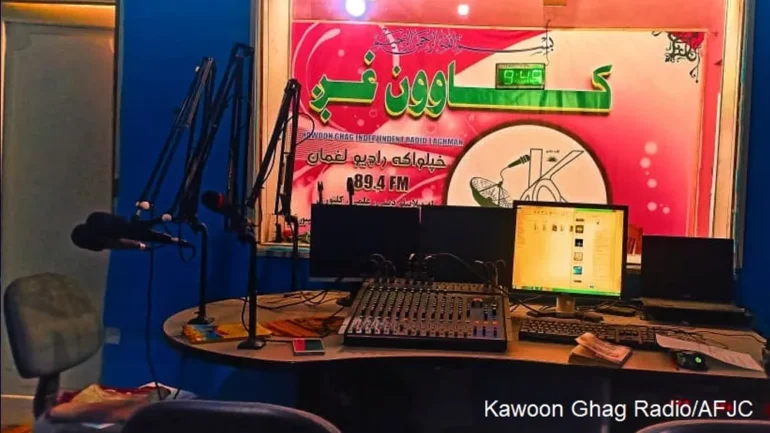

KABUL, AFGHANISTAN – The International Federation of Journalists (IFJ) says Taliban morality police officials raided the office of Kawoon Ghag Radio in eastern Laghman province, temporarily detaining and questioning four female journalists, the station’s manager and its broadcasting officer.
In a statement on Wednesday, November 25, the IFJ said the six media workers had been detained on November 14 and released after two hours of questioning.
According to the federation, the media workers were preparing equipment to record a programme examining the economic situation of women journalists working in Afghanistan’s media sector when Taliban officials raided the radio station.
The Afghan Independent Journalists’ Association (AIJA), an IFJ affiliate, said Taliban officials cited regulations requiring female journalists to work in separate environments without the presence of men to justify the detention.
The IFJ condemned the arrests, describing them as part of the Taliban’s continued crackdown on media outlets and journalists in Afghanistan. The federation called for the protection of freedom of expression and urged authorities to ensure the safety and freedom of all Afghan journalists.
This was not the first time the radio station had come under pressure from the Taliban. In June 2024, Taliban officials raided Kawoon Ghazh Radio’s office and suspended its activities.
Since returning to power in August 2021, the Taliban have imposed increasingly restrictive rules on media organisations and journalists. Female journalists have faced restrictions on their appearance and working conditions, including requirements to wear face masks while presenting programmes and to work separately from male colleagues.
Taliban forces have also repeatedly raided media offices, suspended broadcasting operations and detained journalists and other media employees.
The incident comes amid a broader deterioration in press freedom in Afghanistan since the Taliban returned to power in August 2021. The Taliban have introduced restrictions on media content, access to information and journalists’ working conditions, with women journalists facing particularly severe limitations.
According to Reporters Without Borders (RSF), more than two-thirds of Afghanistan’s journalists have left the profession since the Taliban takeover, while eight out of every ten women journalists have been forced to stop working. Those who remain face restrictions including workplace segregation, mandatory face coverings and limitations on travelling or appearing in public media.
The Taliban’s Law on the Promotion of Virtue and Prevention of Vice, introduced in August 2024, has further intensified restrictions. The law prohibits women’s voices from being heard outside their homes, a provision that has raised serious concerns about the future of women’s participation in radio and television broadcasting. In some provinces, Taliban officials have used these rules to restrict or ban the broadcasting of women’s voices.
Afghanistan ranked 175th out of 180 countries in RSF’s 2026 World Press Freedom Index, reflecting the severe constraints facing independent journalism under Taliban rule.
Kawoon Ghag Radio has also faced previous interference. In June 2024, Taliban intelligence officials entered its office in Mehtarlam, the provincial capital of Laghman, and shut down the station. The Afghanistan Journalists Center reported at the time that the authorities had claimed the station belonged to the government.