
KABUL, AFGHANISTAN – German Foreign Minister Johann Wadephul has said that Germany has no “real relationship” with the Taliban and does not recognise the group as Afghanistan’s legitimate government.
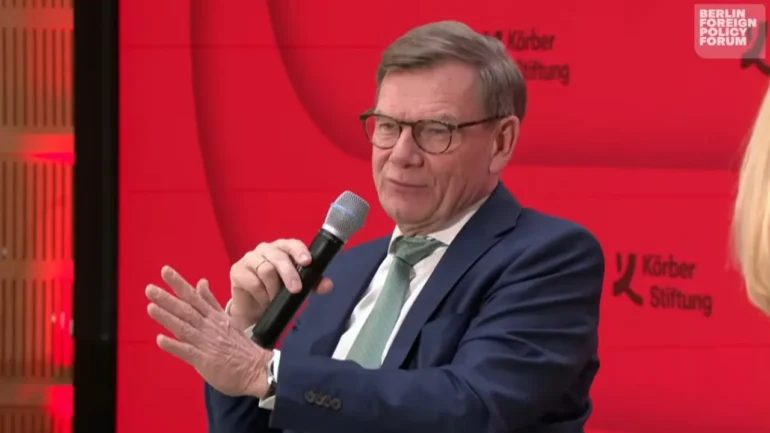
Speaking on Tuesday, November 24, at the Berlin Foreign Policy Forum, organised by the Körber Foundation, Wadephul addressed Germany’s relations with the Taliban during a question-and-answer session.
He said Germany’s contacts with the group were limited to consular and humanitarian matters and did not constitute diplomatic recognition.
Wadephul described Afghanistan as a country with which Germany cannot maintain conventional diplomatic relations, stressing that Berlin does not recognise the Taliban as its legitimate political authority. He said Germany’s limited engagement with the group is restricted to consular matters and is conducted through neighbouring countries.
The German foreign minister also said that humanitarian assistance for Afghanistan was being delivered through neighbouring countries.
Germany was the first European country to engage with the Taliban by allowing representatives of the group to take up positions at Afghanistan’s diplomatic missions in Berlin and Bonn.
Initially, Germany accepted two Taliban-appointed consular officials at the Afghan Embassy in Berlin and the country’s Consulate General in Bonn. Last week, reports that four additional Taliban representatives had been approved to enter Germany also sparked controversy.
Berlin has consistently described its engagement with the Taliban as technical, arguing that cooperation is necessary to facilitate the deportation of Afghan nationals from Germany.
Following Germany, Austria, Switzerland and Belgium also hosted Taliban delegations, while the governments of France and the United Kingdom have recently entered into discussions with the group. In June, the EU hosted a Taliban delegation in Brussels to discuss practical arrangements, including potential cooperation on deportation procedures.
Over the past three days, the foreign ministers of Germany, France and Spain have made similar statements, assuring the public that their governments do not recognise the Taliban as Afghanistan’s legitimate government.
The Taliban returned to power in Afghanistan on August 15, 2021, following the collapse of the former Afghan government and the withdrawal of international forces. Germany subsequently closed its embassy in Kabul and suspended its regular diplomatic engagement with the country.
Since then, Germany has maintained its position that the Taliban administration is not Afghanistan’s legitimate government. However, Berlin has gradually established limited practical contacts with Taliban representatives, particularly over consular services, the documentation of Afghan nationals and deportations.
In 2025, Germany allowed two Taliban-appointed consular officials to work at Afghan diplomatic missions in Berlin and Bonn. The decision marked a significant development in European engagement with the group, although the German government maintained that accepting consular officials did not amount to recognising the Taliban administration.
The issue has become increasingly controversial as Germany expands deportations to Afghanistan. In September, Germany deported 13 Afghans to Kabul. Earlier, 30 Afghan men were returned on June 16, followed by another 31 on July 28. A charter flight carrying 23 Afghan men arrived in Kabul on August 25.
In addition to security-related concerns, the presence of Taliban representatives at Afghan diplomatic missions has raised questions about the safety and rights of Afghan refugees and asylum seekers who may be required to approach these offices for consular services.
Meanwhile, the Taliban continue to impose sweeping restrictions on women and girls, including bans on secondary and university education, restrictions on employment and limitations on women’s participation in public life. International human rights organisations have described these measures as systematic persecution and called for greater international accountability.
Germany’s position therefore reflects a growing dilemma for European governments: how to maintain necessary technical and humanitarian contacts with the Taliban without granting the group political legitimacy or undermining international efforts to hold it accountable for human rights violations.