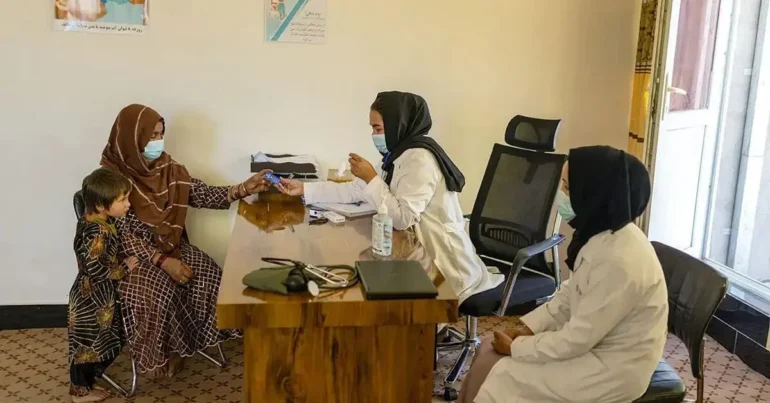

KABUL, AFGHANISTAN – The United Nations has warned that an estimated 22 million women and girls in Afghanistan face a growing long-term risk of losing access to essential healthcare services as Taliban restrictions and declining humanitarian funding continue to undermine the country’s healthcare system.
UN officials raised the alarm during a press briefing in Geneva on Friday, November 20, saying that the escalating restrictions on women’s rights and freedoms, combined with severe cuts to humanitarian assistance, are preventing an increasing number of Afghan women and girls from accessing life-saving healthcare.
According to UN Women, the Taliban have issued more than 100 decrees and directives restricting women’s movement outside their homes and access to education and employment. These restrictions, alongside the reduction in international humanitarian funding, have significantly worsened the situation for women and girls across the country.
Sophia Calltorp, chief of humanitarian action at UN Women, warned that the risk of 22 million Afghan women and girls being deprived of healthcare in the long term is increasing.
During a recent visit to Afghanistan, Calltorp said she met a woman in Kunar province who had experienced several miscarriages without receiving medical care.
“One woman that I met in Kunar told me that she had suffered multiple miscarriages without access to healthcare. I also met with men who spoke of restrictions preventing them from supporting women,” she said.
Calltorp also described the difficult circumstances facing women displaced by natural disasters and conflict. She said she had met women spending their second winter away from home after losing their houses and belongings in last year’s earthquake.
Many of these women have also experienced further displacement as a result of clashes between Afghanistan and Pakistan and severe flooding in recent months, she added.
The UN said reductions in humanitarian funding have forced the closure or suspension of nearly 300 humanitarian health facilities across Afghanistan, affecting more than one million women and girls.
More than 193 centres providing support to survivors of gender-based violence have also closed, leaving over one million women and girls without access to essential protection and support services.
In addition, approximately 3.4 million women and girls in need are now likely to lose access to essential water, sanitation and hygiene services.
Calltorp said these services are critical but cannot compensate for the consequences of Taliban restrictions, which have dismantled protection mechanisms against violence and abuse within households.
Women “continue to find ways to survive, to care for their families, to support one another and to hold on to hope (but) we cannot accept this as normal”, Ms. Calltorp insisted.
UN Women also warned that approximately 2.6 million girls have been deprived of access to education in Afghanistan. The agency said the continued exclusion of girls from education could increase child marriage and contribute to higher maternal mortality rates.
Susan Ferguson, UN Women’s Special Representative in Afghanistan, described the situation as the world’s worst crisis of women’s rights, saying Afghan women are increasingly struggling to survive under the restrictions imposed by the Taliban.
She said declining humanitarian funding has forced aid organisations to make extremely difficult decisions about which women and girls can receive assistance and which must be turned away.
Ferguson called on governments and international donors to maintain and increase their financial support for Afghan women and girls.
“I urge all governments and other international donors to stand with us and with Afghan women and girls. Stay the course and increase, not cut, your support. Back these women,” Ms. Ferguson stressed.
The UN officials stressed that humanitarian assistance remains essential to preventing further deterioration of women’s living conditions and ensuring access to basic services.
The growing healthcare crisis comes amid a series of Taliban restrictions introduced since the group returned to power in August 2021. Girls have been barred from attending secondary schools beyond grade six, while women have been excluded from universities and most forms of employment. The restrictions have also affected women’s ability to travel without a male guardian and participate in public life.
In December 2024, the Taliban authorities further restricted women’s access to medical education by barring them from attending medical training institutions, including nursing and midwifery programmes. The decision has raised concerns about the future availability of female healthcare professionals in a country where many women face restrictions on receiving treatment from male medical workers.
According to a UN report on women’s and girls’ right to health in Afghanistan, the restrictions on medical education have weakened the country’s healthcare workforce and threaten the long-term provision of essential health services. Afghanistan already faces a severe shortage of qualified female medical professionals, making the training of new doctors, nurses and midwives particularly important.
The crisis has also been compounded by declining international humanitarian assistance, economic hardship, natural disasters and the return of millions of Afghans from neighbouring countries, particularly Iran and Pakistan. These pressures have increased demand for healthcare, shelter, food and other essential services while humanitarian organisations face growing funding shortages.
The latest warning from UN Women highlights the combined impact of Taliban policies and the reduction in international assistance on the health and survival of Afghan women and girls. The UN has called for increased humanitarian funding and continued international support, warning that without urgent action, millions more could lose access to essential healthcare and protection services.