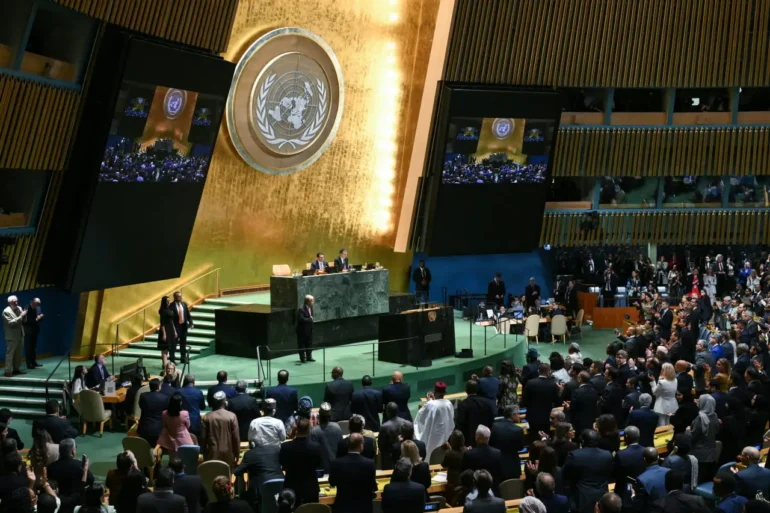

KABUL, AFGHANISTAN – Afghanistan’s diplomatic missions to the United Nations in Geneva, New York and Vienna have marked the 80th anniversary of the country’s membership in the organisation, stressing that Afghanistan’s place at the UN belongs to its people and should not be associated with any particular government or political ideology.
In a joint statement issued on Wednesday, November 18, the missions, together with former Afghan ambassadors and permanent representatives, said the anniversary was an opportunity to recognise eight decades of Afghanistan’s contributions to international diplomacy and reaffirm the country’s international commitments.
Afghanistan joined the United Nations on November 19, 1946, becoming one of the organisation’s early members. To commemorate the occasion, the three diplomatic missions organised an online event titled Afghanistan and the United Nations: Eight Decades of Engagement, Contributions and Lessons for the Future.
The event brought together former Afghan ambassadors and permanent representatives who had served in New York, Geneva and Vienna, as well as current and former diplomats, civil society representatives, academics, students and other participants from Afghanistan and abroad.
According to the statement, the commemoration reviewed Afghanistan’s diplomatic history through archival photographs, significant historical events and excerpts from speeches delivered by former Afghan ambassadors. Participants also discussed the country’s contributions to various UN forums, its diplomatic initiatives and international partnerships, and the role of the organisation in Afghanistan during periods of political transformation, conflict and reconstruction.
The discussions also addressed the achievements and limitations of the United Nations in Afghanistan, highlighting the importance of learning from past international engagement and recognising the contributions of pioneering Afghan women diplomats.
The missions and participating former ambassadors emphasised that Afghanistan’s membership of the United Nations represents the country and its people rather than any particular administration.
“Afghanistan’s place at the United Nations belongs to its people,” the statement said, adding that their will must be reflected through legitimate, inclusive and accountable governance in accordance with the UN Charter, international law and the international conventions to which Afghanistan is a party.
They also criticised the Taliban’s restrictions on fundamental rights and freedoms, particularly those affecting women and girls, arguing that the country’s international identity and commitments remain intact despite the current political situation.
The statement called on the international community to support an Afghan-led and UN-facilitated political process aimed at establishing legitimate, inclusive and accountable governance. It stressed that such a process must ensure the full, equal and meaningful participation of women, young people, civil society groups and ethnic and religious minorities.
The missions further warned against international engagement that could normalise the exclusion of women and girls and other groups from public life, urging the United Nations to respond more effectively to Afghanistan’s ongoing crisis.
A major concern raised during the commemoration was the continued exclusion of Afghan women employees from United Nations offices in Afghanistan. The missions said Afghan women national staff had been prevented from entering UN premises and performing their duties since September 2025, describing the restriction as a violation of their professional rights and dignity and the principles of equality and non-discrimination enshrined in the UN Charter.
The statement urged the United Nations to take clear and coordinated action to ensure that Afghan women employees can return to their workplaces without discrimination.
The UN Assistance Mission in Afghanistan (UNAMA) confirmed in September 2025 that Taliban security forces had prevented Afghan female UN employees and contractors from entering UN compounds in Kabul on September 7. The restriction was subsequently extended to UN offices across the country. The UN warned at the time that the measure could undermine humanitarian operations, particularly assistance delivered to women and girls.
The statement also called for greater openness, dialogue and cooperation, saying Afghanistan’s diplomatic legacy should guide its future relations with the international community. It emphasised the importance of building an Afghanistan at peace with itself and its neighbouring countries.
Afghanistan officially became a UN member on November 19, 1946, alongside Iceland and Sweden, following the General Assembly’s decision to admit the three countries. At the time, the organisation had 55 member states. Afghanistan’s admission was among the first expansions of UN membership after the organisation was established in 1945.
The country’s diplomatic representation at the United Nations, however, has remained disputed since the Taliban returned to power in August 2021. The Taliban authorities have repeatedly sought to have their nominated representatives occupy Afghanistan’s seat, but the UN General Assembly’s Credentials Committee has repeatedly postponed a decision on competing claims to represent the country. Consequently, diplomats appointed under the former Afghan government have continued to represent Afghanistan at the organisation.
The United Nations continues to operate in Afghanistan through its agencies and the United Nations Assistance Mission in Afghanistan, which was established on March 28, 2002, under Security Council Resolution 1401. Its mandate includes supporting peace and stability, human rights, political engagement and humanitarian coordination.
The 80th anniversary comes amid continuing political and human rights challenges in Afghanistan, particularly the systematic restrictions imposed by the Taliban on women’s education, employment and participation in public life.
The anniversary statement therefore places renewed emphasis on the distinction between Afghanistan as a member state of the United Nations and the authorities currently governing the country, arguing that the country’s international identity, commitments and representation should reflect the rights and aspirations of its people.