
KABUL, AFGHANISTAN – The number of confirmed polio cases in Afghanistan has reached 50 since the beginning of 2026, according to figures released by the World Health Organization (WHO).
The WHO’s polio surveillance reports show that eight new cases were reported in Afghanistan during epidemiological week 43, ending on November 1. The cases were recorded in Helmand, Baghlan, Nangarhar, Farah and Kandahar provinces.
Three cases were reported in the districts of Nahr-e-Saraj, Baghran and Kajaki in Helmand province, while two were recorded in Dahana-e-Ghori district of Baghlan. One case was reported in Surkh Rod district of Nangarhar, another in Farah city, the provincial capital, and one in Spin Boldak district of Kandahar.
With these additional cases, the total number of confirmed polio infections in Afghanistan increased from 42 to 50.
The WHO report also recorded 16 positive environmental samples during the week ending November 1. These included five samples from Nangarhar, four from Helmand, four from Kandahar, two from Kabul and one from Paktika. The samples were collected from sewage systems, indicating the continued circulation of the poliovirus in the environment. This brings the total number of positive environmental samples detected in Afghanistan in 2026 to 109.
Meanwhile, the WHO reported one human polio case and 11 positive environmental samples in Pakistan’s Khyber Pakhtunkhwa and Balochistan provinces during the same week. Both provinces share borders with Afghanistan.
In the following epidemiological week, ending November 8, one additional human case was reported in Khyber Pakhtunkhwa, along with three positive environmental samples, including two from Karachi and one from Quetta.
Pakistan’s total polio count for 2026 has reached nine human cases and 151 positive environmental samples, according to the WHO.
No new human or environmental polio cases were reported in Afghanistan during the week ending November 8.
In 2025, Afghanistan recorded 21 human polio cases, while Pakistan reported 31 cases.
Afghanistan and Pakistan remain the only two countries in the world where wild poliovirus has not yet been eradicated.
Difficulties in implementing vaccination programmes are considered a major obstacle to polio eradication efforts in both neighbouring countries.
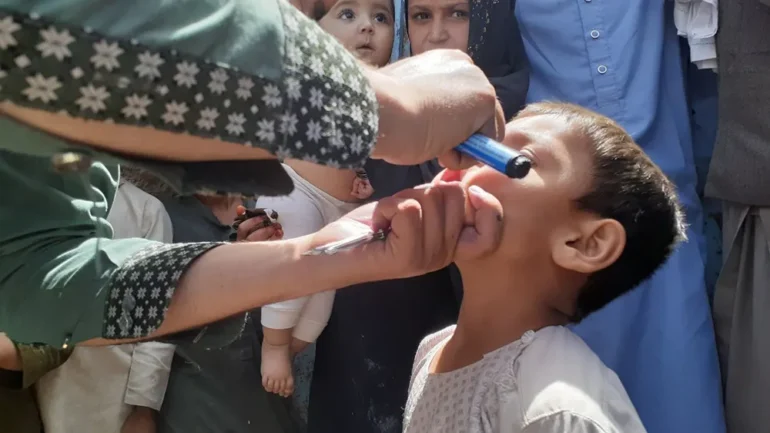
In Afghanistan, the Taliban have banned house-to-house polio vaccination campaigns, a method considered effective in reaching children who might otherwise miss routine immunisation. The restrictions have made it more difficult for health workers to ensure that all children receive the necessary vaccine doses.
The large-scale return of Afghan migrants from neighbouring countries, particularly Pakistan, and the population movements resulting from these returns are also considered factors contributing to the spread of the poliovirus.
Polio is a highly infectious viral disease that primarily affects children under the age of five. It spreads mainly through the faecal-oral route and can cause irreversible paralysis. Although there is no cure for the disease, it can be prevented through vaccination. The WHO and its partners continue to support vaccination and surveillance programmes in Afghanistan and Pakistan as part of global efforts to eradicate the disease.