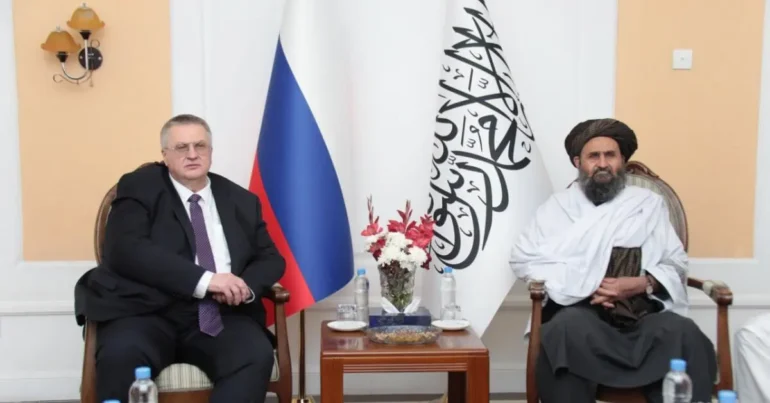

KABUL, AFGHANISTAN – Russian Deputy Prime Minister Alexei Overchuk has met with senior Taliban officials in Kabul as part of a high-level visit aimed at expanding economic and trade relations between Russia and Afghanistan.
Overchuk, who arrived in Kabul on Thursday, November 12, was accompanied by a 130-member delegation comprising representatives of Russian federal ministries and government agencies, as well as investors, businesspeople and industrialists.
During his visit, Overchuk met with Taliban Prime Minister Mullah Mohammad Hassan Akhund at the Gul Khana Palace, where the two sides discussed bilateral relations and opportunities for economic cooperation.
According to a statement issued by the Taliban prime minister’s office, Akhund claimed that security and stability in Afghanistan had created favourable conditions for investment and opened up opportunities for cooperation between the two countries.
Referring to Russia’s formal recognition of the Taliban government, Akhund said the decision demonstrated Moscow’s confidence in Afghanistan’s future. He also thanked Russia for its support, saying it would create further opportunities for the country’s development.
Overchuk, according to the statement, praised what he described as improvements in security, stability and development in Afghanistan and expressed Russia’s interest in investing in various sectors.
The Taliban prime minister’s office added that approximately 70 representatives of Russia’s private sector were accompanying Overchuk to hold discussions with Taliban ministries and government institutions on trade agreements, investment arrangements and removing obstacles to economic cooperation.
Earlier on Thursday, Overchuk also met with Abdul Ghani Baradar, the Taliban deputy prime minister for economic affairs.
According to a statement from Baradar’s office, the discussions focused on expanding economic and trade relations, joint investments and practical cooperation between the two sides.
Baradar invited Russian companies to invest in Afghanistan’s mining, oil and gas, energy, manufacturing, agriculture, healthcare, telecommunications and infrastructure sectors, describing the country as having considerable economic and investment potential.
He also called on Russia to facilitate access for Afghan export products to Russian markets, reduce transportation and transit costs, and simplify customs procedures.
Baradar further urged Moscow to increase imports of Afghan agricultural products, particularly pine nuts, saffron, pomegranates, grapes and cotton. He also requested the facilitation of long-term Russian visas for Afghan businesspeople.
According to the Taliban economic deputy prime minister’s office, Overchuk described the Taliban administration as an important regional partner and expressed Moscow’s willingness to expand cooperation, particularly in trade and economic affairs.
He reportedly said bilateral trade had increased recently and that Russia was prepared to purchase more Afghan agricultural products. He also expressed interest in investing in mining, electricity generation, pharmaceutical production, industry, infrastructure, agriculture and healthcare.
The visit follows a steady expansion of relations between Moscow and the Taliban since the group returned to power in August 2021. Russia has sought to strengthen its political, security and economic engagement with the Taliban authorities, particularly in trade, energy, transportation and regional security.
On July 3, 2025, Russia became the first country to formally recognise the Taliban government since its takeover of Afghanistan. Moscow confirmed the decision after accepting the credentials of Gul Hassan Hassan, the Taliban-appointed ambassador to Russia. The recognition followed a decision by Russia’s Supreme Court in April 2025 to remove the Taliban from its list of terrorist organisations, where the group had been designated since 2003.
Russia’s recognition marked a significant diplomatic breakthrough for the Taliban, whose administration has remained internationally isolated and unrecognised by other governments. Although several countries, including China, Pakistan and the United Arab Emirates, have maintained diplomatic relations with the Taliban and upgraded their diplomatic representation in Kabul, none has formally recognised the government.
Economic interests have been a major factor in Moscow’s engagement with Afghanistan. Russia has expanded exports of fuel, wheat and other commodities to the country while seeking opportunities in Afghanistan’s mineral resources, energy sector and regional transport routes. According to the Associated Press, bilateral trade exceeded $349 million in the first eight months of 2026, more than doubling compared with the same period in 2025.
Despite growing economic and diplomatic ties, Russia has continued to express concerns about security threats originating from Afghanistan, particularly the presence of extremist groups, including the Islamic State’s Khorasan branch (ISIS-K). Moscow has repeatedly called for cooperation against terrorism and has identified counterterrorism as one of the key areas of its engagement with the Taliban.