
KABUL, AFGHANISTAN – The Taliban “arbitrarily” arrested and detained at least 443 people and subjected 97 men and women to ill-treatment over the past three months, mainly over alleged violations of the group’s strict morality rules, the United Nations Assistance Mission in Afghanistan (UNAMA) said on Thursday.
In its latest quarterly report on human rights in Afghanistan, covering July to September, UNAMA said the Taliban’s morality police carried out arrests and detentions over alleged violations of women’s dress code, men trimming their beards or having “Western-style” haircuts, failure to attend congregational prayers at mosques, and playing or listening to music.
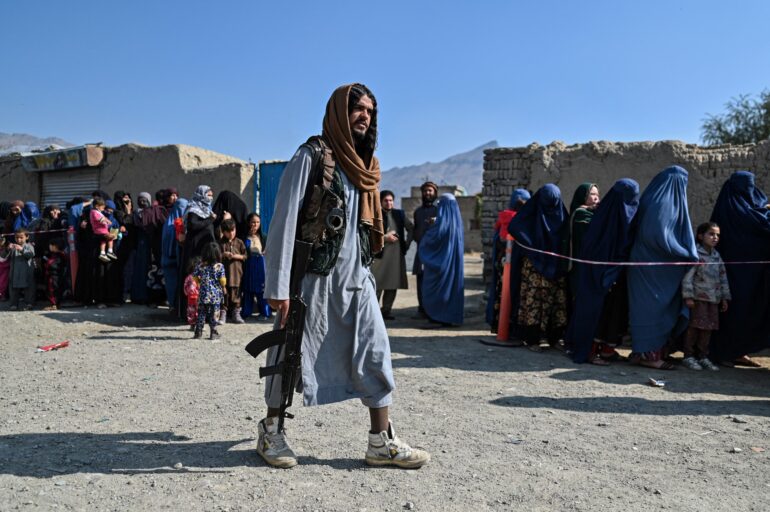
The report documented more than 50 cases in which women were detained, held or formally warned solely over alleged violations of the Taliban’s hijab rules. Most of these incidents occurred in Herat province, where the full chador remains the mandatory form of dress for women, followed by the capital Kabul. One such arrest was recorded in Badakhshan province.
In one documented case, Taliban morality police detained a 13-year-old girl for allegedly failing to comply with hijab requirements. She was held overnight and released the following day only after her father intervened, according to UNAMA.
Taliban authorities continued to issue public instructions telling women to “stay at home, obey and serve their husbands,” the mission said. A sermon prepared by the Taliban’s Ministry of Hajj and Religious Affairs for Friday prayers on Aug. 7 stated that women should obey their husbands, remain at home, avoid leaving without their husbands’ permission, and serve their husbands as an obligatory requirement of Islam.
UNAMA also recorded multiple cases in which women were denied access to basic services because they were not accompanied by a male guardian, known as a mahram. On Aug. 8, morality police in Parwan province stopped two women from entering a healthcare facility because they lacked a mahram. On Aug. 17, a woman was similarly prevented from entering a market in Helmand province for the same reason.
Despite the Taliban’s announcement of a “general amnesty” after seizing power in August 2021, the mission said arbitrary arrests and killings of former Afghan security personnel continued. During the July-September period, UNAMA documented at least 14 cases of arbitrary arrest and detention and four killings involving former government security forces. Former officials and security personnel who return to Afghanistan remain at risk of serious human rights abuses, the report stated.
UNAMA also said Taliban authorities continued to carry out public corporal punishment, although the group’s supreme court had stopped publicly announcing such sentences in April. UNAMA documented the public flogging of 28 people – 22 men and six women – on various charges during the reporting period. Each person received between 36 and 39 lashes, according to the report.