

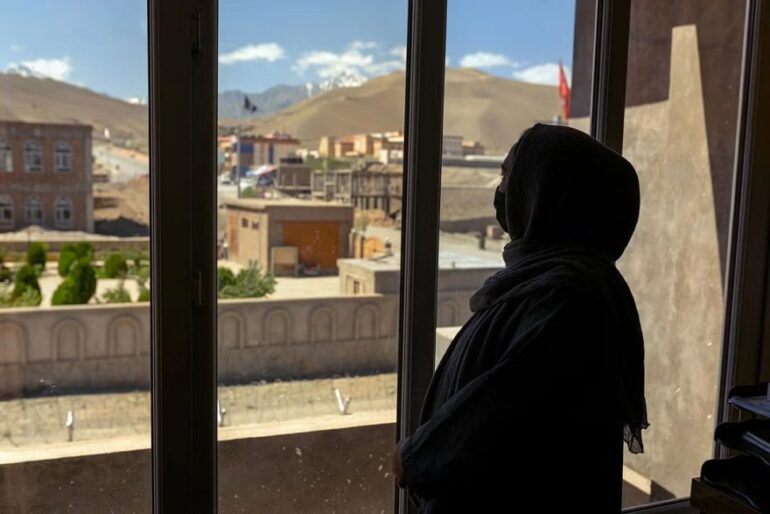

KABUL, AFGHANISTAN – More than half of Afghan women leave their homes only twice a month or less as Taliban restrictions on movement and public life continue to exclude them from society, according to a new UN Women report released on Wednesday.
The report, titled Five Years On: Afghan Women’s Futures at a Crossroads, is based on a nationwide survey of more than 5,000 people. It included a door-to-door survey of 2,190 people conducted between February and March 2025, and telephone interviews with 2,811 people conducted between April and May 2026.
The findings come five years after the Taliban returned to power in August 2021 and imposed sweeping restrictions on women and girls. The group has since issued more than 100 decrees and directives targeting women and girls, U.N. Women said, institutionalizing discrimination and contributing to what it described as the world’s most severe women’s rights crisis.
The survey found that 52% of women leave their homes no more than twice a month, compared with 96% of men who go out daily. The restrictions are more pronounced in rural areas, where 62% of women said they rarely leave home. Nine in 10 women said they need permission from a male family member before going out, while 75% said they feel unsafe leaving home without a male guardian, or mahram. More than half, 56%, said they avoid public spaces such as markets and healthcare facilities, while 66% said they limit what they say in public.
Mental health has deteriorated sharply. Seven in 10 women described their mental health as “bad” or “very bad.” 59% said it had worsened in the previous six months.
According to the report, the restrictions have intensified over the past year, affecting women’s access to education, employment, healthcare, justice and public spaces.
The report highlighted two recent Taliban decrees, known as Decree No. 12 and Decree No. 18, which it said have further restricted women’s access to justice and weakened their legal protections.
Decree No. 12, also known as the “Criminal Rules of Courts,” abolishes legal equality between men and women before the law and places husbands in a position of legal authority over their wives, according to U.N. Women.
Decree No. 18, known as the “Regulation on Separation of Spouses,” makes it significantly harder for women to leave marriages while preserving men’s unilateral right to divorce. The report said the decree also implicitly permits child marriage.
Afghanistan remains the only country where girls are barred from secondary education and women are prohibited from attending university. UNESCO said this week that about 2.4 million Afghan girls have been excluded from secondary education since the Taliban takeover.
U.N. Women said continued restrictions could leave Afghanistan without more than 25,000 female teachers and healthcare workers by 2030.
The report also said declining international funding is threatening women-led organizations that provide services and support to women and girls. Nearly three-quarters of the organizations surveyed reported funding cuts in 2025, while more than half expected to suspend operations or close in 2026.
Women and girls are bearing the greatest impact of Afghanistan’s worsening humanitarian crisis, U.N. Women said, with more than 10.7 million women and girls require humanitarian assistance in 2026. Afghanistan also continues to have one of the world’s highest maternal mortality rates.

