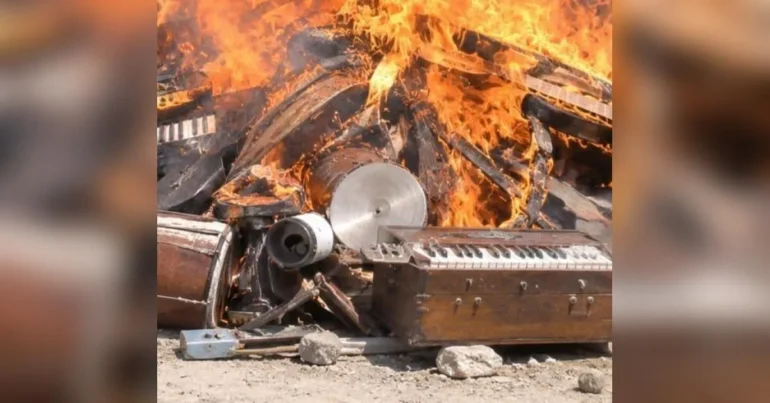

KABUL, AFGHANISTAN – Taliban authorities in eastern Nangarhar province have collected and burned more than 1,600 musical instruments, as the group continues to enforce restrictions on music and artistic expression across Afghanistan.
The Taliban’s Directorate for the Promotion of Virtue and Prevention of Vice in Nangarhar said in a statement that its inspectors had collected 378 musical instruments of various sizes from Kama and Kuz Kunar districts and another 1,248 from Dara-e Noor district.
The department also said that its inspectors had burned the confiscated firecrackers.
The Taliban authorities described the operation as an effort to prevent what they called “improper customs,” maintain a healthy social environment and strengthen Islamic values.
Since returning to power in August 2021, the Taliban have repeatedly confiscated and publicly destroyed musical instruments in different parts of Afghanistan. The group considers playing and listening to music prohibited under its interpretation of Islamic law.
Taliban morality police have also detained, beaten and intimidated people accused of playing or listening to music, including musicians and participants in wedding ceremonies and private gatherings.
In July 2026, Taliban morality police raided a wedding ceremony in Kama district of Nangarhar and detained 14 people for allegedly playing music, according to sources cited by KabulNow. Those detained were reportedly relatives and neighbours of the groom.
In another incident reported by KabulNow in November 2024, Taliban morality police detained eight people at a wedding ceremony in Alingar district of neighbouring Laghman province and confiscated their musical instruments.
The destruction of musical instruments has also been reported in several other provinces in recent months. On November 4, 2026, Taliban authorities in eastern Khost province burned 650 musical instruments collected from the provincial capital and surrounding districts. In September, the group also burned nearly 200 musical instruments in Logar province.
The restrictions on music were further formalised through the Taliban’s Law on the Promotion of Virtue and Prevention of Vice, published in August 2024. The law classifies music played at gatherings or inside homes as a wrongful act and also prohibits drivers from playing music in their vehicles.
The United Nations has also raised concerns over the Taliban’s restrictions on music and the destruction of musical instruments. In a report submitted to the UN General Assembly on August 30, 2024, Richard Bennett, the UN Special Rapporteur on the situation of human rights in Afghanistan, said the Taliban continued to ban playing and listening to music, which the group considers “un-Islamic.”
He added that people found with musical instruments faced violence, ill-treatment and harassment. The report also documented the destruction of musical instruments in Badakhshan and Sar-e Pul provinces in July 2024, noting that many had been collected from wedding halls, hotels, restaurants and private homes.
Similarly, the European Union Agency for Asylum (EUAA), in its Afghanistan Country Focus report published in November 2024, documented cases of musicians being arrested, physically assaulted and publicly shamed, as well as musical instruments being destroyed and burned. The agency said that although music had been informally prohibited since the Taliban takeover, the group’s morality law, introduced in July 2024, formally classified music played at gatherings and inside homes as a wrongful act.
The report also noted that many musicians had left Afghanistan or stopped performing, while music schools had closed following the Taliban’s return to power.
The restrictions have severely affected Afghanistan’s music industry and cultural life. Hundreds of musicians and artists have fled the country since the Taliban takeover, while many who remain have been forced to abandon their professions or continue their work in private, fearing harassment, detention and punishment.
The Taliban had imposed similar restrictions on music, television, films and other forms of entertainment during their previous rule from 1996 to 2001. Following their return to power, many of those restrictions have been reinstated, raising concerns about the future of Afghanistan’s musical traditions and cultural heritage.