

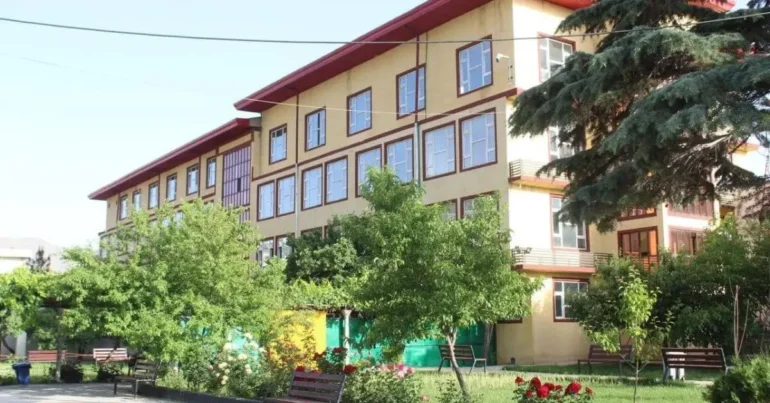

KABUL, AFGHANISTAN – The Taliban’s Ministry of Higher Education has revoked the operating license of Khatam al-Nabieen University, a private university in Kabul, and ordered the closure of its branch in Ghazni, according to the ministry and local reports.
Ziaullah Hashimi, spokesperson for the Taliban’s Ministry of Higher Education, announced the decision on Wednesday, September 16. He said the ministry’s leadership council had decided to revoke the university’s license, accusing it of failing to comply with the ministry’s policies, insulting Islamic values and misusing the university’s reputation and status.
The entrances to the university in Kabul and its branch in Ghazni have been closed. Hashimi said current students would be introduced to other private universities to continue their studies. The ministry did not provide further details about the alleged violations.
Khatam al-Nabieen University was established in Kabul in 2007 and received accreditation from Afghanistan’s Ministry of Higher Education. It has operated faculties in fields including law and political science, economics, computer science, engineering, medicine, dentistry, medical technology and midwifery.
The closure follows weeks of reported pressure on the institution. Earlier this month, sources told local media that the Taliban had taken control of the university’s management and appointed a new president and four deputies. The reports said the move was part of broader efforts by the Taliban to assume control of institutions associated with the Khatam al-Nabieen complex.
According to sources cited by KabulNow, the Taliban had also raised concerns about the university being a Shia institution and allegedly told the Taliban leadership in Kandahar that it did not have Sunni employees. These claims have been reported by local sources and were not included as a detailed explanation in the ministry’s announcement revoking the license.
The university is associated with several institutions established by the late Shia cleric Mohammad Asif Mohseni. Jawad Mohseni, head of Tamaddon TV, and Abdul Qayum Sajjadi, a former member of Afghanistan’s parliament, have been identified as owners of the university in local reports. Sajjadi has also described the university’s closure as unjust and rejected accusations against the institution.
The decision comes shortly after Taliban authorities took action against other institutions associated with the Khatam al-Nabieen complex. On September 7, Taliban forces reportedly entered and evacuated the Khatam al-Nabieen religious seminary in Kabul, a major Shia educational institution. Taliban authorities had not publicly explained the move at the time.
Earlier, on Saturday, September 5, Taliban forces entered the complex and ordered teachers and students to vacate the buildings. Following protests, 28 teachers and students were detained and transferred to the Taliban’s Third Security District in Kabul.
A source told local media that four of those detained have since been released, while 24 remain in custody at the Third Security District.
Tamaddon TV, another institution associated with the complex, was also ordered closed earlier this year. The Taliban’s Ministry of Justice said the land on which the television station and the religious seminary were located had been usurped. The institutions and their representatives have disputed claims concerning their ownership and the legal status of the properties.
The latest decision means that a private university that had operated for nearly two decades will no longer be allowed to continue under its existing license. The immediate impact will fall on its students, who the Taliban Ministry of Higher Education says will be transferred to other private universities.
The closure of Khatam al-Nabieen University can be viewed in the broader context of the Taliban’s restructuring of Afghanistan’s education system around its own religious and ideological framework. Since returning to power, the Taliban have sharply restricted modern education while expanding religious education, including through the growth of madrasas.
Richard Bennett, the UN Special Rapporteur on Afghanistan, has warned about this expansion, noting that the number of religious schools has reportedly risen from around 5,000 to more than 23,000 under Taliban rule. The closure of a prominent Shia educational institution is also significant because the Taliban have imposed increasing restrictions on Shia religious and cultural practices, including restrictions on Muharram ceremonies and the closure of the Khatam al-Nabieen seminary.
While the Ministry of Higher Education officially cited violations of its policies and Islamic values in revoking the university’s license, the decision can be understood as part of a wider pattern of bringing educational and religious institutions under tighter Taliban control and narrowing the space for independent and Shia-oriented education.

