

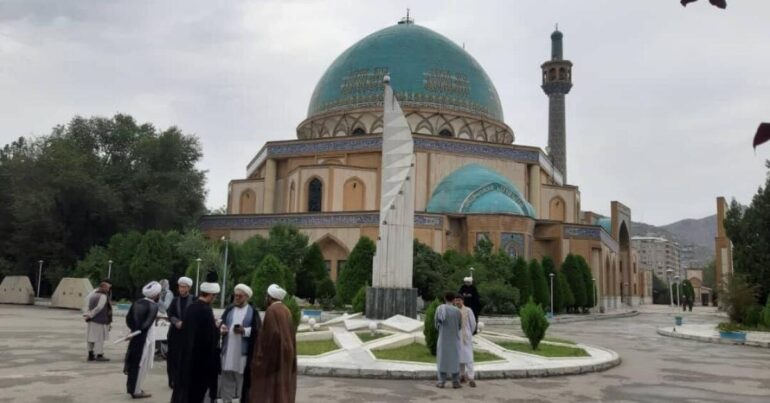

KABUL, AFGHANISTAN – Taliban forces on Monday September 7, forcibly evicted students from the Khatam al-Nabieen complex, one of the largest Shia seminaries in Kabul, and took control of the premises after detaining dozens of teachers and students, while separately arresting three prominent Shia community figures who had planned to discuss the detentions, local sources said.
Sources told local media that Taliban personnel from the Ministry of Justice had given students until around 10 a.m. on Monday to leave the seminary but later removed them by force in the afternoon. Video sent to local media showed students carrying their belongings and leaving the compound.
The sources said the Taliban had allowed some teachers to remain temporarily because their homes are located within the seminary complex, while ordering others to leave.
The eviction came after the Taliban detained several Shia community figures who had planned to meet over the arrests of teachers and students from the seminary.
According to a source familiar with the matter, Taliban authorities on Sunday detained Sufi Gardizi, Sayed Hassan Sharifi Balkhabi and Mohammad Hossein Sangardoost. The three were among a group of Shia scholars and community figures who planned to hold a meeting at the Office for Public Relations of Hazara and Shia Elders to discuss the arrests and seek the release of those detained.
The source said about 50 to 60 Shia scholars and community representatives were expected to attend the meeting. The cook and two guards at the office were also detained, bringing the number of people arrested there to five.
The office operates from a house belonging to Mohammad Mohaqeq, a former Afghan political leader, in the Sarkariz area of Kabul, according to the source.
The meeting was intended to discuss efforts to secure the release of the detained teachers and students and to seek a meeting with Taliban officials. But Taliban authorities learned about the planned gathering before it took place.
The source said the Taliban governor of Kabul initially contacted Gardizi, who heads the office, and ordered him to report to the governor’s office. Gardizi was then transferred by Taliban intelligence forces to the Ministry of Justice in Dar-ul-Aman, where his phone was later switched off.
According to the source, the Taliban governor invoked the era of Abdul Rahman Khan in his warning to Gardizi. The remark appeared to refer to the reign of Afghan ruler Abdur Rahman Khan, whose government is widely associated with the persecution of Hazaras in the late 19th century.
The five people detained from the public-relations office were also transferred to the Taliban Ministry of Justice and had not been released as of Monday, the source said. Their phones were reportedly inaccessible, and their families and associates had no information about their condition.
The latest arrests followed an earlier operation at the Khatam al-Nabieen seminary. On Saturday, September 5, Taliban forces entered the complex and ordered teachers and students to vacate the buildings. Following protests, 28 teachers and students were detained and transferred to the Taliban’s Third Security District in Kabul.
A source told local media that four of those detained have since been released, while 24 remain in custody at the Third Security District.
The Taliban have not publicly commented on the reported arrests or the forced eviction of students from the seminary.
The Taliban’s Ministry of Justice has claimed that the Khatam al-Nabieen complex was built on government-owned land and should therefore be brought under Taliban control. Seminary officials, however, reject the claim and say they possess legal documents establishing their rights to the property. They have also said that the land-ownership case remains before a Taliban court and that no final ruling has been issued.
The eviction in Kabul comes amid a series of property disputes and forced evacuations affecting Hazara and Shia communities in different parts of Afghanistan. In Herat’s Jebrail district, Taliban authorities recently closed around 100 shops in a covered market following a dispute over land ownership, while three residents were reportedly arrested.
Local sources said the dispute followed a claim by a man identified as Sayed Habib to parts of central Jebrail. The Taliban’s Ministry of Justice has also declared a number of properties and institutions in Kabul and elsewhere to be state-owned or built on what it calls “usurped” government land, subsequently ordering their closure or evacuation.
The latest confrontation has raised concerns among members of Kabul’s Shia community, particularly amid reports of arrests and the use of force against students and protesters. Taliban authorities had not publicly provided a detailed explanation for the reported arrests or the evacuation operation at the time of publication.

