

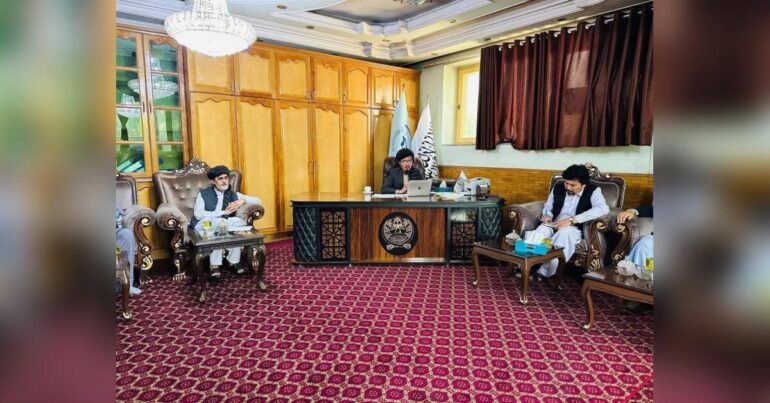

KABUL, AFGHANISTAN – The Taliban’s Ministry of Justice has dissolved the High Shia Commission of Afghanistan, a body reportedly established with the support and coordination of the Taliban’s intelligence agency, according to sources in Kabul.
A source told KabulNow on Monday that the ministry had confiscated the membership cards of 25 members of the commission and instructed them not to return to its office, telling them that the body had been dissolved.
According to the source, the Taliban had contacted the 25 members a day earlier and asked them to report to the Ministry of Justice, telling them that Mohammad Ali Akhlaqi, the commission’s chairman, was expected to be released. However, after the members arrived at the ministry, their membership cards were confiscated and they were barred from continuing their activities within the commission.
A second source familiar with the matter also confirmed that the commission had been dissolved.
The source, speaking on condition of anonymity, said Akhlaqi remains detained at a facility inside the Ministry of Justice allegedly controlled by Abdul Hakim Sharaei, the Taliban’s justice minister.
The source further alleged that the Taliban had told Akhlaqi that he would have to leave his private home in Omid-e Sabz Township in Kabul and hand it over to the group in exchange for his release. The Taliban have reportedly declared the township to be state-owned.
There are also unverified reports that six senior members of the commission, four of whom were former members of Afghanistan’s parliament, are being sought by the Taliban. The individuals are also reportedly residents of Omid-e Sabz Township.
Akhlaqi and several members of the commission were detained about a week ago after they went to the Ministry of Justice to mediate for the release of several influential members of Afghanistan’s Shia community who had previously been detained by the Taliban. Sources said that several members, including Akhlaqi, were taken into custody at the ministry.
The arrests followed an earlier incident in which Taliban forces surrounded the commission’s office in Kabul. Sources said the commission had been operating under the Taliban intelligence agency and had been established on the orders of Taliban supreme leader Hibatullah Akhundzada.
Abdul Hakim Sharaei has previously described the High Shia Commission as a “political-intelligence” institution and said that political and intelligence organizations are not permitted to operate under the Taliban administration. Sources have also said that Sharaei argued there was no need for such an intelligence-linked institution.
The commission was reportedly established after the Taliban returned to power and was presented as an institution representing Afghanistan’s Shia community. Reports about its alleged links to the Taliban intelligence agency have emerged previously, although the Taliban have not publicly provided a detailed account of the commission’s establishment or its institutional status.
The reported dissolution of the High Shia Commission comes amid a series of actions by the Taliban against institutions and communities associated with Afghanistan’s Shia and Hazara population in recent weeks. Taliban authorities have raided and moved to close the Khatam al-Nabieen complex in Kabul, including its religious seminary and university, while the university’s operating license was subsequently revoked.
The Taliban have also taken action against Tamadon TV, a Shia-affiliated broadcaster, and have pursued a legal case declaring more than 1,500 jeribs of land in Omid-e-Sabz Township in Kabul state-owned. In Herat’s Jebrail area, Taliban authorities have also closed around 100 shops amid a land ownership dispute and reportedly arrested several residents.
These developments have prompted concerns among Shia and Hazara figures and rights advocates over what they describe as increasing restrictions on their religious, social and economic institutions.
A recent European Union Agency for Asylum report also documented restrictions on Shia religious practices under Taliban rule, including limitations on Muharram and Ashura commemorations and the removal of Shia religious symbols in several provinces. While Taliban authorities have generally framed recent actions against individual institutions as legal, administrative or land-related measures, Shia and Hazara representatives have argued that the cumulative effect amounts to discriminatory treatment of their communities.

