

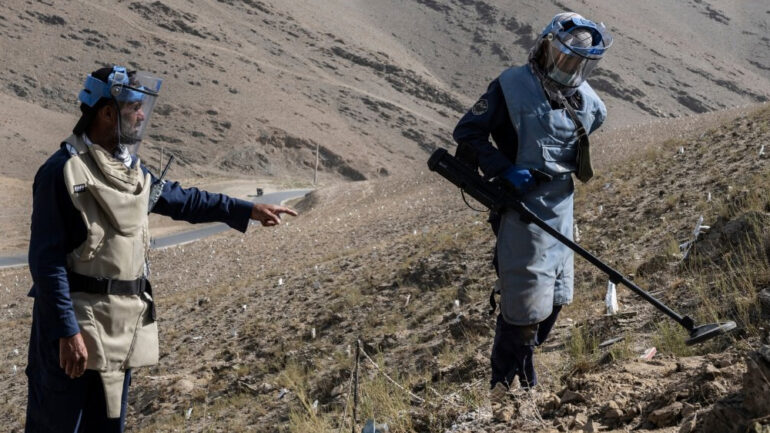

KABUL, AFGHANISTAN – The United Nations Development Programme (UNDP) and its partners are continuing efforts to clear explosive remnants of war and raise public awareness about the dangers of mines and unexploded ordnance in Kunduz, a province in northeastern Afghanistan.
UNDP said on Sunday, October 4, that explosive hazards remain a serious threat to communities in Kunduz and that further efforts are needed to clear contaminated areas and reduce the risks faced by civilians. The programme involves clearing areas contaminated by explosive remnants while providing mine-risk education to local communities.
The initiative is being implemented in cooperation with the International Organization for Migration (IOM), the United Nations High Commissioner for Refugees (UNHCR) and the United Nations Human Settlements Programme (UN-Habitat), with support from the United Nations Special Trust Fund for Afghanistan (STFA).
The programme comes as Afghanistan continues to face one of the world’s most serious explosive-ordnance problems. According to the United Nations, 64 incidents involving explosive remnants of war and unexploded ordnance have been recorded in eastern Afghanistan since the beginning of 2026, resulting in 64 civilian casualties. The UN has warned that children are particularly vulnerable to the dangers posed by abandoned and unexploded weapons.
Kunduz, located in northeastern Afghanistan, has experienced years of armed conflict, leaving communities exposed to explosive remnants in residential areas, farmland and along roads. The continuing presence of unexploded ordnance can prevent communities from safely using agricultural land and infrastructure and can pose risks to people returning to areas affected by conflict.
The need for mine-risk education has also increased as thousands of Afghans return from neighbouring countries. A recent UNDP-supported programme in Kunduz and neighbouring Baghlan province included mine-risk education for children, teaching them how to identify mines and unexploded ordnance and what to do if they encounter suspicious objects. The programme is part of broader efforts to help returnees and host communities rebuild their lives safely.
The United Nations has repeatedly stressed that explosive hazards remain a long-term consequence of Afghanistan’s more than four decades of conflict. Mine-action organisations have cleared millions of explosive items across the country over the past decades, but significant contamination remains.
The continued presence of mines and unexploded ordnance also threatens humanitarian and development activities. Contaminated land can restrict access to farmland, grazing areas, roads, schools and other public facilities, making clearance and community awareness an important part of recovery efforts.
UNDP and its partners say the ongoing work in Kunduz is intended to create safer conditions for communities to live, work and rebuild. However, humanitarian organisations have warned that funding shortages continue to limit mine-action operations across Afghanistan, leaving many communities exposed to explosive hazards.

