

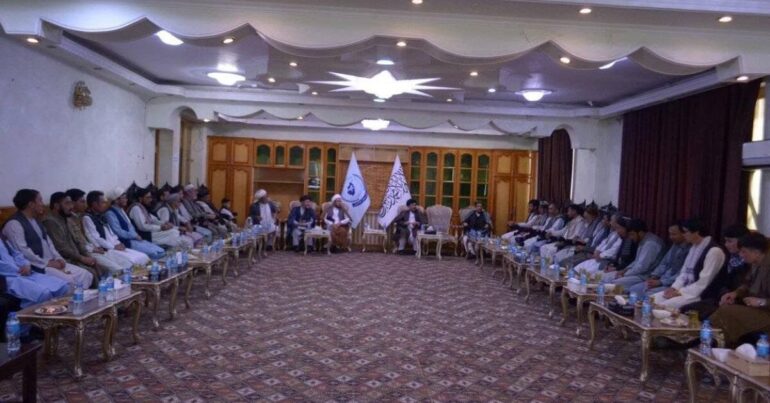

KABUL, AFGHANISTAN – Taliban forces have surrounded the office of Afghanistan’s “High Shia Council” in Kabul, local sources said on Tuesday.
A source told local media that the office is located in the Karte Char area of Kabul. According to the source, Taliban forces surrounded the office at around 2 p.m. The reason for the move was not immediately clear.
The “High Shia Council of Afghanistan” was established in coordination with the Taliban and is reportedly supported by the group’s intelligence apparatus, according to local sources.
The reported siege followed an earlier operation at the Khatam al-Nabieen seminary. On Saturday, September 5, Taliban forces entered the complex and ordered teachers and students to vacate the buildings. Following protests, 28 teachers and students were detained and transferred to the Taliban’s Third Security District in Kabul.
A source told local media that four of those detained have since been released, while 24 remain in custody at the Third Security District. The Taliban’s Ministry of Justice has declared the land on which the seminary stands to be state-owned.
Media outlets close to the Taliban reported on Tuesday that weapons and ammunition had been discovered at the Khatam al-Nabieen seminary. The reports did not provide further details about the alleged weapons or when they were found.
In addition, Taliban authorities on Sunday detained Sufi Gardizi, Sayed Hassan Sharifi Balkhabi and Mohammad Hossein Sangardoost. The three were among a group of Shia scholars and community figures who planned to hold a meeting at the Office for Public Relations of Hazara and Shia Elders to discuss the arrests and seek the release of those detained.
Khatam al-Nabieen, founded by the late Shia cleric Asif Mohseni, was one of the largest religious institutions serving Afghanistan’s Shia community. The Taliban considers the land belonging to the seminary and several affiliated institutions, including Khatam al-Nabieen University and Tamadon Television, to have been unlawfully seized from the state.
The Taliban has not publicly explained the reason for surrounding the Shia Council’s office or provided further details about the reported operation.
The situation of Afghanistan’s Hazara community has remained precarious under Taliban rule, with concerns ranging from land and property disputes to forced displacement, discrimination and worsening security. Long-running disputes between Hazaras and Kuchi nomads over land and grazing areas have continued, with rights groups and researchers documenting cases of intimidation, violence and displacement.
The Taliban’s land-reclamation campaign has also raised concerns among Hazara communities. In Kabul, the Taliban’s Ministry of Justice declared more than 1,500 jeribs of land belonging to the predominantly Hazara Omid-e Sabz township state-owned and ordered the evacuation of residents, while the ministry has said it is reviewing other Hazara- and Shia-populated properties.
In Herat, Taliban authorities recently closed around 100 shops in the Hazara-dominated Jebrail district amid a land ownership dispute, with three residents reportedly arrested. Such developments have added to broader concerns about the security and property rights of Hazaras, who have also faced deadly attacks by armed groups and, in some cases, violence involving Taliban forces.

