

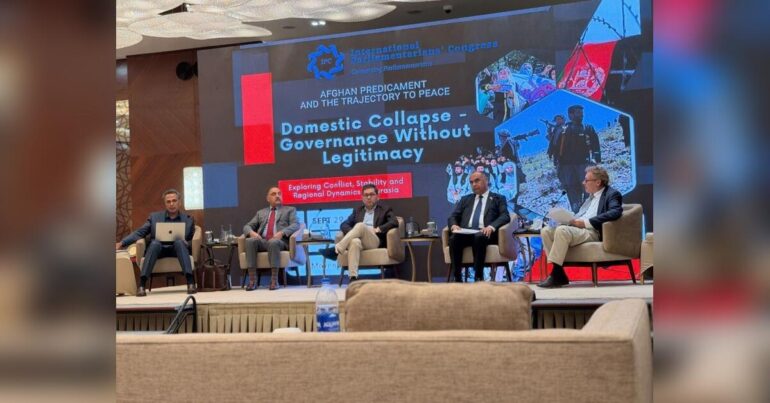

KABUL, AFGHANISTAN – A conference titled “Afghan Predicament and the Trajectory to Peace: Domestic Collapse and Government Without Legitimacy” began in Islamabad on Tuesday with the participation of several Afghan political figures opposed to the Taliban and representatives from regional countries.
The two-day conference, organised by the International Parliamentarians Congress (IPC), brought together former Afghan officials, parliamentarians and representatives from several countries to discuss Afghanistan’s political and security situation and the prospects for peace.
Mohammad Tahir Zuhair, Afghanistan’s former minister of information and culture, and Amanullah Payman, a former member of the Afghan parliament, attended the conference on behalf of Afghanistan. Representatives from Tajikistan, Kazakhstan, Kyrgyzstan, China and Russia also participated and shared their views on developments in Afghanistan.
The conference focused on what organisers described as Afghanistan’s crisis of political legitimacy, the presence of militant and terrorist groups in the country, the security risks posed to neighbouring and regional countries, and possible pathways towards peace. Pakistani Information and Broadcasting Minister Attaullah Tarar also addressed the opening session.
Speakers on the first day expressed concern over the presence and activities of militant groups in Afghanistan and warned that insecurity could have consequences beyond the country’s borders.
They also argued that Afghanistan’s political and security crisis could not be resolved without establishing an inclusive political system. Speakers said the Taliban did not represent all sections of Afghan society and that large segments of the population were currently excluded from political power.
Tahir Zuhair and Amanullah Payman raised concerns over what they described as the suppression and exclusion of non-Pashtun ethnic groups and the Taliban’s failure to establish an inclusive government. They called on regional and international countries to support efforts aimed at changing the current political situation and establishing an inclusive system of governance.
Speaking at the opening of the conference, Attaullah Tarar said Pakistan believed in peaceful coexistence with Afghanistan but accused the Taliban administration of maintaining what he described as a “militant mindset.” He said Pakistan had repeatedly sought to resolve disputes with Kabul through dialogue and negotiations, but that the presence of terrorist safe havens and internationally proscribed organisations in Afghanistan remained a major obstacle to improved relations.
Tarar also said Afghanistan had significant potential to serve as a regional trade and connectivity corridor, linking Central Asian countries with Pakistani ports. He argued that peace and stability in Afghanistan could contribute to greater economic cooperation and prosperity across the region.
The conference comes amid a sharp deterioration in relations between Pakistan and the Taliban authorities. Pakistan has accused the Taliban of allowing militant groups, particularly groups operating against Pakistan, to maintain safe havens on Afghan territory. The Taliban authorities have repeatedly rejected the allegations and accused Pakistan of violating Afghanistan’s sovereignty through military operations and airstrikes.
The latest escalation followed a series of attacks and military incidents along the two countries’ border. On September 24, Pakistan carried out airstrikes on locations in Kandahar, Paktia and Khost, saying the operations targeted sites linked to attacks against Pakistan. The Taliban authorities reported civilian casualties and condemned the strikes.
On September 26, a suicide attack at a security checkpoint in Dera Ismail Khan, Khyber Pakhtunkhwa, killed at least 12 people and injured 35 others, according to a police case registered in connection with the attack. Pakistani authorities said suspected members of factions affiliated with the Tehrik-e-Taliban Pakistan (TTP) may have been involved.
Two days later, Taliban’s Ministry of Defence said its forces had killed 28 fighters and wounded 32 others in Nuristan province after an attempted incursion from the direction of Pakistan. Pakistan has disputed Afghan allegations concerning its involvement in the incident.
On Tuesday, September 29, Taliban’s Ministry of Foreign Affairs summoned Pakistan’s chargé d’affaires in Kabul and handed him a formal protest over what it described as an attempted crossing of armed elements towards Kamdesh district in Nuristan. The Taliban authorities accused Pakistan’s military of supporting and directing the armed groups, allegations Pakistan has rejected.
Against this backdrop, the Islamabad conference places Afghanistan’s internal political crisis and the deteriorating security relationship between Kabul and Islamabad within a broader regional debate. Pakistan has called for negotiations and an end to what it describes as militant activity from Afghan territory, while Afghan officials have continued to accuse Pakistan of military intervention and supporting armed groups inside Afghanistan. The conference is scheduled to continue on Wednesday.

