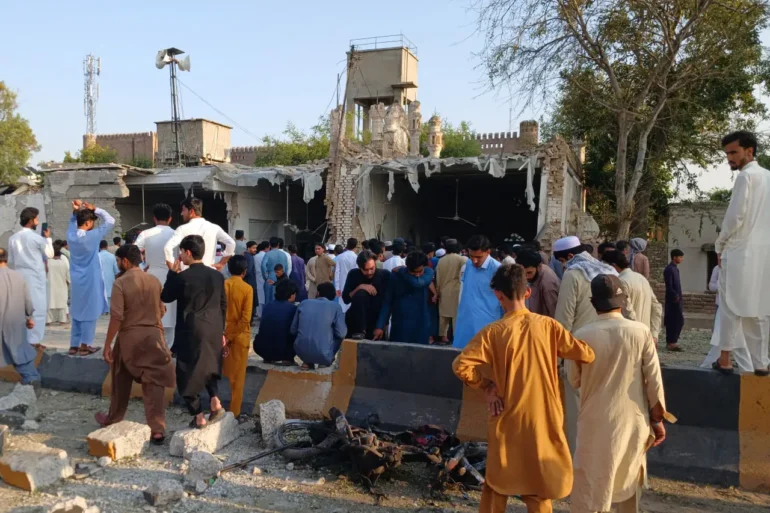

KABUL, AFGHANISTAN – The death toll from a suicide bombing and gun attack on a police complex in Kohat district of Pakistan’s northwestern Khyber Pakhtunkhwa province has risen to 31, including 16 police personnel, according to a senior Pakistani police official cited by AFP. More than 100 people were also wounded in the attack.
The attack began on Friday afternoon at the Old Police Lines complex in Kohat, where a mosque is located inside the compound. Police said an explosives-laden vehicle was driven into the complex, followed by an armed assault as militants attempted to enter police facilities.
The provincial police chief said the attackers targeted the complex while police officers and their families were attending Friday prayers. The compound houses the district police headquarters as well as offices of the Counter Terrorism Department, Special Branch and other police units.
The attack triggered a prolonged gun battle between the assailants and Pakistani security forces. After more than 20 hours of fighting, the Pakistan Army said on Saturday that its clearance operation had ended and that all eight attackers involved in the assault had been killed.
The militant group Ittehad-ul-Mujahideen Pakistan, which is linked to Hafiz Gul Bahadur and has been described as a faction associated with the Tehrik-e-Taliban Pakistan (TTP), claimed responsibility for the attack.
Pakistani President Asif Ali Zardari and Prime Minister Shehbaz Sharif condemned the attack and called for the complete elimination of what the government refers to as “Fitna al-Khawarij”, a term it uses for the TTP.
The Taliban’s Foreign Ministry also condemned the attack. Abdul Qahar Balkhi, the ministry’s spokesperson, said the attack on the mosque was “unjustifiable” and expressed condolences to the victims and their families.
The assault has also renewed attention to tensions between Pakistan and Afghanistan over militant activity along the two countries’ border. Pakistani authorities have repeatedly accused armed groups, particularly the TTP and factions associated with Hafiz Gul Bahadur, of operating from Afghanistan and carrying out attacks inside Pakistan. The Taliban authorities in Afghanistan have denied allowing militant groups to use Afghan territory for attacks against Pakistan.
The attack came a day after a roadside bombing in neighbouring Hangu district killed six Pakistani soldiers. Pakistani security forces subsequently carried out operations in several areas, reporting that 10 suspected militants had been killed. The incidents come amid a broader increase in militant violence in Khyber Pakhtunkhwa, a province bordering Afghanistan that has experienced repeated attacks against security forces in recent years.
The latest violence is likely to further complicate already strained relations between Islamabad and Kabul, particularly over Pakistan’s allegations that the TTP and other militant groups maintain bases or support networks in Afghanistan. The TTP is a separate organization from Afghanistan’s Taliban authorities, although the two have historical and ideological links.
Militant violence has surged across Pakistan in recent years, with the northwestern Khyber Pakhtunkhwa and southwestern Balochistan provinces — both bordering Afghanistan — seeing the highest number of attacks. The TTP and Baloch separatist groups have stepped up attacks on security forces and state installations.
Islamabad accuses the Afghan Taliban authorities of harbouring TTP fighters and allowing them to use Afghan territory to plan and launch cross-border attacks. The Taliban rejects these allegations, maintaining that Pakistan’s security challenges are an internal issue and that no such groups operate from Afghan soil.
Tensions between Islamabad and Kabul have escalated sharply since late 2025, marked by dozens of border clashes, Pakistani airstrikes inside Afghanistan — including targets in Kabul and Kandahar — and retaliatory actions. The exchanges have resulted in hundreds of casualties on both sides, including civilians.