

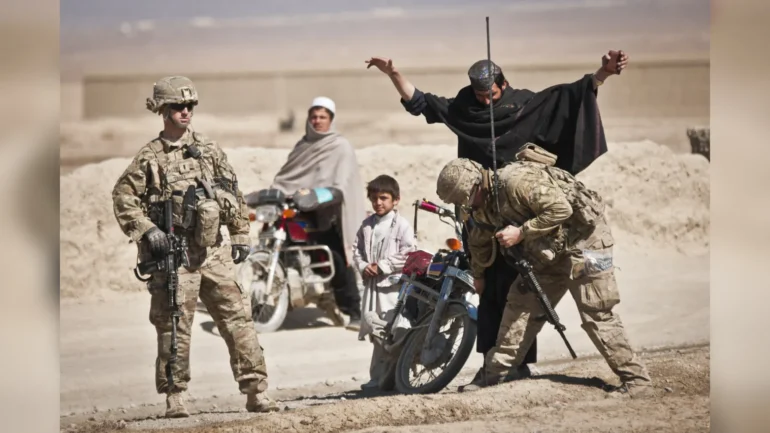

KABUL, AFGHANISTAN – Human Rights Watch (HRW) has called on the United States and other countries involved in the war in Afghanistan between 2001 and 2021 to investigate alleged war crimes committed by their forces and provide reparations to victims.
In a statement published on Sunday, October 4, the rights organization said that 25 years after the beginning of the US-led war in Afghanistan, Afghans who were wrongfully harmed or killed continue to await justice.
HRW said that after two and a half decades, there is still no clear avenue for victims to seek redress or hold those responsible accountable.
“Twenty-five years on, Afghans tortured in US custody and families of those wrongfully killed still have no clear path for filing a claim or receiving redress from the US government,” said Patricia Gossman, senior associate Asia director at Human Rights Watch. “Successive US administrations have swept grave abuses under the rug, leaving those most affected with neither compensation nor justice.”
Gossman called on the United States and other countries that participated in the Afghanistan war to properly investigate and pursue alleged war crimes committed by their forces and provide appropriate reparations to victims of abuses and their families.
“The indifference of governments and the passage of time should not deny people the justice, compensation, and recognition they are due,” she said.
Following Al-Qaeda’s September 11 attacks on the United States, the US government authorized interrogation methods for suspected militants. HRW said some of these methods amounted to torture.
The organization said it had documented torture and other abuses by US forces in Afghanistan, including beatings, humiliation, waterboarding, prolonged sleep deprivation and mock executions.
HRW said many civilians detained by US forces were released after months or years in detention without ever being charged with a crime, while the US government failed to provide full accountability or compensation for the abuses.
Among the cases cited by HRW is the account of an Afghan farmer who was detained by US forces in Ghazni in 2019 while recovering from eye surgery.
The farmer said he permanently lost his eyesight after being beaten by US soldiers during interrogation and being denied medical care.
“Whenever one didn’t like my answers, the other American would hit me with his rifle butt,” he said. “They told me I was lying and beat me with fists, kicks, and rifle butts.” He was never charged but only released in August 2021.
The United States has prosecuted some of its soldiers over unlawful killings.
Robert Bales was convicted in 2012 of killing 16 civilians in Kandahar. In the so-called “Kill Team” killings, in which 15 civilians were killed in Kandahar in 2010, Calvin Gibbs was sentenced to life in prison for murder, while Jeremy Morlock was sentenced to 24 years. Two other soldiers were sentenced to three and seven years respectively for failing to prevent the killings.
HRW, however, said many other significant cases had never resulted in prosecutions, including the killing of at least 18 civilians in Nerkh district of Wardak province in 2014.
HRW also criticized the lack of accountability for US forces, noting that then-US President Donald Trump pardoned several American soldiers in 2019, including Clint Lorance and Matthew Golsteyn, who had been convicted in cases involving unlawful killings.
The organization said that, apart from US forces, other members of the international coalition had also failed to take effective action to seriously investigate alleged grave violations committed by their troops in Afghanistan.
Australia and the United Kingdom have both launched investigations into allegations of extrajudicial killings and mistreatment of civilians by their forces, but HRW said progress in those investigations had been slow.
During the 20-year presence of NATO forces in Afghanistan, foreign troops were not the only actors accused of abuses and war crimes. According to HRW, powerful figures within the US-backed Afghan government were also responsible for serious abuses, including attacks on civilians, torture and rape of detainees, and enforced disappearances.
HRW said the Taliban and other insurgent groups also targeted civilians and caused the deaths and injuries of thousands of civilians during the conflict.
The organization said the Taliban assassinated female officials and journalists and carried out attacks against embassies, hotels, polling stations and humanitarian organizations. It also said the Taliban’s indiscriminate use of improvised explosive devices on public roads and in populated areas was a major cause of civilian deaths and injuries.
HRW said the Taliban had also failed to hold their members accountable for abuses, while other armed groups, including an affiliate of the Islamic State, known as Islamic State Khorasan Province, carried out suicide attacks targeting Hazaras and other minority communities that have largely gone unpunished.
The International Criminal Court (ICC) initially investigated alleged war crimes and crimes against humanity committed in Afghanistan after May 2003 by all parties to the conflict, including the Taliban, Islamic State, Afghan government forces, the US military and the CIA.
However, the Trump administration condemned efforts to investigate alleged crimes by US forces and imposed sanctions on ICC judges and prosecutors.
In 2021, Karim Khan, then ICC prosecutor, decided to prioritize alleged crimes committed by the Taliban and Islamic State. The decision eventually led to arrest warrants being issued last year for the Taliban’s leader and chief justice of the Taliban Supreme Court. Investigations into alleged crimes committed by other parties to the Afghanistan war have not publicly made significant progress.
In October 2025, the United Nations Human Rights Council decided to establish an independent investigative mechanism for Afghanistan to collect, consolidate, preserve and analyze evidence of past and ongoing international crimes committed by all parties and prepare case files to facilitate future prosecutions.
The United Nations leadership should ensure that the mechanism receives adequate resources and begins its investigations without delay, Human Rights Watch said.

