

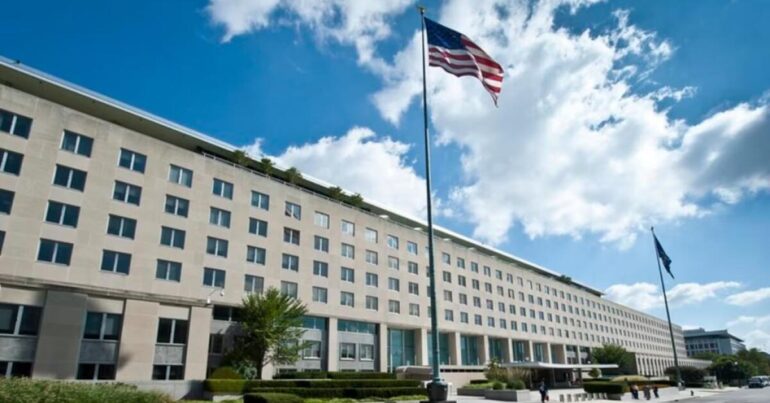

KABUL, AFGHANISTAN – The United States has rejected a request from the Taliban for investment in Afghanistan’s mining sector, saying Washington does not engage with “terrorists.”
A spokesperson for the U.S. State Department, responding to a question from Voice of America, said Washington has no plans to engage with the Taliban, which it described as a “global terrorist organization,” on the development of Afghanistan’s mineral resources.
The spokesperson said that U.S. investment in Afghanistan’s mining sector would only provide the Taliban with financial resources and enable what Washington described as their “horrific treatment” of the Afghan people.
The remarks came after Taliban Foreign Minister Amir Khan Muttaqi told the Financial Times that the Taliban would welcome U.S. investment in Afghanistan’s mining sector.
Zabihullah Mujahid, the Taliban’s spokesperson, also said on Wednesday that the group wants good relations with the United States and that Afghanistan needs diplomatic and economic ties with Washington.
During the past five years, the Taliban have repeatedly called for diplomatic relations with the United States and have released several American detainees as a gesture of “goodwill.”
Washington, however, has so far shown little willingness to establish formal relations with the Taliban. U.S. officials continue to describe the Taliban in official statements as a terrorist organization and have maintained a cautious approach to engagement with the group.
For the past two decades, the Taliban described the U.S. presence in Afghanistan as an “occupation” and claimed that they were waging “jihad” against it.
According to figures from the United Nations Assistance Mission in Afghanistan (UNAMA), more than 40,000 civilians were killed and over 77,000 others were injured during the conflict between 2009 and 2021 alone.
Since the Taliban returned to power in August 2021, Afghanistan has experienced a sharp deterioration in human rights and fundamental freedoms, with women and girls bearing the greatest burden. The Taliban have imposed sweeping restrictions on women’s access to secondary and higher education, employment, freedom of movement, public life and access to justice, while new decrees have further institutionalized discrimination against women and girls.
Ethnic and religious minorities have also faced concerns over discrimination, political exclusion, restrictions on religious practices and alleged abuses, particularly members of the Hazara and Shia communities. At the same time, Afghanistan continues to face severe economic pressures, including high unemployment, declining international assistance, weak private investment, widespread poverty and food insecurity, and limited opportunities for sustainable economic growth.
The United States, previously the largest provider of humanitarian assistance to Afghanistan, has sharply reduced and effectively halted its humanitarian funding since 2025. U.S. funding accounted for more than 40 percent of humanitarian support for Afghanistan before the cuts, according to aid officials and U.S. government data.
The withdrawal has placed additional pressure on an already fragile humanitarian response, forcing aid organizations to scale back services and geographic coverage as millions of Afghans continue to depend on humanitarian assistance. The cuts have raised concerns that shortages in food, healthcare, nutrition and other essential services could further deepen Afghanistan’s humanitarian crisis.
Nearly 22 million people in Afghanistan are expected to need humanitarian assistance this year, according to the United Nations, with women and children among those most vulnerable.
Restrictions on women’s participation in the economy have further weakened the country’s productive capacity.
The Taliban’s increasingly restrictive system of governance, combined with its failure to establish an inclusive political order and persistent concerns over human rights, has also left the country diplomatically isolated. Although several countries maintain diplomatic or working-level relations with Kabul, Russia became the first—and remains the only—country to formally recognize the Taliban government after accepting the credentials of its ambassador in July 2025.

