

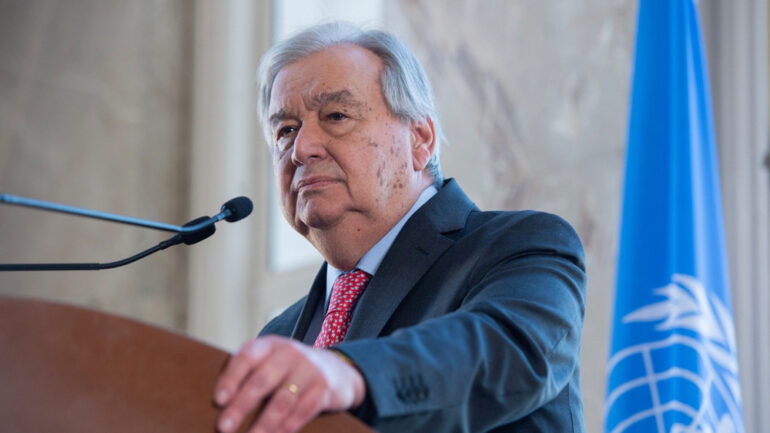

KABUL, AFGHANISTAN – As the ban on Afghan women working at United Nations offices in Afghanistan approaches its first anniversary, UN Secretary-General Antonio Guterres has urged the Taliban to immediately lift the restriction and ensure safe and unhindered access for female UN staff to their workplaces.
Stephane Dujarric, the UN secretary-general’s spokesperson, said in a statement on Sunday, September 6, that Guterres also called on the Taliban to lift all restrictions imposed on women and girls and uphold their rights to participate fully, equally and meaningfully in all aspects of Afghan society.
Guterres said he was deeply concerned about the Taliban’s discriminatory policies against Afghan women and girls, which he said affect virtually every aspect of their lives.
Restrictions on women’s participation in public life, education and many areas of employment violate their fundamental rights and pose a major obstacle to Afghanistan’s economic development, stability and reintegration into the international community, Guterres said.
Monday, September 7, marks one year since the Taliban barred all Afghan female UN employees from entering UN offices across Afghanistan. The restriction was imposed on September 7, 2025.
Guterres said the ban was inconsistent with international law, including the UN Charter, and undermined the organization’s ability to carry out its mandate and provide life-saving and other assistance to Afghans at a time when humanitarian needs remain high.
He also stressed the importance of ensuring unhindered access for all UN personnel to their workplaces so they can carry out their duties and reach and support vulnerable people, particularly women and girls, in line with Afghanistan’s cultural context.
Guterres said ensuring that women can deliver humanitarian assistance and essential services to women and girls is critical to an effective and principled humanitarian response.
The United Nations has repeatedly called on the Taliban to lift the ban on Afghan women working at UN offices, but the Taliban have so far not acted on those calls.
Since returning to power in August 2021, the Taliban have imposed sweeping restrictions on women and girls, including bans on secondary and higher education, restrictions on employment and movement, and limits on their participation in public life. Human rights experts have described the system of restrictions as amounting to gender apartheid.
Human rights organizations, including Amnesty International and HRW, along with Afghan civil society groups and activists, have repeatedly pushed for an international accountability mechanism. They argue it should be mandated to investigate violations, collect and preserve evidence, and lay the groundwork for potential prosecutions of serious crimes.
Gender-based violence remains a serious concern. While authorities claim to have resolved hundreds of women’s rights-related cases, UNAMA documented numerous incidents of forced marriage, including cases involving girls under 18. In one reported incident, a girl was detained by police on the order of a court after refusing a forced marriage and remains in detention, in violation of existing decrees prohibiting such practices.
UNAMA warns that the cumulative impact of these measures reflects an entrenched pattern of gender-based discrimination and serious human rights violations. The mission emphasizes that Afghan women and girls are being systematically denied education, work, healthcare, freedom of movement, and protection from violence, raising grave concerns about Afghanistan’s compliance with international human rights obligations.
In his latest report, covering developments from November 2025 to August 2026, UN Special Rapporteur Richard Bennett said Taliban policies and decrees had affected virtually every aspect of life in Afghanistan, with particularly severe consequences for women and girls. Citing UNICEF estimates, Bennett said about 3.8 million girls aged 7 to 18 were out of school in 2024, including more than 2.6 million adolescent girls, while the Taliban’s ban on secondary education had directly affected at least one million girls over the past five years.

