

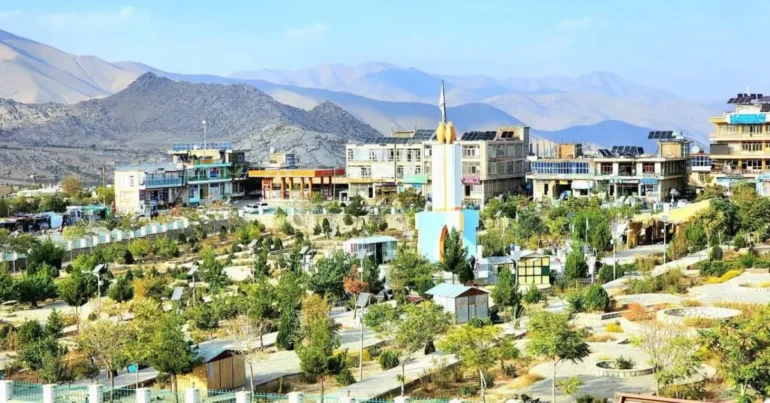

KABUL, AFGHANISTAN – The Taliban are preparing to hold a book-reading competition in Nili, the capital of central Daikundi province, for the second time this year as part of efforts to promote what they describe as “obedience to the emir.”
According to a call issued by the Taliban, the competition will be organized on October 4 by the Taliban’s Department of Information and Culture in Daikundi, the Technical and Vocational Education Authority and the Manar Scientific and Cultural Publishing Organization.
The designated reading material is a book titled The Effects of Obedience on the Consolidation of the Sharia System, written by the Taliban’s Central Dar al-Ifta, or central religious edict office.
The call invites young people, school and university students, and Taliban members to read the book and participate in the competition.
The approximately 30-page book focuses on what it describes as the religious obligation of unconditional obedience to the emir and prohibits disobedience to his orders.
A source in Daikundi told KabulNow that Taliban officials have instructed the heads of technical and vocational institutes to ensure that their students participate in the competition.
The book identifies Taliban supreme leader Hibatullah Akhundzada as the “emir” or “emir al-Mu’minin” and states that obedience to the emir is a religious duty.
According to the book, disobeying the emir’s commands and prohibitions is not permissible and individual wishes have no standing against his orders.
The Taliban’s religious edict office also argues in the book that people should obey the emir “for the sake of God” and that, after pledging allegiance to him, they do not have the right to withdraw that allegiance. The book describes breaking the pledge of allegiance to the emir as impermissible.
Another section states that obedience to the emir remains obligatory even when people do not know the reason or benefit behind an order, and says members of the Taliban cannot demand explanations for the emir’s commands.
The competition is not the first such event organized by the Taliban in Daikundi. In February this year, the group held a similar book-reading competition in the province to promote obedience to the emir, using the same book as the required reading material.
Similar competitions have also reportedly been organized in other provinces, including Ghor and Parwan.
Over the past two years, the Taliban have also promoted another book, Emarat-Shenasi (Understanding the Emirate), written by Abdul Sattar Saeed and translated into Persian by Sayed Noor Mohammad Mohebi Korabi. Book-reading competitions based on the book have been organized in different parts of Afghanistan.
Sources at universities in several provinces have previously told Afghan media that students were required to participate in the competitions and read Emarat-Shenasi before taking examinations on its contents.
The promotion of such material comes amid broader efforts by the Taliban to reshape Afghanistan’s education system around their interpretation of Islam and the policies of their administration. The European Union Agency for Asylum reported in February 2026 that the Taliban had expanded religious content in education while removing or restricting some subjects considered inconsistent with their interpretation of Islam.
A 2024 report by the U.S. Special Inspector General for Afghanistan Reconstruction also found that Taliban education policies had narrowed curricula and increased the emphasis on religious studies aligned with the group’s interpretation, while some secular subjects were removed.
The Taliban have also tightened ideological oversight of higher education. In August 2025, the group’s Ministry of Higher Education ordered universities to remove hundreds of books and revise other academic materials to ensure that they were consistent with what the Taliban described as Islamic principles and the policies of the “Islamic Emirate.”
More recently, the Taliban have continued to place obedience to their supreme leader at the center of religious instruction. In August 2026, a Taliban-approved curriculum for religious preachers instructed them to teach that obedience to the emir and officials appointed by him is obligatory, including when an individual is dissatisfied with an order.
The Taliban have ruled Afghanistan without holding national elections since returning to power in August 2021. Since then, the group has progressively centralized political and religious authority under its supreme leader and introduced restrictions affecting education, public life, media and freedom of expression. The expansion of religious and ideological material in educational institutions has consequently become part of the broader transformation of Afghanistan’s education system under Taliban rule.
Since the Taliban returned to power in August 2021, they have imposed sweeping restrictions on Afghan women and girls, including bans on secondary and higher education, restrictions on employment, limitations on freedom of movement, and severe constraints on participation in public life.
The Taliban have generally justified these measures by invoking their interpretation of Islamic law and social norms, although UN bodies and Muslim scholars have disputed the claim that such restrictions are required by Islam. The UN has described the restrictions as systematic discrimination against women and girls and has repeatedly called on the Taliban to reverse them.

