

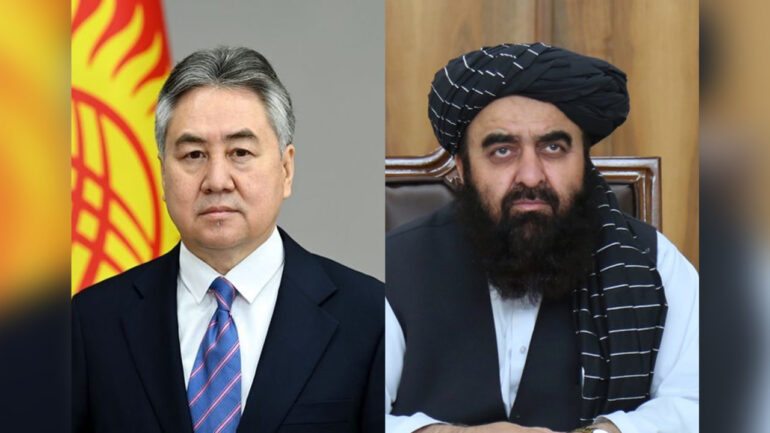

KABUL, AFGHANISTAN – Taliban Foreign Minister Amir Khan Muttaqi has asked Kyrgyzstan to support Taliban positions at the United Nations Security Council once the Central Asian country takes its non-permanent seat in 2027, the Taliban’s foreign ministry said.
The ministry said in a statement that Muttaqi made the request during a phone call with Kyrgyz Foreign Minister Jeenbek Kulubaev on Tuesday.
Kyrgyzstan was elected in June as one of 10 non-permanent members of the Security Council for the 2027-2028 term. It will serve on the 15-member council alongside the five permanent members — China, France, Russia, Britain and the United States — which hold veto power.
The Taliban ministry said Muttaqi described Kyrgyzstan’s election to the council as a “significant achievement” and stressed the importance of “mutual cooperation and support” between Afghanistan and Kyrgyzstan within the framework of the Security Council.
The two ministers also discussed high-level exchanges of delegations, regular political consultations and efforts to strengthen bilateral relations. They discussed expanding political ties and economic cooperation, including trade, investment and joint projects, the statement said.
Kyrgyzstan does not formally recognize the Taliban administration. In 2024, however, it removed the Taliban from its list of terrorist organizations and has maintained political and economic contacts with authorities in Kabul. Kyrgyz delegations have also visited Afghanistan.
The Taliban seized power in Afghanistan in August 2021 after the collapse of the Western-backed government and the withdrawal of U.S.-led foreign forces. Russia remains the only country to have formally recognized the Taliban administration. Several other governments, including neighboring and regional states, maintain diplomatic relations or working-level contacts without granting formal recognition.
Afghanistan’s seat at the United Nations continues to be occupied by a diplomat appointed by the previous government. The Taliban has repeatedly sought to gain control of the seat, but the UN has not recognized its claim.
Several countries have indicated that any recognition of the Taliban could depend on conditions that include respect for human rights, particularly the rights of women and girls, counterterrorism commitments and the formation of a more inclusive government.
The Taliban’s treatment of women and girls remains a major obstacle to wider international acceptance. Since returning to power, the authorities have barred girls and women from secondary and higher education and imposed restrictions on women’s employment and participation in public life. They have also introduced strict rules governing women’s dress and travel, including requirements for male guardians on certain journeys.
The group claims that its policies are based on its interpretation of Islamic law and Afghan culture, and it has rejected international criticism of the restrictions as interference in Afghanistan’s internal affairs.

