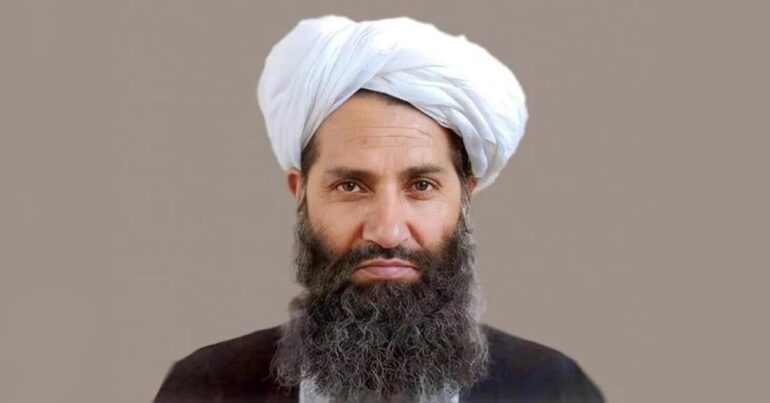

KABUL, AFGHANISTAN – Taliban Supreme Leader Hibatullah Akhundzada said on Tuesday that all Afghans follow the Hanafi school of Islamic jurisprudence and described the practice of the Shafi’i school as “impermissible,” according to an audio recording attributed to him and released by Taliban-aligned media.
Taliban-run Radio Television Afghanistan (RTA) reported that Akhundzada made the remarks during a rare visit to Kabul on Tuesday, delivering a 90-minute speech at Kabul University at a conference focused on examining the impact of his decrees.
The conference, titled “The Impact of the IEA Supreme Leader’s Decrees: From Islamic Leadership to Sharia, Social, Political, Economic and Cultural Developments”, was attended by religious scholars and senior Taliban officials, according to the agency.
“According to Sharia, the Imam chooses a path, and on that basis everyone in Afghanistan will follow the Hanafi school. Practising the Shafi’i school is impermissible,” Akhundzada said, according to Taliban media.
He urged Afghans and religious scholars to unite behind a single religious and jurisprudential position, stressing that obedience to the Amir, or leader, was essential to maintaining the Islamic system.
Akhundzada also said that qisas, or retributive punishment, and executions could not be carried out without his personal authorisation, further underscoring his control over the group’s judicial system.
During the gathering, pro-Taliban scholars renewed their allegiance to Akhundzada and conferred on him the title “Sheikh ul-Islam.” The Taliban have previously referred to him as “Sheikh ul-Hadith” and “Sheikh ul-Quran”.
Akhundzada’s remarks come amid growing concerns over restrictions on religious minorities and their practices under Taliban rule. Afghanistan has a predominantly Sunni Muslim population, most of whom follow the Hanafi school, but also has significant Shia communities, including followers of the Ja’fari and Ismaili traditions. The Shafi’i school is another major tradition within Sunni Islam.
The previous Afghan government officially recognized the Ja’fari school and had a Personal Status Law governing family and personal matters among Shia Muslims. The Taliban revoked the law after returning to power in August 2021.
The United Nations Assistance Mission in Afghanistan (UNAMA), in its July-September 2026 update, reported that Taliban authorities detained dozens of people and closed or revoked the operating licences of Shia-affiliated institutions in Kabul and Ghazni in September. The report also documented restrictions on religious practices, including the closure of Ismaili prayer halls in Badakhshan and limits on Shia religious observances.
Human Rights Watch, in its World Report 2026, said Taliban authorities in Bamyan banned Shia religious books and a Shia gathering in September. It also reported that authorities used physical abuse and death threats to pressure members of the Ismaili community in Badakhshan to convert to Sunni Islam.
The U.S. Commission on International Religious Freedom, in its annual report, described religious freedom conditions in Afghanistan in 2025 as “extremely poor,” citing the Taliban’s enforcement of a single interpretation of Islam and pressure on religious minorities. The commission recommended that Afghanistan be designated a Country of Particular Concern over restrictions on religious freedom and the treatment of religious minorities.