

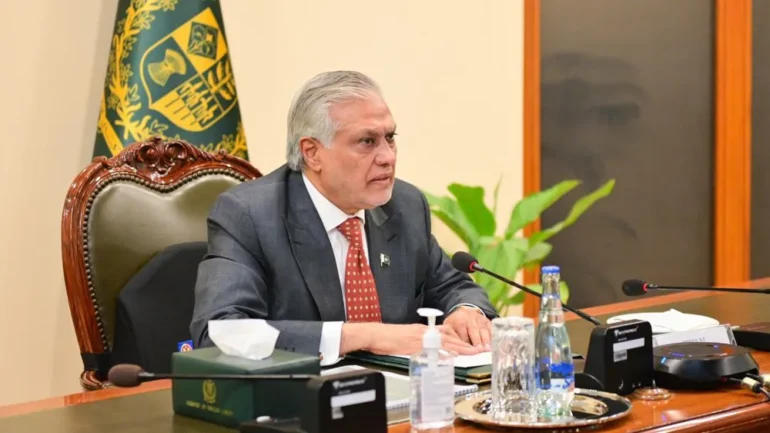

KABUL, AFGHANISTAN – Pakistan’s Deputy Prime Minister and Foreign Minister Ishaq Dar has said that more than 24 “terrorist groups” are operating inside Afghanistan, warning that their activities pose a threat to regional and international security.
Dar made the remarks at a meeting of the Organisation of Islamic Cooperation (OIC) Contact Group on Afghanistan on the sidelines of the 81st session of the United Nations General Assembly in New York.
According to a statement issued by Pakistan’s Foreign Office, he said Islamabad was particularly concerned about the presence of the Tehrik-e-Taliban Pakistan (TTP), Balochistan Liberation Army (BLA) and its Majeed Brigade, Islamic State Khorasan (IS-K), al-Qaida and the Eastern Turkistan Islamic Movement (ETIM) in Afghanistan.
Dar accused the groups of operating from Afghan territory “with impunity” and said attacks against Pakistan were being planned and carried out from Afghanistan. He urged the Taliban authorities to take what he described as “concrete and verifiable” measures to prevent Afghan territory from being used for attacks against neighbouring countries.
The Pakistani foreign minister also referred to a recent attack at a mosque in Kohat, in Khyber Pakhtunkhwa, saying at least 24 Pakistanis were killed. Pakistani authorities have linked the recent wave of militant violence to groups operating from or maintaining sanctuaries in Afghanistan, while the Taliban authorities have rejected accusations that Afghan territory is being used to launch attacks against Pakistan.
The remarks come amid a sharp deterioration in relations between Afghanistan and Pakistan. The two neighbouring countries have long maintained close ethnic, cultural, religious and economic ties, while Pakistan has also hosted millions of Afghan refugees over several decades. At the same time, relations have repeatedly been strained by disputes over the border, trade, refugees and, increasingly, militant activity.
The TTP has emerged as the most contentious security issue between Islamabad and Kabul. UN reporting has documented the group’s continued presence in Afghanistan and attacks against Pakistan, while also noting that the issue has contributed to military confrontation along the two countries’ border.
Tensions escalated significantly in 2026. In February, fighting broke out along several points of the Afghanistan-Pakistan border after Pakistan carried out strikes against what it described as militant targets in Afghanistan.
According to the United Nations Assistance Mission in Afghanistan (UNAMA), at least 372 civilians were killed and 397 wounded in Pakistani airstrikes and border clashes in the first three months of 2026. UNAMA also verified 13 civilian deaths and 10 injuries from Pakistani strikes on Khost, Kunar and Paktika on June 9 and 10.
The dispute has also affected trade and movement between the two countries. UN reporting has warned that repeated border closures disrupt trade flows, raise the cost of goods and affect humanitarian operations. A UN report has estimated that border closures associated with the security confrontation can cost the Afghan economy around $1 million a day.
Islamabad has repeatedly called on the Taliban to prevent armed groups from using Afghan territory against Pakistan. Kabul, meanwhile, has rejected Pakistan’s allegations and has accused Islamabad of violating Afghanistan’s sovereignty through military strikes. The continuing disagreement over the TTP and other armed groups has therefore become one of the central issues shaping relations between the two countries.

