

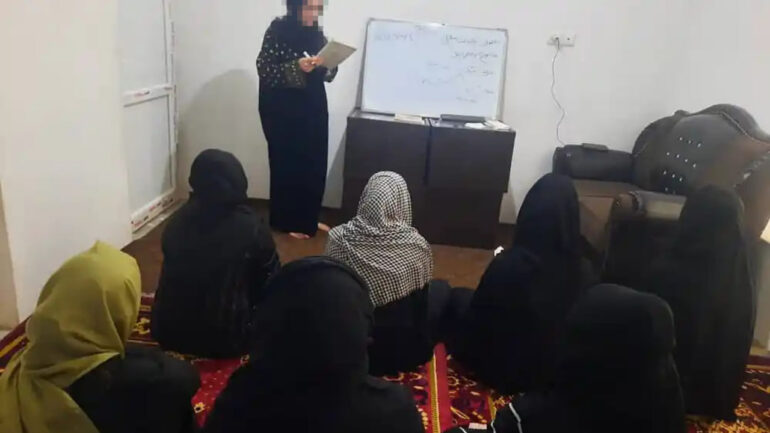

KABUL, AFGHANISTAN – Teenage girls studying at a secret basement school in Kabul have handed CBS News handwritten letters appealing to the world to hear the voices of Afghan women and girls, which they say have been choked in their throats under Taliban rule.
CBS reporters were given rare access to the undisclosed school, where girls aged 14 to 16 continue their studies despite the Taliban’s ban on formal education for girls beyond the sixth grade. The students surprised the team by asking them to deliver their deeply personal messages to the outside world.
In one letter, a girl wrote: “Please listen to the voices of Afghan women and girls — voices that have been choked in their throats, unable even to cry out.”
“Don’t you see Afghanistan? Defenceless people, guilty of no crime, are dying in silence in prisons and in the backstreets of our cities. Is this what human rights are?” she said. “These are not just my words. They are the words of people in my country who are not allowed to speak them.”
Another wrote: “I want rights: the right to study, the right to work, the right to choose, and the right to build my own future. Is that really too much to ask?” She added: “World, I am asking you for an ordinary life—a life where having bread is not a dream, where work is not a matter of luck, and where safety and freedom are not fantasies.”
The students and their teachers dress conservatively and carry only pens and notebooks to avoid detection. Some hide pieces of fabric in their bags so they can claim they are heading to sewing classes if stopped by Taliban morality police.
“We are afraid of the Taliban. They might arrest us,” one girl told CBS.
The school’s main teacher, a 25-year-old woman who was in her final year of university studying science when the Taliban banned women from higher education, said she runs the classes “because I don’t want these girls to be uneducated and illiterate like women 20 years ago.”
Taliban Foreign Ministry spokesman Abdul Qahar Balkhi told CBS that the suspension of education beyond sixth grade is temporary and does not amount to denying girls their fundamental right to education. “It’s a particular type of schooling system, educational system, and it’s suspended for now,” he said, according to CBS.
Taliban authorities have repeatedly said restrictions on girls’ education are temporary and linked to conditions they say must be met before schools and universities can reopen to women and girls. The authorities have not set a date for a full return to secondary and higher education.
Five years after the Taliban seized power in August 2021, Afghanistan remains the only country where girls and women are formally banned from secondary and higher education. UNESCO estimates 2.6 million girls are currently excluded from secondary school. Women face sweeping restrictions on employment, movement without a male guardian, and public life, with UN agencies describing the situation as a systematic erasure of half the population from society.
A recent UN Women survey found more than half of women leave home only once or twice a month, nearly three-quarters feel unsafe going out without a male guardian, and only 7% of women are employed compared with 84% of men. Seven in 10 women describe their mental health as bad or very bad.
Despite the restrictions, some girls and women continue to pursue education through secret schools, online classes, and community-based programs, seeking to maintain access to learning and preserve opportunities that have been closed to them under Taliban rule.

