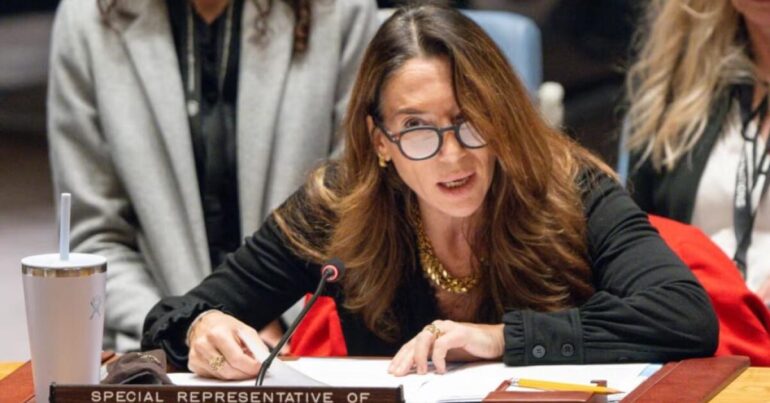

KABUL, AFGHANISTAN – Vanessa Frazier, the United Nations Special Representative for Children and Armed Conflict, has warned that poverty and economic hardship are making children in Afghanistan vulnerable to recruitment into the Taliban’s ranks.
In an interview with Voice of America (VOA), Frazier urged the Taliban authorities to end the recruitment of children and recognise 18 as the legal age of adulthood.
“Families struggling to feed their children may see joining an armed force as a source of food, security and income,” she told VOA.
Frazier said boys were being used in various roles within Taliban ranks, including cooking, carrying weapons, fighting and performing border guard duties.
She also expressed concern over the militarisation of schools and ideological indoctrination of children in religious schools, known as madrasas, under Taliban administration.
According to Frazier, some children recruited into the Taliban’s ranks may already have been exposed to ideological indoctrination through religious education before joining the group.
The UN representative stressed that the Taliban’s definition of a child is inconsistent with the UN Convention on the Rights of the Child, to which Afghanistan is a signatory.
She said physical signs of puberty should not replace the internationally recognised legal age of 18 when determining whether someone is a child.
A UN report published in September 2026 documented the recruitment and use of 557 boys, including children as young as 12, by the Taliban between 2023 and 2025.
The UN Secretary-General’s annual report on Children and Armed Conflict for 2025 also documented the recruitment and use of boys by the Taliban in combat and support roles.
Frazier called on the Taliban authorities to immediately end the recruitment of children and ensure that their rights are protected in accordance with international standards.
The recruitment and use of children by the Taliban has remained a serious human rights concern in Afghanistan, both during the group’s insurgency and following its return to power in August 2021.
Under international law, the recruitment and use of children under the age of 18 by armed forces or armed groups is prohibited. Afghanistan is a party to the UN Convention on the Rights of the Child, which defines a child as every human being below the age of 18, unless adulthood is legally attained earlier.
However, the Taliban have relied on physical signs of puberty rather than the internationally recognised age threshold when determining eligibility for recruitment.
In March 2022, the Taliban’s supreme leader issued a decree prohibiting the recruitment of children who had not reached puberty into security institutions. In May of the same year, the Taliban’s Ministry of Defence also issued an order prohibiting the recruitment and presence of minors in its ranks.
The United Nations has nevertheless raised concerns over the implementation of these directives, particularly the absence of a reliable age-verification mechanism and the lack of accountability for those responsible for recruiting children.
According to the UN Secretary-General’s report on children and armed conflict, 342 boys were recruited and used by the Taliban in combat and support roles in 2023. The report also documented 11 boys recruited in 2024.
The latest UN findings show that child recruitment increased significantly over the 2023–2025 reporting period. At the same time, the UN reported that 576 boys were released from Taliban ranks in northern and northeastern Afghanistan and enrolled in reintegration programmes.
The United Nations has warned that widespread poverty, unemployment, displacement, the absence of birth registration and limited access to education and social protection increase children’s vulnerability to recruitment and exploitation.
Afghanistan’s humanitarian crisis has particularly affected children, with millions of families struggling to meet their basic needs. The suspension of secondary education for girls, restrictions on women’s employment and the deteriorating economic situation have further undermined children’s access to education, protection and essential services.
The UN has repeatedly called on the Taliban authorities to prevent the recruitment and use of children, establish effective age-verification procedures, release children from their ranks and ensure their rehabilitation and reintegration into civilian life.