

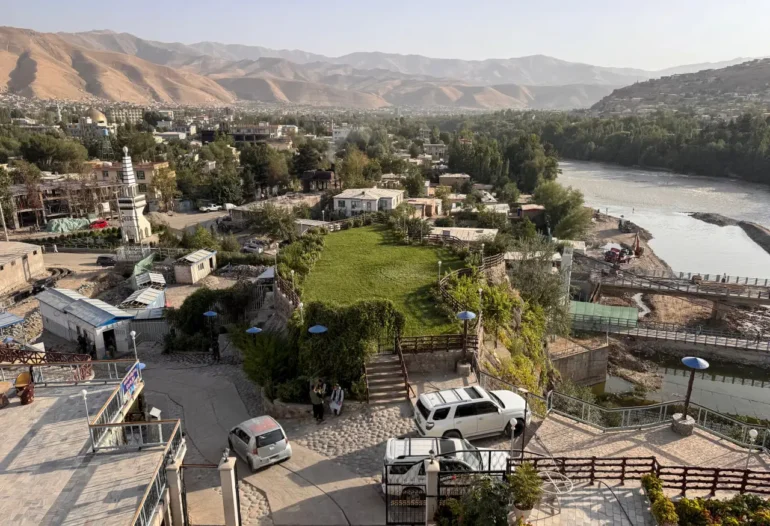

KABUL, AFGHANISTAN – Afghanistan Freedom Front (AFF) has claimed responsibility for an explosion targeting a vehicle in Faizabad, the capital of northeastern Badakhshan province, on Monday.
In a statement, the AFF said its fighters carried out an attack at around 9:45 a.m. near the Taliban’s Directorate of Mines in Faizabad. The group claimed that three Taliban members were killed and two others were wounded in the attack.
Local sources had earlier reported an explosion in the Jalgari area of Faizabad at around 10 a.m., saying a Toyota Hilux vehicle had been targeted. The Taliban authorities in Badakhshan have not commented on the incident or the AFF’s claim.
The AFF is one of several armed anti-Taliban groups that emerged or became active following the Taliban’s return to power in August 2021. Alongside the National Resistance Front (NRF), the AFF has claimed responsibility for attacks against Taliban personnel and facilities, particularly in northern and northeastern provinces.
The groups say they are fighting against Taliban rule, while the Taliban authorities have generally described such armed groups as security threats and have carried out operations against their members. Independent verification of casualty figures and claims of responsibility in individual attacks is often difficult.
Since the Taliban takeover in August 2021, several armed groups have continued to oppose Taliban rule, with the National Resistance Front (NRF) and the Afghanistan Freedom Front (AFF) among the most active. Other smaller groups, including the Afghanistan Liberation Movement and National Mobilization Front, have also claimed attacks. Their activities have generally involved ambushes, attacks on Taliban checkpoints and patrols, and occasional clashes with Taliban forces, rather than sustained territorial control.
In recent months, reports of armed resistance have increased in several parts of the country. The Freedom Front, National Resistance Front and other groups have claimed attacks on Taliban positions in provinces including Badakhshan, Kunar and Nuristan. In July, a newly formed group known as the Sepahiyan-e Mihan (Homeland Soldiers Front) briefly seized a district center in Badakhshan before withdrawing.
More recently, on September 26, the AFF reported ongoing clashes with Taliban forces in Kamdesh district of Nuristan, claiming that its fighters had captured several Taliban checkpoints; the Taliban-linked media reported that an operation against armed opponents had been conducted, but neither side’s claims could be independently verified.
The armed opposition, however, remains fragmented, and no anti-Taliban resistance group currently controls territory on a sustained basis. The EU Agency for Asylum said in its 2026 assessment that the armed groups do not pose a significant challenge to the Taliban’s overall territorial control, while UN reporting has documented hundreds of attacks attributed to armed opposition groups during the preceding reporting period.

