

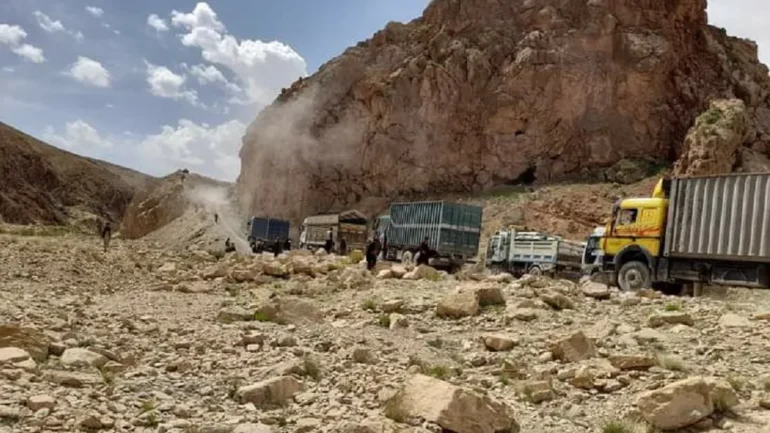

KABUL, AFGHANISTAN – Afghanistan’s National Statistics and Information Authority, which operates under Taliban control, says 92.6 percent of the country’s roads are unpaved, with Daikundi and Ghor provinces recording the lowest shares of paved roads.
The authority said on Tuesday, September 15, that it had, for the first time, established a comprehensive assessment of Afghanistan’s road network, estimating its total length at more than 245,072 kilometres.
According to the assessment by the authority’s Geographical Information Directorate, only 18,241 kilometres, or 7.4 percent, of the country’s roads are paved, while 226,831 kilometres, or 92.6 percent, are unpaved.
The authority said the assessment was conducted to provide a comprehensive and unified picture of the country’s road network. It compiled and analysed data from several sources, including the Ministry of Public Works, the Ministry of Rural Rehabilitation and Development, OpenStreetMap and satellite imagery.
The findings show significant differences between provinces. Kabul has the longest paved road network, with 4,084 kilometres, while Nuristan has the shortest, with only 12 kilometres.
In terms of the share of paved roads within each province’s total road network, Kapisa ranks highest at 25.1 percent. Daikundi and Ghor have the lowest shares, with paved roads accounting for only 0.5 percent of their respective networks. Both provinces are mountainous and among the more remote areas of central Afghanistan.
The assessment also identified 4,747 large and small bridges, 8,681 culverts and 854 flood-control crossings across the country. It recorded 16 damaged bridges and 249 locations where new bridges are needed.
The authority also assessed rural population access to roads. Based on a two-kilometre distance standard, about 41 percent of the rural population has access to paved roads, 63 percent has access to public roads and 96 percent has access to the overall road network.
The figures highlight major differences in transport access across Afghanistan and could help identify areas where road infrastructure requires further development and investment.
Afghanistan’s road infrastructure has suffered from decades of conflict, destruction and inadequate maintenance. The World Bank has previously noted that poor road connectivity has isolated many rural communities from schools, healthcare facilities, markets and other essential services. It has also supported projects aimed at building and upgrading rural roads to improve year-round access to basic services.
The condition of unpaved roads is particularly challenging during periods of heavy rain, flooding and winter weather, when some routes can become difficult or impossible to use. Earlier World Bank assessments also found that a significant proportion of Afghanistan’s roads were not serviceable throughout the year and that many unpaved roads could not adequately handle increasing traffic.
Poor road conditions have also been linked to road safety concerns. The World Bank has reported that damaged infrastructure, potholes and long stretches of unpaved roads contribute to unsafe conditions for road users, while weak enforcement of traffic rules and reckless driving have also contributed to road crashes.
The new assessment provides one of the most extensive recent estimates of Afghanistan’s road network and illustrates the scale of the country’s infrastructure needs, particularly in remote and mountainous provinces where paved-road access remains extremely limited.
Over the past five years since the Taliban took control of Afghanistan, the country’s already fragile road and transport infrastructure has faced further deterioration. Poorly maintained and largely unpaved roads, unsafe driving and weak traffic management have contributed to a high number of road accidents and casualties.
Cross-border tensions and fighting between Afghanistan and Pakistan have also damaged roads and other infrastructure in border areas, disrupting trade and movement. At the same time, heavy rains and recurrent floods have destroyed homes, damaged roads and bridges, and displaced thousands of people, further limiting access to essential services and isolating communities, particularly in rural and mountainous areas.

