

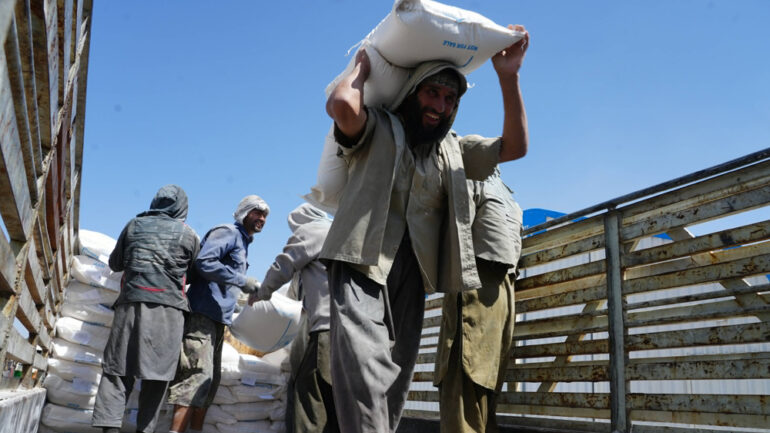

KABUL, AFGHANISTAN – The United Nations Assistance Mission in Afghanistan (UNAMA) has called for the participation of women in the delivery of humanitarian assistance in Afghanistan, in a message marking World Humanitarian Day.
Bruno Lemarquis, UNAMA’s Deputy Special Representative and Humanitarian Coordinator for Afghanistan, made the remarks in a video message released on Wednesday (August 19). He also called for humanitarian workers to be allowed to continue their work without impediment.
Lemarquis said that without Afghan women working in humanitarian operations, aid cannot be delivered effectively to women and girls in need across the country.
He thanked humanitarian workers in Afghanistan who continue to face significant challenges while working to provide assistance to people in need.
According to Lemarquis, Afghanistan continues to face extensive humanitarian needs, with many families affected by food insecurity, climate-related disasters and recurring natural hazards.
He added that the return of millions of Afghan migrants from neighboring countries in recent years has placed additional pressure on communities and essential services.
Despite these challenges, Lemarquis said humanitarian workers continue to provide assistance with “commitment, expertise and compassion,” often putting their own safety at risk while carrying out their duties.
He described the expertise, resilience and commitment of women humanitarian workers as essential pillars of the humanitarian response, stressing that their participation in aid distribution is necessary to ensure that women and girls in need can safely and appropriately access humanitarian assistance with dignity.
The UN humanitarian coordinator for Afghanistan called for the “full, safe and meaningful participation” of women in humanitarian efforts, saying their contribution is vital to reaching people in need across the country.
He also called on the international community to continue supporting the people of Afghanistan and stressed, without directly naming the Taliban, that humanitarian workers must be able to carry out their duties safely and without obstruction.
Since reclaiming power in August 2021, the Taliban have steadily imposed restrictions that have increasingly excluded women and girls from public life. Girls above sixth grade remain prohibited from attending school, leaving millions without access to secondary education and worsening Afghanistan’s humanitarian and economic challenges.
Women have also been barred from universities, while the suspension of medical education for women and girls has raised concerns about the country’s future shortage of female healthcare professionals.
The restrictions have also affected the humanitarian sector. In December 2022, the Taliban instructed national and international NGOs to prevent women from working, citing alleged violations of the group’s dress requirements. The policy has significantly disrupted aid operations, particularly in a country where many women and girls face cultural and social barriers to interacting with male aid workers.
The restrictions were further expanded in April 2023, when the Taliban banned Afghan women from working at the UN’s headquarters and provincial offices in Afghanistan, directly affecting around 400 women.
The cumulative impact of these restrictions is reflected in Afghanistan’s broader labour market. In a brief published on Tuesday (August 18), the International Labour Organization (ILO) said women’s labour force participation in Afghanistan has fallen to 5.1 percent, giving the country the world’s second-lowest rate.
The ILO said restrictions imposed by the Taliban have contributed to the widening exclusion of women from economic activity and deepened gender disparities in the country’s already fragile labour market.

