

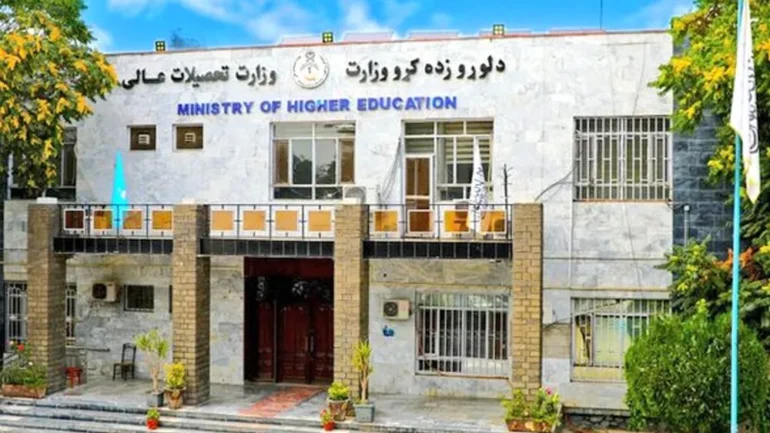

KABUL, AFGHANISTAN – The Taliban’s Ministry of Higher Education has announced the suspension or permanent revocation of operating licenses for nine private higher education institutions, citing the presence of “ghost students” and administrative corruption.
In a statement issued on Sunday, August 9, the ministry said the operations of seven private universities had been suspended for one year, while the licenses of two others had been permanently revoked.
The ministry said the decisions were made following monitoring and evaluations conducted during the spring semester of the 1405 solar year.
According to the statement, the licenses of Barlas University in Jawzjan, Rah-e Saadat and Turkistan universities in Balkh, Azhar and Barna universities in Badakhshan, Reshad University in Faryab, and Payam University in Kabul have been suspended for one year.
The operating licenses of Kohandazh University in Kunduz and Khana-e Danesh University in Takhar have been permanently revoked, the ministry said.
The Taliban ministry accused the institutions of failing to provide the necessary conditions for students and engaging in administrative corruption by allowing students to graduate without regularly attending classes or completing required practical work in laboratories and hospitals.
It said some of the universities held classes according to their schedules, but in some classrooms, not a single student was present.
The ministry listed several reasons for the measures, including the absence of proper academic and administrative leadership, the enrollment of “ghost students,” failure to maintain attendance records, allowing students who had been barred from exams to sit for final semester examinations, inadequate laboratory equipment for medical students, failure to teach the curriculum approved by the ministry, and a lack of opportunities for medical students to complete practical training in hospitals.
More than 120 private higher education institutions operate across Afghanistan’s 34 provinces, a large proportion of which offer programs in medical fields.
Since returning to power in August 2021, the Taliban have significantly reshaped Afghanistan’s education system. Girls have been barred from attending secondary schools beyond Grade 6, while women have also been banned from universities and most forms of higher education.
The Taliban have introduced changes to school curricula and increased the emphasis on religious education, including the teaching of Islamic subjects and the Hanafi school of jurisprudence. The authorities have also revised textbooks and educational content, while placing greater emphasis on religious instruction and what they describe as Islamic values.
Recent reports indicate that these changes also extend to students’ religious beliefs. In a report published on May 25, KabulNow reported that documents obtained by the outlet showed students at some private universities were required to sign pledges committing themselves to the Hanafi school of Islam.
A mandatory pledge form reportedly required students to agree to follow the Hanafi school and abide by rules described by the Taliban as “Sharia principles” and “Islamic guidelines.” Similar pledges were also reportedly distributed at public universities, including Herat University, with students required to abandon their existing religious or sectarian beliefs and follow the Hanafi school.
These policies have fundamentally changed access to education, particularly for girls and women, and have raised concerns among the United Nations, human rights organizations and education advocates about the long-term impact on Afghanistan’s education system and the country’s future workforce.

