


KABUL, AFGHANISTAN – Documents obtained by KabulNow show that the Taliban are also requiring students at private universities to pledge adherence to the Hanafi school of Islam.
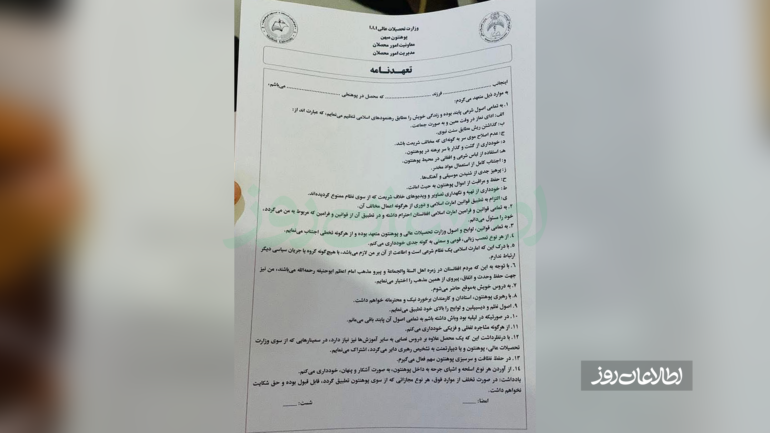
A copy of the mandatory pledge form for students at private universities, obtained by KabulNow, is related to Mihan Private University.
Article 6 of this document, which all students are required to sign, concerns religious conversion.
The article states that since the people of Afghanistan are considered followers of Ahl al-Sunnah wal-Jama’ah and the Hanafi school founded by Imam Abu Hanifa, the student also agrees to adopt the same school of thought in the interest of maintaining unity and social cohesion.
With the beginning of the new academic year in the country, public universities in various provinces of Afghanistan, including Herat University, which drew significant attention, forced students to sign a “one-sided” pledge.
According to this pledge, students are required to abandon their current religious and sectarian beliefs and follow the Hanafi school of thought.
Students are also compelled to abide by rules that the Taliban describe as “Sharia principles” and “Islamic guidelines” in other private aspects of their lives.
Under this pledge, students commit not to style their hair in ways deemed contrary to Sharia, not to socialize with “non-mahram” individuals on university premises, and to refrain from listening to music.
According to this document, whose signature and fingerprint are “mandatory,” students also pledge to recognize the Taliban’s “Islamic Emirate” as a “legitimate Islamic system” and affirm that “obedience to it is obligatory upon me, and I will not maintain any relationship with any other political group or movement.”
This comes while many university students and professors in the country are followers of the Shia sect as well as other schools among the four Sunni schools of Islamic jurisprudence.
Since regaining control of Afghanistan, the Taliban have declared the Hanafi school the country’s only official school of thought and have removed official recognition of the Shia sect.
Officials of the group have repeatedly called on people to follow only the Hanafi school and, in numerous cases, have imposed restrictions on the religious freedom of followers of other sects, including Shias.
The group has also dissolved political parties and declared any political activity outside its own structure illegal.
In line with these growing restrictions, the U.S. Commission on International Religious Freedom previously warned that the Taliban have “completely eradicated” religious freedom in Afghanistan by enforcing a single interpretation of Islam and targeting individuals with differing beliefs.
The commission noted that this policy has left religious minorities especially vulnerable to persecution and called for urgent protections for Afghans facing religious discrimination. It also criticized the Taliban’s so-called “morality law,” describing it as a tool of systemic oppression that excludes women from public and religious life while placing minority communities at heightened risk.
Previously, a London-based human rights group (Rawadari) had warned that a newly approved Taliban criminal code formalized discrimination against religious minorities, restricted fundamental freedoms, and allowed arbitrary detention and punishment.
The group, Rawadari, said it had obtained a copy of the “Criminal Procedures Code of the Taliban Courts,” which had been approved by Taliban leader Hibatullah Akhundzada and distributed to judicial bodies for implementation. According to the group, the code, consisting of multiple sections and articles, conflicted with international human rights standards and failed to guarantee basic fair trial rights, including access to legal defense, the right to remain silent, and protection against unjust punishment.
Rawadari had also highlighted provisions in the code that classified non-Hanafi Sunni Muslims and followers of other beliefs as “innovators,” a designation that targeted religious minorities such as Shia Muslims, Ismailis, Sikhs, and Hindus.
The group further warned that certain clauses labeled “rebels” as beyond reform without execution and allowed individuals to punish perceived moral violations, raising concerns about potential extrajudicial actions against critics and opponents without due process.
In addition, Amnesty International has also warned that the new criminal regulation approved by the Taliban could escalate violence and discrimination against women and minority groups, with serious implications for human rights across the country.
According to Amnesty, the regulation puts minority groups at heightened risk. It imposes severe penalties for religious non-compliance, targeting beliefs outside the Taliban’s Sunni interpretation, and allows arbitrary enforcement. The group warned that this could institutionalize discrimination, leaving minorities vulnerable to persecution and restricting their freedoms.
These warnings further reinforce concerns that measures such as forcing university students to pledge adherence to the Hanafi school reflect a broader campaign to suppress religious diversity across Afghanistan.
These measures have raised growing concerns among human rights advocates and academic communities, who warn that such policies further restrict religious diversity, academic freedom, and personal liberties in Afghanistan’s higher education system.

