

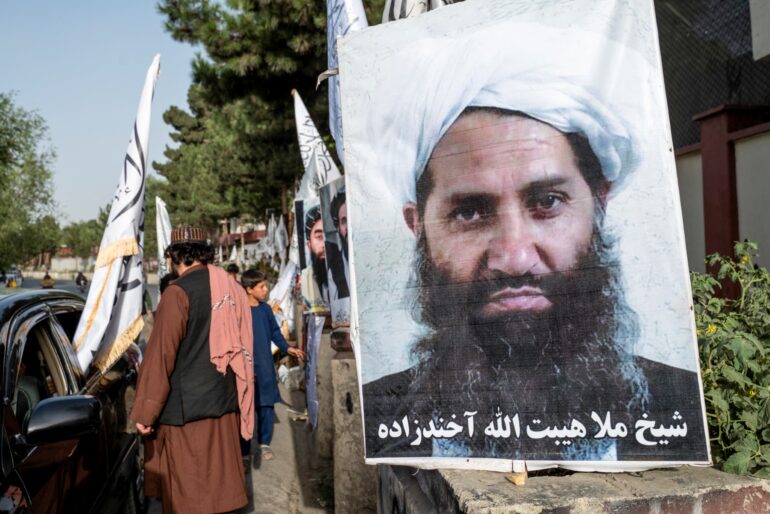

KABUL, AFGHANISTAN – Taliban leader Mullah Hibatullah Akhundzada has said that “obedience” is a condition for protecting and maintaining the Taliban administration.
Akhundzada made the remarks on Saturday, August 15, in Kandahar during a gathering of Taliban supporters marking the fifth anniversary of the group’s return to power. An audio recording of the speech was released today.
Akhundzada called on all members of the Taliban to follow his authority, warning that disobedience or independent action could undermine security and lead to the emergence of parallel governments.
The Taliban refer to Akhundzada as the “Emir al-Mu’minin” and “Emir.” He has repeatedly emphasized obedience to his authority in his speeches, amid reports of disagreements among different Taliban factions, which the group has consistently denied.
In his Kandahar speech, Akhundzada claimed that no one within the Taliban administration opposes his orders. He said he had moved a minister into the position of head and changed a head into a minister without facing any opposition.
The development comes as Taliban authorities have also introduced a new law making obedience to supreme leader Hibatullah Akhundzada mandatory and placing decisions on jihad under his exclusive authority. Published by the Ministry of Justice on August 16, the six-chapter “Nisab-e Muballighin” (Preachers’ Curriculum), endorsed by Akhundzada, instructs Taliban preachers on religious teachings concerning obedience, jihad, women, marriage and hijab.
The law also requires women to obey their husbands and describes men as the “rulers” of their wives, while obliging husbands to provide food, clothing, housing and dowry.
His renewed emphasis on obedience comes as fighting has reportedly broken out between a dissatisfied Taliban commander and southern Taliban fighters in Badakhshan. The clashes began last week in Nusay District.
At the same time, military activities by anti-Taliban groups have increased in Badakhshan and several other provinces.
The Taliban describe their administration as an Islamic system governed by their interpretation of Sharia, but their strict policies have drawn criticism from experts, human rights groups and the international community.
Supreme leader Hibatullah Akhundzada holds ultimate authority over major religious and political decisions, with key policies shaped through centralized rule from Kandahar.
Since returning to power in 2021, the Taliban have imposed sweeping restrictions on women and girls, including bans on secondary and higher education and severe limits on employment and public participation.
In 2024, many of these restrictions were formally codified under the Law on the Propagation of Virtue and Prevention of Vice. The Taliban remains largely unrecognized internationally and continues to defend its policies as religiously justified.

