


KABUL, AFGHANISTAN – A new report by the Bolaq Analysts Network examining the situation of Afghanistan’s Hazara community during the five years of Taliban rule describes a pattern of escalating insecurity, economic hardship, cultural restrictions, legal discrimination and land dispossession.
The report examines the situation across five major areas: security, economic conditions, cultural rights, the legal system, and land grabbing and forced displacement.
It argues that these developments should not be viewed as isolated incidents, but as interconnected forms of discrimination that have affected the Hazara community since the Taliban returned to power in August 2021.
Security is one of the most serious concerns identified in the report.
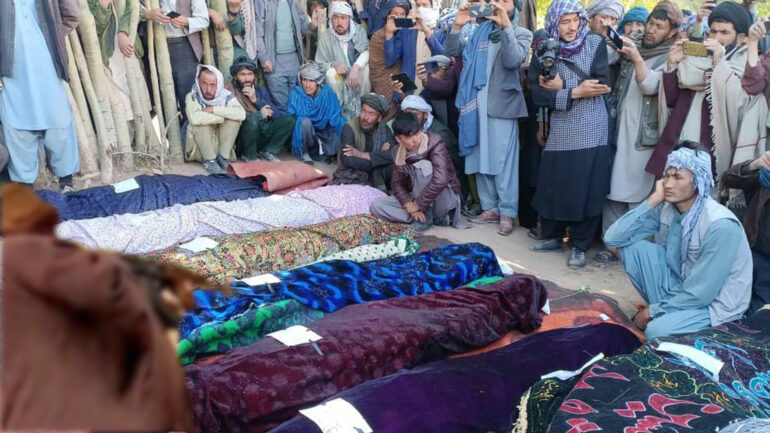
According to the report’s assessment, at least 36 terrorist attacks were recorded in Hazara-populated areas during the five-year period. In addition, 47 cases of targeted killings were documented. Taken together, the attacks and targeted killings reportedly resulted in the deaths of at least 497 people, including 81 women and 44 children, while 363 others were injured. The report presents these figures as evidence of a persistent pattern of violence targeting the Hazara community.
The report also points to targeted assassinations, arbitrary arrests, torture and other forms of intimidation beyond large-scale attacks.
The authors argue that the security crisis has affected not only the physical safety of Hazaras but also their everyday lives. Fear has reportedly led families to restrict movement, particularly for women and girls, while communities have adopted additional informal security measures.
The report links the continuing insecurity to ideological hostility, the composition and policies of the Taliban administration, weak accountability mechanisms and the geographic vulnerability of some Hazara-populated areas.
The second major section examines the economic consequences of the Taliban takeover.
The report says Afghanistan’s economy suffered a major shock after August 2021, when government salaries stopped, businesses and service providers faced severe disruption, and significant amounts of capital and skilled labour left the country. The economic crisis has particularly affected communities whose livelihoods depend on agriculture, livestock, small businesses and local markets.
For many Hazaras living in rural areas, agriculture and livestock remain among the principal sources of income. According to the report, these sectors have been affected by drought, floods, agricultural and livestock diseases, taxation and pressure over agricultural and grazing land.
The report also links economic vulnerability to land disputes and the loss of agricultural resources. When families lose access to farmland or grazing areas, the consequences extend beyond property ownership and directly affect food security and household income.
To illustrate the severity of Afghanistan’s broader economic crisis, the report cites cases of families selling their children because of extreme poverty. One cited case involved a family selling four daughters for 42,000 Afghanis, while another source cited by the report reported that approximately 70 children were sold in three northern provinces in one year.
These figures are presented as examples of Afghanistan’s wider poverty crisis and are not identified as exclusively Hazara statistics.
The third section focuses on what the report describes as increasing pressure on Hazara cultural and religious identity.
Among the issues documented are restrictions on Ja’fari jurisprudence, Shia religious practices, cultural publications, music, artistic activities, media and educational institutions. The report argues that these measures go beyond restrictions on individual freedoms and have implications for the preservation of Hazara religious and cultural identity.
The report particularly highlights restrictions on Muharram and Ashura ceremonies. For the Hazara Shia community, the authors argue, these ceremonies are not only religious observances but also important expressions of collective identity and historical memory. Restrictions on the ceremonies therefore have broader cultural consequences.
The report also refers to the destruction and suppression of artistic activities under Taliban rule. It cites reports that more than 21,000 musical instruments have been destroyed in Afghanistan, placing this figure within a broader discussion of restrictions on music and cultural expression.
The authors characterize the cumulative effect of restrictions on religious practices, education, cultural expression and historical memory as a form of cultural erasure or forced cultural assimilation. The report also discusses these developments in relation to international legal concepts surrounding cultural genocide.
The fourth section examines the legal and judicial system established by the Taliban.
The report says that after the Taliban abolished the previous constitutional order, a new system based on Taliban decrees, religious interpretations and legal documents was established. It specifically discusses the “Islamic Emirate and Its System” and the Criminal Code of Courts, as well as the role of the Taliban’s religious enforcement structures.
According to the report, the new legal framework has weakened equal access to justice and created particular difficulties for religious minorities, including Shia Hazaras.
One issue highlighted is pressure on members of other Islamic schools of jurisprudence to follow the Hanafi school. The report also raises concerns about broad judicial powers, unclear legal concepts and the absence of adequate guarantees for fair trials.
The report uses the term “legal apartheid” to describe what it considers systematic discrimination embedded in the Taliban’s legal and administrative system. It argues that legal mechanisms have also been used in disputes over land and property, particularly in cases involving Hazara communities.
The fifth major section focuses on land confiscation, property disputes and forced displacement, which the report identifies as both an economic and demographic threat to Hazaras.
The Bolaq investigative report states that, based on the cross-referencing of field data, maps, and official letters from Taliban commissions, at least 19,840 jeribs of land with documented and specified areas have been seized or placed under restrictions on ownership or use. This includes 10,089 jeribs in Jaghori, 7,990 jeribs in Gizab and Pato, and 1,761 jeribs in Omid Sabz Township in Kabul.
According to the network’s report, over the past five years, hundreds of jeribs of agricultural land and grazing areas have been confiscated in the provinces of Ghor, Bamyan, Parwan, and Baghlan. Dozens of families, including 20 families in Bom village in Ghor and 25 families in Rashk village in Bamyan, have reportedly been forcibly displaced at gunpoint and compelled to hand over their land to Kuchi nomads and individuals affiliated with the Taliban.
In some cases, according to the report, traditional or religious ownership documents held by Hazara residents have not been recognized, while decisions by Taliban courts or commissions have facilitated changes in land ownership or control.
The report presents these developments as particularly serious because land represents not only a source of income but also a foundation of community stability and demographic continuity.
In its concluding section, the report calls for stronger action by the international community and international justice mechanisms.
The report urges international institutions to investigate alleged crimes against Hazaras, including targeted killings, forced displacement and land confiscation, and to assess whether some of these patterns could constitute crimes against humanity or genocide.
It also calls for stronger international monitoring and accountability mechanisms to document violations against Hazaras and other vulnerable minorities in Afghanistan.
Another major concern raised by the report is the need to protect Hazara refugees and asylum seekers from forced return to Afghanistan, given the security and religious risks documented in the report.
The report further calls for international pressure on the Taliban to end discriminatory policies, guarantee equal rights for religious and ethnic minorities, protect cultural and religious freedoms, and address disputes over land ownership.
The Bolaq Analysts Network’s report portrays the situation of Hazaras under five years of Taliban rule as a multidimensional crisis rather than a series of unrelated incidents.
Its five areas of concern—security, the economy, culture, the legal system and land ownership—are closely connected. Violence threatens physical security; economic hardship is intensified by the loss of land and livelihoods; cultural restrictions affect religious and collective identity; and the legal system, according to the report, provides insufficient protection against these pressures.
The report ultimately warns that without international monitoring, accountability and meaningful guarantees of equal rights, the cumulative impact of these policies could have long-term consequences for the security, economic survival, cultural identity and demographic presence of Afghanistan’s Hazara community.

