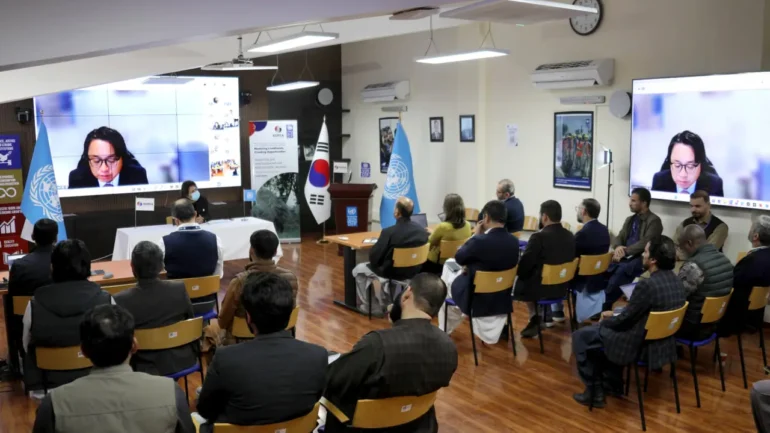

KABUL, AFGHANISTAN – The United Nations Development Programme (UNDP), with funding from South Korea, has launched a $6 million project to support communities affected by mass returns, displacement and natural disasters in five provinces of Afghanistan.
The project, titled REVIVE Plus, will focus on Ghazni, Paktiya, Kunar, Nangarhar and Kabul, particularly communities hosting returnees and vulnerable households, according to an announcement issued on November 15.
Building on the first phase of the REVIVE initiative, the second phase is expected to benefit more than 386,000 people directly and indirectly through infrastructure rehabilitation, employment opportunities, economic recovery and improved access to essential services.
The project will focus on three main areas: rehabilitating community infrastructure and supporting mine action, restoring livelihoods and economic opportunities, and improving essential services, resilience and social cohesion.
Under the initiative, UNDP plans to construct and repair irrigation canals, roads, water supply systems, flood protection structures and other community facilities. It will also carry out mine surveys, explosive ordnance risk education and clearance activities to improve safety in areas hosting large numbers of returnees.
To support economic recovery, the project will provide short-term employment through community infrastructure projects, distribute agricultural inputs and productive assets to farmers, and assist small businesses through vocational training and seed funding. Women and young people will be among the key groups targeted for employment and income-generating opportunities.
The initiative will also provide counselling, psychosocial support and referral services, while supporting community dialogues and local coordination to reduce tensions among returnees, displaced families and host communities.
South Korea’s Ambassador to Afghanistan, Cho Sung-kwan, said his country remained committed to supporting Afghans during the current challenges, adding that initiatives such as REVIVE were important for restoring livelihoods and helping communities build a more resilient future.
UNDP said the second phase would be implemented in coordination with local authorities, implementing partners and community institutions. It will also explore cooperation with South Korean organisations and private-sector companies in renewable energy, climate-smart agriculture, green businesses and resilient infrastructure.
Afghanistan has experienced a significant increase in returns from neighbouring countries, particularly Iran and Pakistan, placing additional pressure on housing, employment and public services. According to figures published by UNHCR and the International Organization for Migration (IOM), more than 1.4 million Afghans returned to the country in 2026 as of November 7, including approximately 727,000 from Pakistan and 681,100 from Iran.
Meanwhile, the humanitarian situation remains critical amid declining international assistance. UNICEF reported that the 2026 Afghanistan Humanitarian Needs and Response Plan, which requires $1.71 billion, was 67 percent underfunded as of the end of September, limiting humanitarian organisations’ ability to provide essential services.
Afghanistan continues to face a deepening humanitarian crisis driven by multiple, overlapping challenges, including Taliban restrictions on women and girls, recurring natural disasters, climate change, large-scale returns from neighbouring countries and declining international humanitarian assistance. According to the United Nations’ 2026 Humanitarian Needs and Response Plan, an estimated 21.9 million people, representing 45 percent of the country’s population, will require humanitarian assistance in 2026.
The crisis has been further exacerbated by drought, floods and earthquakes, while restrictions on women’s education, employment and freedom of movement have increased their vulnerability and limited their access to essential services. Meanwhile, the return of more than 1.4 million Afghans from neighbouring countries in 2026, as of October 24, has placed additional pressure on already overstretched communities and public services.
Humanitarian operations have also been severely affected by funding shortages. According to figures reported by the UN Office for the Coordination of Humanitarian Affairs (OCHA) on November 11, only 32.7 percent of the $1.71 billion required for Afghanistan’s 2026 humanitarian response had been secured, leaving millions of vulnerable people at risk of being deprived of life-saving assistance.