

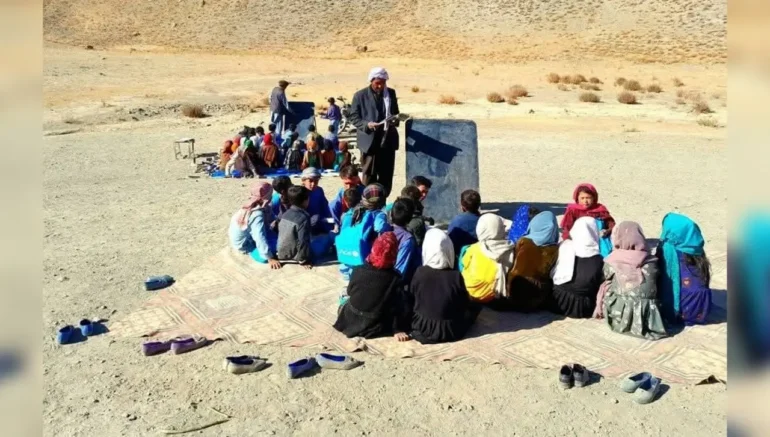

KABUL, AFGHANISTAN – The United Nations Assistance Mission in Afghanistan (UNAMA) has paid tribute to Afghan teachers on World Teachers’ Day, saying educators across the country, particularly those in rural and remote areas, continue to teach despite limited resources and numerous challenges.
In a message published on Monday, October 5, UNAMA said Afghan teachers, particularly those working in villages and remote areas, continue their work with commitment and dedication despite difficult conditions, limited resources and numerous challenges.
The UN mission said it particularly honoured and appreciated these teachers for their efforts.
UNAMA also praised teachers who, through education, inspiration and guidance, help shape people’s lives and make an important contribution to building the foundations of “peaceful and prosperous societies.”
The UN mission said the role of teachers has become more important than ever in a world increasingly shaped by artificial intelligence, social media and the spread of false and misleading information.
World Teachers’ Day comes as Afghanistan’s education system continues to face severe challenges, with thousands of teachers and students affected by restrictions imposed by the Taliban.
For nearly five years, girls have been barred from attending secondary schools. According to UNICEF, more than 2.6 million girls in Afghanistan have been denied secondary education since the ban was imposed in 2021. Afghanistan remains the only country in the world where secondary and higher education is effectively closed to girls and women.
The restrictions have also affected the country’s female teaching workforce. UNICEF says the number of female teachers in basic education fell by more than nine percent, from nearly 73,000 in 2022 to around 66,000 in 2024. The agency estimates that Afghanistan could lose up to 20,000 women teachers by 2030 if current restrictions continue.
The decline in female teachers is particularly concerning for girls’ access to education, as female teachers are essential in many communities, especially in rural areas. UNICEF has said that a shortage of female teachers is among the factors limiting girls’ access to education.
The broader education system is also facing a serious learning crisis. A joint UNICEF and UNESCO assessment published in 2025 found that more than 90 percent of 10-year-old children in Afghanistan were unable to read a simple text, highlighting what the agencies described as a profound crisis of “schooling without learning.” The report also pointed to severe teacher shortages, particularly among women, inadequate infrastructure and chronic underinvestment.
UNICEF said that restrictions on girls’ education and women’s employment are also weakening Afghanistan’s human capital. Its 2026 analysis estimates that restrictions on women’s education and employment are costing the Afghan economy at least $84 million annually in lost economic output.
Despite the restrictions, humanitarian organizations continue to support education initiatives across the country. In 2025, UNICEF said more than 3.7 million children in public schools received emergency educational support, while 442,000 children benefited from community-based learning initiatives, 66 percent of them girls.
UNICEF and UNESCO have repeatedly called on the Taliban authorities to lift restrictions on girls’ and women’s secondary and higher education, warning that continued exclusion will have lasting consequences for Afghanistan’s education system, economy and future workforce.

