

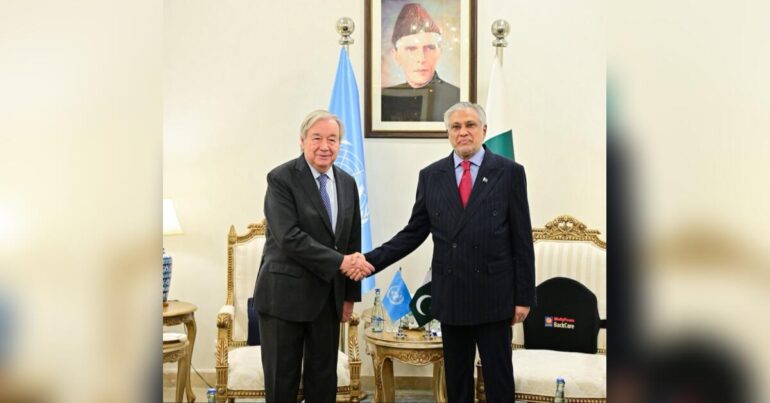

KABUL, AFGHANISTAN – United Nations Secretary-General António Guterres said on Tuesday that the U.N. is committed to working with Pakistan to uphold protection principles and ensure Afghan returns proceed in a voluntary, safe and dignified manner.
Speaking at a joint news conference with Pakistani Foreign Minister Mohammad Ishaq Dar in Islamabad, Guterres highlighted Pakistan’s long record of hosting Afghan refugees. As former U.N. High Commissioner for Refugees, he said he had seen firsthand how Pakistan opened its doors for decades to millions of Afghans fleeing conflict and instability.
Communities across the country shared whatever they had with people seeking protection and safety, Guterres noted.
“The United Nations is committed to working together with Pakistan to uphold protection principles and ensure that returns of Afghans proceed in a voluntary, safe and dignified way,” he said.
Pakistan has hosted one of the world’s largest Afghan refugee populations for decades, with successive waves of Afghans arriving amid conflict, political upheaval and economic hardship in Afghanistan. Many Afghans have lived in Pakistan for decades, while some were born and raised there.
In late 2023, Pakistan launched what it called the Illegal Foreigners Repatriation Plan, which affected a large number of Afghans. Some, including people who had lived in Pakistan for decades or were born there, faced the cancellation of temporary protection documents, business closures, arrest and deportation.
Pakistani officials say about 2.4 million Afghans have either returned voluntarily or been deported since the plan began. Data from the U.N. refugee agency UNHCR show that more than 1.15 million Afghans returned from Pakistan during 2025 alone.
A similar deportation campaign is underway in neighboring Iran, where authorities continue to arrest and deport undocumented Afghans. The United Nations says more than 6.4 million Afghans have returned from Pakistan and Iran over the past three years.
The mass returns are taking place as Afghanistan faces a severe humanitarian crisis under Taliban rule, with millions of people dependent on humanitarian assistance. Women and girls remain barred from secondary and higher education and largely excluded from the workforce under restrictions imposed by the Taliban since its return to power in 2021.
U.N. agencies, human rights organizations and Afghan activists have repeatedly called for returns to be voluntary, safe and dignified. They have raised concerns about conditions facing returnees in Afghanistan, including restrictions on basic rights and limited access to food, healthcare, shelter and other basic services.

