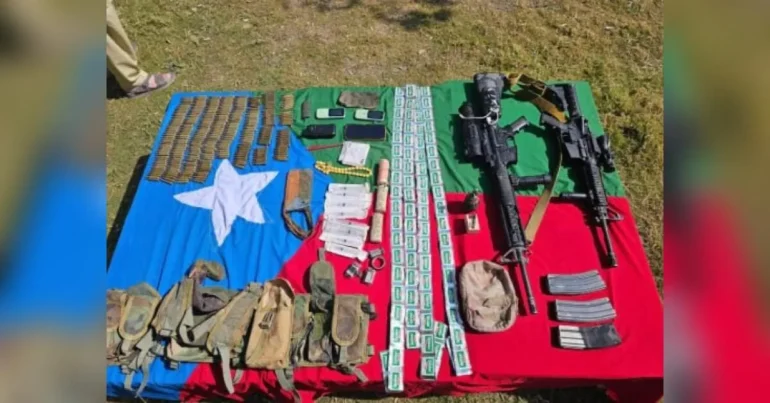

KABUL, AFGHANISTAN – Pakistan’s military said on Wednesday, October 28, that nine militants were killed during two security operations in Balochistan province, which borders Afghanistan, amid a continuing surge in militant violence across Pakistan.
In a statement, the Inter-Services Public Relations (ISPR), the Pakistani military’s media wing, said the operations were conducted on October 26 in Kachhi and Wadh districts following intelligence reports about the presence of militants allegedly linked to what Pakistan calls Fitna al-Hindustan.
According to the statement, security forces targeted a suspected militant hideout in Kachhi district, where seven militants were killed following an exchange of fire. The military said weapons and ammunition were recovered from the site.
In a separate operation in Wadh district, security forces tracked and intercepted the movements of suspected militants, killing two more following an intense exchange of fire, the statement said.
The military described those killed as Indian-sponsored militants and said clearance operations were continuing in both areas to search for other suspected militants. However, the claims about the identities and alleged affiliations of those killed could not be independently verified.
Pakistan uses the term Fitna al-Hindustan to refer to militant groups it accuses of receiving Indian support, particularly armed separatist groups operating in Balochistan. Islamabad has repeatedly accused India of backing militant activity in the province, allegations New Delhi has denied.
Balochistan has experienced a prolonged insurgency led by separatist groups, including the Balochistan Liberation Army (BLA) and the Balochistan Liberation Front (BLF). These groups seek greater autonomy or independence for the resource-rich province and have carried out attacks against Pakistani security forces, government installations, infrastructure and other targets. Pakistani authorities have banned the BLA and designated it a terrorist organisation.
The province has become a major focus of Pakistan’s counterterrorism campaign as armed attacks have increased in frequency and scale. According to the Pakistan Institute for Conflict and Security Studies, militant violence intensified nationwide in September 2026, with Balochistan accounting for a substantial share of reported attacks. The province has also experienced attacks targeting infrastructure and projects associated with the China-Pakistan Economic Corridor.
Security challenges extend beyond Balochistan to neighbouring Khyber Pakhtunkhwa, particularly districts bordering Afghanistan, where the Tehreek-e-Taliban Pakistan (TTP) has carried out attacks against Pakistani security forces and government institutions.
Islamabad has repeatedly accused the Taliban authorities in Afghanistan of allowing the TTP to operate from Afghan territory and plan attacks inside Pakistan. Pakistani officials have demanded that Kabul take action against the group and other armed organisations they consider a threat to Pakistan’s security.
The Taliban authorities have rejected Pakistan’s allegations and denied that Afghan territory is being used to organise attacks against neighbouring countries. The dispute has contributed to deteriorating relations between Kabul and Islamabad, with border clashes, military operations and restrictions on cross-border movement further straining ties.
Although the latest operations were conducted inside Balochistan and were not reported as cross-border actions, they come amid broader regional security tensions involving Pakistan, Afghanistan and allegations of foreign support for armed groups.
Pakistan’s military has said its counterterrorism campaign will continue under the government’s Azm-e-Istehkam security initiative, which aims to strengthen operations against militant networks. However, persistent insurgent activity in Balochistan and attacks in Khyber Pakhtunkhwa highlight the challenges facing Pakistani authorities in restoring security.
The latest military statement did not provide details about the identities of the nine people killed beyond the alleged affiliations cited by the army, nor did it report civilian casualties in the two operations.